Roll up! Roll up! Get your sci-fi here!

51KvMefOX-L._BO2,204,203,200_PIsitb-sticker-v3-big,TopRight,0,-55_SX278_SY278_PIkin4,BottomRight,1,22_AA300_SH20_OU01_

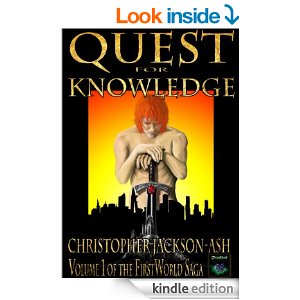
Get a free e-copy of Quest for Knowledge – Volume 1 of the FirstWorld Saga by Christopher Jackson-Ash by downloading it from Amazon before 5th February.

You should also get – though I’m not sure if this only applies to UK customers – the chance to buy other popular sci fi Kindle books for 99p each instead of their normal price.

I’ve been an intrigued ‘first reader’ of Christopher’s series and can assure you that there is plenty of heroic fantasy to please lovers of the genre in this story of Simon and his sword. I won’t go into detail – you can read the Amazon blurb – but this is the start of an epic tale of swords, sorcery, the multiverse and an Australian student who is catapulted into the middle of it all.

As it’s free, you lose nothing by giving it a chance, and you might end up liking the concepts and the writing enough to follow the rest of the volumes to come. At least two more are ready and waiting to be published, and I know a fourth is in the pipeline. There is also a website with extra tales and information: http://firstworld.info/

Enjoy!

The plot’s fine but the sub plot thickens

lichen

I hope you recall my post about the editing of Harlan Coben’s book. I found another of his in a local charity shop and grabbed it. It turned out to be a much earlier one, and although it was very good it was easy to tell just how much he has matured as a writer.

The title of this second read is Drop Shot.

It was a competent crime story with believable characters and an interesting plot. There were a couple of places (in a whole novel) where I would have edited the tense usage, but it wasn’t anywhere near as bad as the later book. I can only assume that as authors become more and more famous publishers leave them more and more to their own devices, which isn’t really very sensible, because if Coben was confused about tense use in the first place, the mere process of becoming a best-selling author wasn’t in itself going to sort him out.

I’m not sure whether they hold back on editing out of deference to someone who is making them a lot of money (far more than he is making for himself) or whether they just think they are paying him enough to find a proof reader/copy editor privately.

The fact that there were very few ‘errors’ in construction goes some way towards justifying my theory that he isn’t actually using tense changes for effect. (If he was, I can’t imagine what the intended effect might have been, in either book.)

I will definitely read more by this author, but I am confused by editing policy!! And annoyed that people point the finger at self-published books with the comment that they’re all so badly edited. Not true, and even when they are, they’re no worse than what comes out of the big publishing houses.

Does anyone have any similar stories to tell?

A boring thriller

New Image

The second book I read whilst away and felt impelled to discuss on my return was Death Comes To Pemberley by P.D.James.

Great, I thought – a murder story written by a revered exponent of the genre and based on an Austen classic that is one of my favourites. Fan Fiction, of course, except that because it’s ‘official’ and she gets paid for it we don’t call it that. Dear me, no!!

The story was quite interesting – enough to keep me reading to the ending and solution. But the writing was another matter. The English, unlike that of the last author I reviewed, was impeccable, and the editors had even managed to exclude any typos. But the general presentation of the story left a lot to be desired. The prose was ponderous – heavy and repetitive. I’m not sure whether James was trying to sound nineteenth century, but Austen’s work, whilst written in a style that would be considered almost odd, and perhaps flowery today, is always witty and sparkling, littered with humorous asides and references to social matters. This never sparkled for a moment. The other aspect that I disliked was a propensity for the characters to expound to each other on matters that they should not have needed to mention. It was as if James had taken in the idea of ‘show, don’t tell’ in a very half-hearted manner and had simply moved over-long exposition from narrative to dialogue. It was irritating and disappointing.

I loved the Adam Dalgleish mysteries as shown on TV but when I tried the books I found them less than satisfactory – very long-drawn-out, with occasional plot holes and less than sympathetic characters. But it’s ages since I read them so I can’t remember whether they shared the faults of this volume.

Perhaps it didn’t help that I had just read a fanfic based around the same Austen novel. It was a fusion story, which for those of you who aren’t familiar with fanfic is a story where characters from a fandom replace the characters in a film or novel. We get to explore the way different people might have dealt with the plot, how far plot affects character and behaviour, etc. This particular story followed the events of Pride and Prejudice quite closely but tweaked some of the minor outcomes in accordance with the characters they had chosen to use e.g. Collins was much more sympathetic). I won’t give details of the fic here because whilst Pride and Prejudice is clearly out of copyright, the other fandom isn’t and I would hate the authors (it was a team of two) to suffer any harassment even though I firmly believe the work is transformative and therefore perfectly legal. It was beautifully written, in bright prose that carried the reader along just as Austen does, and there was all the social commentary, humour and romance we could have hoped for. The alterations to the plot were intriguing in themselves, and the only flaw I could find in the entire thing was the authors’ knowledge of English geography, which was quite evidently non-existent.

The main thing is, I have preserved my copy of the fanfic and will look forward to re-reading it, just as I re-read Austen. The fact that it was free is neither here nor there – I would happily have paid for it. My copy of the James book was paid for, and I will never look at it again. It’s a Kindle version so I can’t even give it to a charity shop.

The experience blurred the lines drawn around fanfic even more than I had previously imagined.

Two queries occur to me. Am I, as a writer, too prone to read with a mental red pen in my hand and if so what do I do about it? And how do authors gain the respect of what seems like the entire publishing world when their writing really leaves a lot to be desired? Apart from both being writers in the general crime genre, James and Coben (see my last post) have very little in common, and their flaws are dissimilar. But they do make me wonder about publishers – and about readers.

I wouldn’t recommend the book I discuss here but I would welcome further ideas on the issues I’ve raised.

Publicity for FirstWorld – a fantasy.

Logo
This is an unusual post for me as it is totally concerned with someone else’s work. Despite the tag, it’s publicity rather than a review.

I gained some friends through an online writing group and have since met most of them personally; when one of them gets work published I’m delighted. In this case, the route to publication has been self-publishing, which as you know, is my own preferred course of action. But Chris has been braver than me and has become his own publisher, selling from his websites as well as through Amazon. His websites went live this month and I said I would help to publicise them.

The author website, http://www.ChristopherJackson-Ash.com gives you the links to the others, but check it out anyway; it has a lot more than links and is an introduction to the author.

I was privileged to be a ‘first reader’ of his FirstWord saga, though I still haven’t reached the end of the story. It’s a long epic in the high fantasy genre, centred on themes of the multiverse, time travel, and a universal hero. (And of course there’s a sentient sword.) There are also fascinating allusions to the works of fantasy writers like Tolkien and Moorcock. If you enjoy this kind of novel or series of novels – and I’m sure that there will be some among you who are fans of Terry Brooks and similar fantasy authors – give this a try. The website dedicated to the series is hosted by Kris the Bard, the narrator of the books at http://www.FirstWorld.info and the first volume, available there for download, is currently free so you have nothing to lose!

Then there’s something completely different, a website devoted to stories for children. http://www.TrickyTristan.com At the moment there’s one story to read online (with a sequel promised) and one to download free. There are two others for a small price and the website has a secure checkout.

The picture at the top of this post isn’t, for once, one of mine. It’s a logo for the FirstWorld series and was created by the very talented artist Chris has retained to illustrate his work.

I wish him all the best with this venture and hope some of you will be interested enough to visit the websites and start reading!

Young Adult Fiction – some thoughts.

56. Young Adult Fiction

I recently bought and read a book called The Prince of Mist by Carlos Ruiz Zafón. I had previously read The Shadow of the Wind by the same author and had enjoyed it immensely. This book advertised itself as ‘young adult’, which was quite a change of genre, but as I’m interested in books for younger readers I thought I’d try it. It’s a kind of thriller and a kind of ghost story, but I found it very disappointing. Neither the location nor the characters were sufficiently developed to enable me to get thoroughly into the book and the parts that some reviewers thought scary seemed overdone and ridiculous to me. However, it did leave me with some questions about young adult books in general that I want to discuss.

First of all, the genre is somewhat nebulous. Some authors and publishers seem to mean ‘teenage’ by the term – perhaps trying to lure teenage readers by calling them young adults. Some seem to mean they want to target readers between the ages of fifteen and twenty-five, and specialise in ‘coming of age’ stories. Yet others seem to apply the term to anything that is ‘lighter’ reading, stories that are shorter or less complex than what are presumably ‘fully adult’ books. Zafón says he wrote the kind of story he would have liked to read as a teenager but hoped it would appeal to all ages. I find all this confusing. The only conclusion I can tentatively come to is that publishers regard the term as a marketing tool.

Secondly, even if the target audience is young, I am not at all convinced that the readers deserve some of the stories handed out to them. Personally, I was reading ‘fully adult’ books at quite a young age, particularly the classics, and was perfectly capable of coping with quite complex plots, language and structure. I also had sufficient general knowledge to handle references to well known historical, geographical or scientific facts, etc.  However, younger readers do not always have the experience to empathise with older characters and might prefer  heroes, heroines, and even villains to reflect their own lives and emotions. This would be true, I suppose, of films and shows, too, so a middle aged detective (for example Poirot, or Morse) might appeal to fewer young readers or viewers, though I admit I enjoyed Poirot when I was a teenager. The main protagonists in Zafón’s story were teenagers, which actually made them less interesting to even the youngest of adult readers, particularly because the average adult would know quite well that most teenagers would be physically incapable of the heroic feats they were portrayed as engaging in. (A group of teenagers must confront a ghostly monster and try to defeat it.) I suspect most teenagers would know that, too. I accept that a lighter kind of novel is probably better without too many sub-plots or a cast of hundreds, and that a short novel can do without an overabundance of descriptive detail or philosophical meanderings, but I do think that plenty of people, both teen and adult, want light reading that still respects their intelligence. And I do think that teenage heroic figures need to be realistic, even within a fantasy or paranormal tale.

Thirdly, I was annoyed, in The Prince of Mist, and in some other YA books, by the over-simplification of the language. It is not necessary to avoid complex sentences or ‘difficult’ vocabulary even with older primary age students so they certainly shouldn’t be dismissed from YA novels. I am not sure whether Zafón or his translator was at fault but I found the results irritating and staccato. I have, however, found the same level of simple sentences in some books directed at an adult audience (including the Swedish Wallander detective series), so maybe it’s just a style I dislike. If a series of books are actually intended for people whose reading skills are limited, I suppose some publishers might advertise them as YA to avoid stigmatising readers. But that leaves other young readers short-changed. And I’m pretty certain the Zafón book was never intended for this category.

So these were some of my thoughts: I did, as a teenager, want stories with comparatively fast-paced action, but when I read Les Miserables (I was about twelve) I just skimmed the philosophical asides and carried on with the story. Zafón’s story had such fast-paced action I was unable to suspend disbelief. The only time I have ever needed a dictionary by my side (for fiction) was when I read (as an adult) Eco’s The Name of the Rose, and that was because I didn’t know, and wanted to know, some of the mediaeval architectural terms used. I think we cheat young readers if we don’t give them the chance to come across unusual words. There are stories, such as retellings of fairy tales, that demand spare language and simple sentences, but modern thrillers, in my opinion, do not.

I then began to wonder whether my own fantasy detective series is a YA series and whether I should, when I eventually publish, market it as such. It deals with coming of age, with starting a career and learning new skills, and with the beginnings of romance. In that sense, it’s about young people and likely to appeal to them.  The individual novels aren’t long epics – they average about seventy thousand words. They aren’t particularly complex, because each deals with one specific crime or series of crimes. There is, admittedly, a teenage dragon. But should I be concerned about what age group I am writing for? I started writing the series for myself, not for anyone else. And should I worry about the language?  It isn’t especially difficult but I haven’t tried to keep it simple. Something I have tried to do is to keep sex out of the stories, other than by implication, because I am not personally fond of finding explicit sex in what starts out as a lightweight detective novel. That’s really where the series differs a lot from some of my other work. It’s the only way in which I think I have leaned towards a YA series, apart from the subject matter.

I have enjoyed some YA books enormously. Others leave me less than impressed. This, I think, has been true ever since I was a teenager myself. What I don’t know is whether I should be using the term to describe what I have written – for marketing purposes – or whether I should simply ignore the entire issue. I certainly would not like to think my books were directed solely at teenagers, though I am fairly sure they would appeal to older teens and younger adult readers.

I’d love to have your views on the subject and I know some of you have written in the YA field. Can we define it? Should we? And is it a minefield or is it somewhere stories can find a comfortable home?

Meanwhile, to anyone who loved The Shadow of the Wind for its convoluted plot, detailed locations, three dimensional characters and beautiful language, be warned – The Prince of Mist is probably not for you!!

January

50. January 13

I tend to hibernate in January. It’s partly the weather, which has been cold and miserable, and partly a kind of post-Christmas inertia which hits me every year. My blog has suffered along with everything else.

I have, however, started writing again. I’ve written the first three chapters of the third volume in my fantasy detective series. Genef, trainee investigator, along with her mentor, Rath, and her teenage dragon friend, Scratch, have travelled to The Ice Country to track down a crown that was stolen from their queen and that they believe might have been traded to a collector in this cold and forbidding place. They have just learned that they must go further inland, battling snow, ice and criminals. I’m enjoying the story. I know the rough outline, of course; some plotting is essential to any kind of mystery.  But the details are always a surprise and a pleasure to discover. I got tired of editing and formatting and decided I deserved some writing time.

I have been to the cinema twice. This is unusual for me because I tend to wait until films are available on DVD. We have a DVD projector and a reasonably big screen and most things are fine on that.

We decided to see Skyfall at the cinema to get the full benefit of the special effects and I have to say it was worth it. The film is excellent. It is quite different from most of the Bond films and doesn’t really fit the series well. I think it is better than the others, especially the more recent ones, particularly because it does not rely on gadgets, and the villain is not a stereotype. Daniel Craig brings a grittiness and realism to the Bond role that I think the other actors never matched.

Then we went to see The Hobbit – again. This time we saw the 3D version and it was truly spectacular. I absolutely loved it. In 3D the fight scenes were much easier to follow, which was good.  I was also surprised at how much more detail I noticed second time around. It’s a film that repays a second look!

I spent some time – almost a week – reading the final volume of Robert Jordan’s Wheel of Time. After fourteen volumes (fifteen if you count the prequel, written a long time after the first books) that came out over twenty years, I was glad to reach a conclusion but sad in some ways to say goodbye to an old friend. Jordan, of course, died before the cycle was complete and the last books were written by Brad Sanderson, relying on extensive notes and plans. I know the story is Jordan’s but I think Sanderson is probably a better writer. He managed to keep my interest through a very long ‘last battle’ with lots of military detail, and that’s something very few writers could do. The ending was satisfactory but in some ways I was sorry to reach it. However, I would never read the series again. Now that I know the fates and futures of the main group of characters the earlier books would lose their appeal. That’s odd, because the same is not true of, for example, The Lord of the Rings, which bears frequent re-reading. I wonder what makes the difference? Jordan attempted to create a myth but I think ultimately failed in that respect.

I then turned to Pratchett’s Snuff, which was funny, serious and glorious, and to David Crystal’s The Fight for English, the subtitle of which is How the Pundits Ate, Shot and Left, a book which made me think very carefully about the way our language has developed over the centuries, and thus brings me back to my own writing.

January is almost over and perhaps I will manage to blog more often once Spring is on the way.

Final reading and viewing for 2012

OLYMPUS DIGITAL CAMERA

Reading

 4Dec P The Water Horse by Julia Gregson** Well written and well researched but thoroughly grim and depressing. After the death of her mother, Catherine, a Welsh farmer’s daughter, leaves home, and her drover sweetheart, to join Florence Nightingale’s nurses in the Crimea. There is romance in Catherine’s future, but it is so overshadowed with the horrors of war and army hospitals that I was unable to read the book from start to finish without rests to read magazines and fanfic for light relief. I’m sure the war sections were very realistic but they were, of course, gruesome. I wanted to know what happened but was very glad to reach the end. Probably my least favourite book of the year.

14Dec E A Season for the Dead by David Hewson****. Gruesome but intelligent and absorbing crime story set in Rome. The murders involve senior churchmen and the city’s churches in the hunt for a serial killer. There is tension between the state police and the diplomatic immunity provided by the Vatican. The young policeman at the centre of the case is apparently to figure in a series and I might look out for more.

21Dec E My Secret Garden by Nancy Friday**. Ms Friday collected information about women’s sexual fantasies and wove them into a book interspersed with her own opinions on the subject. There is also an afterword by a psychiatrist. He and the author both claim that the book will allow women to admit to having sexual fantasies. I think this argument makes the entire project seem very old fashioned, and yet it’s possible that this was one of the works that led to some more liberal thought. The author does not claim to have a complete record of the subject; her collection is limited by the people who responded to her advertisements and talks. One criticism of the book is that it is a kind of porn and at first I was tempted to agree but then realised that if it was, it was very inefficient. I could certainly have done without so many long descriptions of fantasies, but mainly because they were boring. I think my major finding was that other people’s sexual fantasies are not a turn-on. Even if they are shared, there are bound to be details that change them and decrease their power. What was really interesting was the extent to which people indulge in fantasy, their motivations, and the stimuli for the different types of fantasy in the first place. An fascinating concept but I had to force myself to finish the book.

I have apparently read so little this month! That’s not the whole truth but I haven’t read many novels. I have been distracted by all the online ficlets that I mentioned in my post on novels and shorter writing. I ought perhaps to give particular mention to Josh Lanyon’s codas. Every other day he gave his blog followers a coda or short glimpse of Christmas for a pair of characters from one of his novels or novellas. It was a lovely idea, and the codas were very satisfying, linked to the main story and giving an extra ‘ending’. There has also been an Advent Calendar of fanfic recommendations on one of the communities I belong to on Live Journal, and to my surprise, almost half were stories I had not read before. As a result of all this, my usual reading habits suffered!

132 books in a year – about 11 per month, so around 3 a week. But I probably doubled that with fanfic reading, a lot of which is novel length.

Viewing

6Dec Magic Mike** The film was billed as a story of a young man shown the ‘ropes’ as a male stripper by an expert. I expected – well, I’m not sure, but probably sexy moves and perhaps some comedy. Something like The Full Monty. The dance routines were incredible, but the plot was quite dark, and the filming was dark, too, with a lot of the action taking place seen through windows, curtains, etc. and in sepia-style colours. I found a lot of the dialogue hard to follow – the southern American accents plus a lot of dialect and idiom didn’t come across well for an English viewer. Disappointing.

14Dec Snow White and the Huntsman*** Very beautiful and quite dark, as befits the underlying story. However, the main characters were insufficiently developed and there were minor plotholes in the retelling. I was faintly disappointed, having looked forward to this for some time.

19Dec The Hobbit***** For once, we went to the cinema. The computer graphics really do need ‘space’ and although we have a DVD projector we felt a need to see the film on a bigger screen and as soon as it came out. The only possible criticism is the slowness of the way the plot develops. Of course, Jackson made Lord of the Rings in three films from three long volumes, and has now decided to make three films from the comparatively short one volume book of The Hobbit so the pace was bound to be different. It was very well done, though at time he took liberties with the story for cinematic effect. He has chosen to insert things from The Silmarillion to explain things – it wouldn’t have worked in the book but perhaps it was needed for a film. Some of the family thought it improved in the second half; I was satisfied right from the opening scenes. The hobbit hole is perfect! We supported our local independent cinema and now need to see the film again in 3D!

20Dec Eyes Wide Open**** This story about two very religious Jewish men in Jerusalem who desire each other and question their sexuality is absorbing and ultimately (inevitably?) sad. The underlying themes of homophobia and the question of sin within a religious context are interestingly presented but I think the main fascination of the film was the detail about daily life in Jerusalem in an Orthodox neighbourhood. I have been to Jerusalem and recognised some aspects of it but found the glimpses ‘behind the scenes’ illuminating. It was also, for me, something new to watch a film (subtitled, of course) in Hebrew.

22Dec The Mystery of Edwin Drood**** A BBC period drama that adapts and completes the Dickens story. Extremely well acted. The switch from Dickens to BBC was seamless! One strange aspect of the film was that although most scenes were shot in apparently normal locations, and not a studio, there were no ‘extras’, no people around other than the cast.

23Dec Loving Miss Hatto***** An extremely well acted and filmed BBC drama scripted by Victoria Wood. It tells the true story of a classical music hoax and of the love story behind it. I didn’t intend to watch it but was hooked from the first scene.

24Dec The Snowman and the Snowdog*** Sweet but unmemorable ‘sequel’ to The Snowman. It lacked the novelty of the original and the soundtrack wasn’t anywhere near as exquisite. I have since watched a documentary about the way it was made, and that was intriguing.

24Dec In Bruges* I was talked into watching this (over two nights) on the understanding that it was a dark comedy with a good ending. Nothing could be further from the truth and it was not something I would have chosen to watch on Christmas Eve. Tense, violent, and sad. Extremely well acted but I don’t that makes up for the drawbacks.

25Dec Room on the Broom*** Another children’s film based on the story by the author of The Gruffalo. Beautifully produced but perhaps without quite the endearing quirkiness of The Gruffalo.

25Dec The Snowmen: The Doctor Who Christmas Special.**** I suspect a lot of future snowmen will have evil features so perhaps it’s a good job it was raining here over Christmas. The doctor gained a new companion who is a bit of a mystery. The episode was slightly unsatisfying as we have no way of solving the mystery until the new season starts, which isn’t immediately. Presumably it’s meant to hook the audience into watching the new season, though surely that can’t be necessary.

27Dec The Birds** I honestly thought I’d seen this Hitchcock ‘classic’ but it turns out I hadn’t – just clips – and of course I was familiar with the Daphne du Maurier story it’s based on. That made quite an impact when I first read it. I wasn’t impressed by the film – too glossy and unreal, too long-drawn-out, etc. The way actresses in films of that era kept their hair and make-up intact provokes giggles rather than admiration.

28Dec Restless*** A BBC spy drama – a three hour film shown over two nights. Much better than The Birds in terms of acting and direction but it had numerous plotholes and some huge continuity errors.

29Dec Men in Black III**** I still think the first film in the series was the best but the sequels are very enjoyable. Perhaps it’s the lack of novelty that makes them less, somehow. Once you’ve seen the underground offices full of aliens, you’ve seen them, after all. I love Will Smith, and I liked the way the plot linked itself to the original moon launch, way back in the month I got married – I could really relate to all those people watching on their televisions! And the villain was quite original. Not five star, but still very good.

30Dec Moon** A sci-fi film that BBC billed as Film of the Day. Very long-drawn-out story about workers on the moon discovering that they are clones. They didn’t exactly have to spend much on sets or cast. Boring!

Early December viewing was pretty sparse then things came thick and fast over Christmas! I won’t be watching any films on New Year’s Eve so that’s it for 2012.

This has been an interesting exercise but I think next year I will only review things that you need to know about, because they are either extremely good or extremely bad. I might add fanfic to the mix. I will also try to review in more depth though I will, I promise, avoid my pet hate – plot spoilers within a review. However I organise my reviews, there won’t be a monthly post.

Meanwhile, Happy New Year!

November reading and viewing

OLYMPUS DIGITAL CAMERA

Reading

3Nov Skin Deep by Drew Zachary **** After reading a few books by him I know the author can be trusted to deliver a good story, well told. This is an erotic romance, set in a world where there are magic users. Razi possesses the power of glamour, and, after a childhood made miserable by abuse, is terrified that nobody will ever want the real person behind the magical beauty and glitter. It’s up to Dannan to prove Razi’s fears are groundless. The magic is beautifully described, and the gradual change to a normal relationship is both heart-warming and full of lessons for the reader which are all the better for not being too heavily presented. I would have liked a little more of both worlds, the glamorous and the prosaic, and a little less sex, but the publishers clearly wanted this to sell as erotica and the sex was at least well written.

6Nov Casket of Souls by Lynn Flewelling**** This is the sixth book in the Nightrunner series, and I enjoyed it, but thought it lacked some of the sparkle of its predecessors. The characters are as engaging as ever, and the plot is satisfyingly complex. The world building is detailed and competent. I thought the structure of the story was more prosaic and less exciting than the previous tales; the reader knew what was going on almost before the protagonists did, which reduced the tension. I also found the language at times less well-edited than is normal for this writer. I was engrossed by the story but somehow hope Ms Flewelling turns her attention to new characters for her next novel; I suspect she has, at least temporarily, run out of interesting things to say about Seregil and Alec, and also out of convincing mysteries for them to unravel. The pair still command affection but there seems to be little more to learn about them, and their country has perhaps had its fair share of national and city-wide disasters and triumphs. Whilst the plot hinges, as usual, on magic, the overall magic is waning. However, for anyone who has been following the series, this book is to be recommended. For anyone else, it probably wouldn’t make sense.

 9Nov Gleams of a Remoter World by Fiona Glass*** This is a romance mixed with a ghost story set in Ireland on the coast of Galway where a ruined rectory (next door to an equally ruined church) is haunted by a murder that took place during the first world war. Investigative journalists are sent to cover the story and the results change their lives, bringing an end to their already rocky relationship then creating better futures for everyone. I enjoyed the location and the plot was mysterious enough, but I never really took to the main characters, and the confusing spirit manifestations were never altogether convincing. Well done but perhaps not totally to my taste. When it comes to paranormal tales, as opposed to absolute fantasy, I am hard to please.

13Nov Sidetracked by Henning Mankell*** The third of the Wallander books I bought. Unfortunately I read them in the wrong order and realised who the criminal in this one was before I should have done which rather reduced themystery element. The plots are quite intriguing but I think I shall avoid them in future because the constant short sentences have a staccato effect that I find very irritating.

15Nov Ashes of Honor by Seanan McGuire***** The sixth volume in the October Daye series. I absolutely adore this beautifully written urban fantasy series with the changeling private detective and all the forays into faerie. I can even forgive the American spelling of the title, because, after all, the author is American and the stories are based in San Francisco. This time, October has to stop an uncontrolled changeling teenager destroying the foundations of the fairy lands.The books need to be read in order otherwise a lot of things woudn’t make sense, but I can thoroughly recommend them to anyone who likes a hefty dose of magic and lots of different fae races mixed with a violent thriller-style plot and a helping of romance.

17Nov Transforming Hades by Drew Zachary*** I was disappointed in this. It’s an erotic romance set against a sci fi background (terraforming planets for human occupation) and the world building and characterisation are up to the author’s usual standards. But the plot is too slight to support the amount of sex and too short to really engage the reader.

21Nov Half Moon Chambers by Harper Fox***** I love this author’s work. I was pleasantly surprised by the fact that there were no paranormal elements included. Recently, Harper’s stories have all had hints of ghosts or other beings and whilst I sometimes don’t mind at other times I find it interferes with the narrative. This was a straightforward romance between a cop and a witness, with plenty of police procedure, violence and suspense. When it went ‘live’ Harper asked her fans to take a survey about their e-book reading preferences, e.g. formats, online stores, etc. and I was one of the lucky ones picked at random to get a free copy of one of her books. As I have them all, I’ve been promised the next one!

28Nov The Scottish Prisoner by Diana Gabaldon***** I really like the Lord John Grey novels and novellas by this author but am less keen on the Outlander series for which she is so famous. Time travel in anything other than science fiction really isn’t my ‘thing’ and I find it very hard to suspend disbelief. So I approached this novel cautiously as it contains elements of both series. I was relieved to find that twentieth century Claire was missing from the plot except when her husband, Jamie Fraser, thought about her, and everything was firmly grounded in eighteenth century England and Ireland. The story was complex and fascinating and the writing was brilliant. That’s true of the Outlander books, too, but I’ll stick with John Grey and his military entanglements. Jamie, a Scot captured after Culloden, is a paroled prisoner under the control of John Grey, and is persuaded to help foil a new plot to put Charles Stuart on the throne. He agrees, because he knows (from Claire) that the plot will fail and he wants to spare his friends death and destruction.The growing friendship between the two men is overshadowed by Grey’s position as parole officer and also by his declaration (in an earlier book) that he loves  and desires Jamie. The characters are drawn in such detail that the reader feels they are real acquaintances by the end, but I suspect that a knowledge of the earlier books, at least the John Grey ones, is needed to make sense of some of the events. Highly recommended if you already know the series.

Some excellent reading this month!

Viewing.

5Nov Legend of the Seeker Season 1*** I’d read most of the books and wanted to see what a TV series had made of them. The world building in the books is fantastic and kept me reading, but the films used what looked like the same woods, the same studio villages and the same ‘palaces’ over and over again. The acting is wooden, the fights are badly choreographed, and the plot wanders away from the source material. This was cheap television. Something I disliked about the books was the emphasis on pain, but the worst volume was reduced to one episode. Something I liked about both books and films was the focus on friendship and family. I have season 2 and will probably watch it at some point. I know the series ended when the funding was withdrawn and does not cover all the books but I would be interested to find out how far it gets.I stopped reading the books but I know the show doesn’t get as far as the volumes I read, anyway.

 7Nov The Dictator** This wasn’t as funny as some of Sacha Baron Cohen’s earlier work. It tried too hard and the humour became too heavy handed to make me laugh. The plot concerns a dictator who tries to keep his country from becoming westernised. There are echoes of North Korea, Afghanistan, Iraq and other states, but Wadiya is not a real place, just a symbol of oppression. During a trip to the US to talk to the UN the dictator meets an American girl and his world view gradually changes. He tells the US that they are the real dictatorship then goes home determined that his country will never fall into western ways. As a satirical concept it works, but as a film it is never great, and occasionally boring.

10Nov Firefly: Serenity.*** LoveFilm sent me Disc One, which had the film on it, and two of the series episodes. I suspect I should have seen some episodes before watching the film, as I never really engaged with the characters. It was quite an exciting sci-fi story with a lovely space ship, and a visit to a planet with echoes of the wild west but I won’t mind much if I never see Disc Two.

11Nov The 10th Kingdom** I really wanted to see this and missed the TV series so was thrilled when a friend gave me her copy of the eight episodes. I was disappointed. I had been lured with tales of fae characters in New York. In fact, after the first episode, most of the action takes place in the nine kingdoms of Fairyland with a father and daughter team from New York expected to save the day. The concept was good but the humour, the horror, and the romance were all heavy handed. The story was based around fairy tales such as Snow White, Red Riding Hood etc. with walk-on parts for nursery rhymes such as Little Bo Peep. I didn’t think it was nearly as good as The Brothers Grimm.

13Nov Inspector Montalbano Season 2**** I really enjoy the Sicilian locations and the glimpses of the Sicilian way of life. The main characters are very pleasing, too. There are flaws. The plots, which I believe are taken from novels, are convoluted and sometimes hard to follow, probably because they are condensed into hour and a half or two hour episodes. Some of the humour is also hard to understand via subtitles. However, I’ve been quite involved in watching the series and will probably watch the next season.

24Nov The Lincoln Lawyer**** A courtroom drama that turns into a thriller with a lot of twists and turns. Competent and engaging.

 25Nov DCI Banks**** TV series. I’ve forgotten which season this was. It’s a police drama series with the main focus on Banks (Stephen Tompkinson) but with a good supporting cast. I love the Yorkshire locations and the attention to detail that makes this show so real and believable. I tried the books it’s based on but was less than impressed by the writing style.

28Nov The Young Victoria***** I was really surprised that I liked this film so much. I wanted to see it because of all the reviews but half expected it to be boring. The acting and direction were superb, and it was a lovely glimpse of Victoria’s youth and marriage. We have such firm views of the queen, coloured by time and hindsight and we forget that she was young once. This is a romantic film but it also shows a great deal about politics and about the relationship between the monarch and government. Highly recommended.

29Nov Secret State***** Four part Brit political thriller highlighting the links between the banks and the petrochemical industry versus the government of the day. Well acted and scripted. Interesting and intelligent.

A mixed bag of viewing this month with a couple of highlights at the end.

October reading and viewing

Reading

10Oct P Ice, Wind and Fire***** – Mel Keegan. An excellent thriller featuring a pair of gay investigative journalists who are holidaying in Jamaica when they run foul of organised crime. Exciting, interesting and well written. Even the explicit sex scenes, which are frequent, were always carefully designed to further character development and plot. I borrowed this from a friend and was glad to be introduced to such a competent author.

 13Oct P Firewall*** – Henning Mankell. This is one of the Wallander series, made popular by two TV shows, one Brit, starring Kenneth Branagh, and the other Swedish but shown in UK with subtitles. I haven’t watched either but am assured that the Swedish version is better. I think the same might be true of the books. The plots are complex and fascinating, and the characters are well drawn but the language, I suspect, suffers in translation. Almost all the sentences are short and simple which gives a staccato effect. Occasionally two simple sentences are joined with a conjunction which comes almost as a relief. The plot, which centres around internet crime, must have been original and startling when the book was first written in 1998. Translation took ten years and was probably only undertaken in response to the TV shows. The story is no longer ‘cutting edge’ but is still very plausible.

16Oct P Death’s Head***** – Mel Keegan. Another exciting m/m romance, this time sci-fi. There were, for me, too many detailed battle scenes and these could have been cut without affecting the basic story, but I’m sure a lot of readers would be enthralled by the futuristic armour, weapons and strategies. A pair of ship captains are involved in policing drug running and riots  – one stays with the ship while the other goes undercover. They want each other but the service doesn’t approve of involvement that might endanger missions. When one is caught by the drug lords and forcibly addicted the other agrees to a permanent empathetic bond to save his friend. The results are fascinating. An unusual and interesting novel.

19Oct P Love Song**** – Charlotte Bingham. This was a traditional romantic tragedy with a helping of hope at the end. It was, in some ways, over sentimental but it was beautifully written and interesting from a point of view of studying the writing technique. It follows the dissolution of a marriage and the growth of a new love, with sub-plots detailing the lives of the adolescent children. I thought the epilogue was unnecessary and the few things it told us about the future could have been worked into the body of the novel, but apart from that I found the story gripping and could only admire the execution. It was also wonderful to read a book that had no typos or other infelicities. Not my usual choice of reading matter but I enjoyed it.

23Oct Before the Frost*** – Henning Mankell. Another Wallander story – I picked up three at a charity stall. I didn’t enjoy this one much although the translation was slightly better (or the original writing was…). At the end of the previous book I read, Wallander’s daughter is about to join the police force, and this book is written from her point of view. I found her a less interesting and sympathetic character than her father, even though the case revolved around some of her friends. The plot grows out of the 1978 James Town massacre of the Christian sect led by Jim Jones but the beliefs of the supposed survivor are not well explained.

28Oct Anguished English** – Richard Lederer. A book of idiotic abuses and misuses of our language by students, politicians, newspaper headlines, etc. Something to dip into rather than to read at one sitting.  I imagine that when it was first published readers split their sides laughing. The trouble is, so many of these readers have since shared their favourite quotations with the rest of us via ‘joke’ emails that the originals no longer raise a smile.

October in general… I have been reading some online zines, especially Beneath Ceaseless Skies. Each issue contains at least two short stories or a short story and the first (or second) part of a slightly longer one. From time to time the zine publishes an anthology of ‘the best of’. I loved the cover pictures and thought there would be plenty of sci-fi and fantasy. I was very disappointed in the contents. Most of the writing was pretentious and quasi-experimental. There seemed to be a ‘fashion’ for setting the stories in a pseudo-oriental world with the addition of magic. Altogether disappointing. I also read a couple of issues of Silver Shorts – free short stories by authors who publish with Silver Publishing, presumably intended to showcase and advertise their skills, and available to people who purchase from the publisher’s site. These were better, for the most part, than the Ceaseless Skies offerings, but were too short to appeal to me much – I like to get really into a story and settle down to enjoy it. The occasional ficlet can be entertaining but a diet of them left me feeling cheated.

I have also been spending a lot of time reading the stories in a fandom ‘big bang’ which is when writers and artists join to provide a diet of illustrated novellas spanning a month. As I was one of the authors I felt a need to check out the offerings of my fellow contributors and spent a great deal of October enjoying their work and entering into fandom discussion about it.

Viewing

11Oct A Very Long Engagement**** – French film about a girl searching for her fiancé – she does not believe reports of his death in the first world war. Exquisite filming and direction, and some good acting, but the film was long, dark and quite depressing, with gruesome footage about the trenches, so I had mixed feelings about it. However, I had wanted to see it for ages, and am glad I eventually did.

19Oct Taken*** – Liam Neeson as a CIA operative rescuing his daughter from sex traffickers. I kept getting distracted (this was on TV) and followed the main story but never got truly involved.

23Oct  Bride and Prejudice** – The Bollywood version of Pride and Prejudice. I have heard about this film for ages and finally rented it from LoveFilm. It crashed, twice, and the second time, I gave up, because I wasn’t particularly enjoying it anyway. I find musicals tend to bore me, Hollywood, Bollywood, or otherwise. The plot adaptation was clever, but didn’t live up to Miss Austen’s standards. The acting was mediocre. So I haven’t actually watched this film to the end, but I can imagine the ending because I know the original story so well.

25Oct Priscilla-Queen of the Desert*****- some excellent acting. Terence Stamp was amazing as Bernadette. I loved seeing parts of the Australian landscape again, and the plot was endearing. I had heard of this film but never seen it, and LoveFilm sent it quickly as compensation for the breakdown of Bride and Prejudice. I enjoyed it. I wish I had seen it before I saw the play Ladies Down Under at the theatre (which a friend produced) because I now realise that the play was in some senses a kind of homage to the film. I think the cross references would have been fun to recognise at the time. One thing I hadn’t known in advance was that the Priscilla of the title was a bus.

31Oct Going Postal*****. This is the third in the Terry Pratchett DVD trilogy of films my sister-in-law bought me last Christmas. I absolutely loved it and found it really exciting even though I have read the book and knew perfectly well that the hero was going to survive. Well, I thought I did, because of course Terry himself endorses these films. But it’s a measure of both the original story and the film version that the ending is truly gripping. The filming is superb, with wonderful attention to detail in both the locations and the ‘machinery’, and all the acting, from a host of well-known names, is great. David Suchet, for example, makes a fantastic villain, and Charles Dance is convincing as the enigmatic Lord Vetinari. Highly recommended, and one I will re-watch.

September reading and viewing

October already! Reporting on my reading and viewing has made me much more aware of my habits. I’ll continue this monthly review to the end of the year but I think from January I will only write notes about the things that really appeal to me. Meanwhile…

Reading:

3Sep E Irregulars***** – a fabulous anthology of four stories by well known m/m writers set in a shared magical world. The Irregulars of the title police interactions between humans and others. (In some respects the premise resembles the basic plot of Men in Black.) The stories are well written, full of detailed world building and rich description. The characters are fascinating and their adventures are gripping, filled with unexpected violence, secret crimes and different ways of looking at the world. The romances are unusual and compelling: goblins, fae and humans returned from ‘fairy’ realms abound. One major character plays a minor part in another writer’s tale. I wanted to read more about the world created, and was really sad to finish the book. Happily, the writing was so dense and packed with interest that reading took quite a while, and of course I can always read it again. Kimberling, Lanyon, Amara and Hale have written a delightful and intriguing collection of stories. Highly recommended for anyone who enjoys adult ‘fairy’ tales.

10Sep E Warhorses of Letters*** -Marie Phillips and Robert Hudson. I initially heard this as a radio series which I adored, and I subscribed to the publication by Unbound Books. When I read the whole thing, complete with extra footnotes etc., I was slightly disappointed. It purports to chronicle a love affair (by letter) between Marengo, Napoleon’s horse, and Copenhagen, Wellington’s horse. Obviously a lot of the plot is humorous  – not to the horse characters, who are in earnest, but to the human reader. However, in the text, the humour overwhelmed the pathos and excitement that came across in the radio presentation so that the horse characters seemed somehow distanced and less important than the attitude of the writers. I was also sorry that the story simply stopped, rather than having any kind of historical ending. That was fitting, perhaps, for something that was supposed to be based on scraps of old letters, but it was unsatisfying to the reader. I told all my friends to listen to the radio series but sadly, would not recommend them to buy the book.

10Sep P The Presentation of Self in Everyday Life ** – Erving Goffman. This was quite a dense book in the sociology/psychology genre about the way we present ourselves to others and the way we understand their presentations. It was first published in 1959 and the author died in 1983 but I expected more insights and more to interest me. Unfortunately, Goffman used examples that were drawn almost wholly  from American society at the time of writing. His few examples from Britain were either very ‘dated’ (and in some cases based on nineteenth century society) or based on an outsider’s observation of life on one of the Shetland Isles. As a result, I found the examples, meant, one assumes, to illuminate and expand the text, to be less accessible than the text itself, and they therefore hindered rather than helped my understanding. I struggled through the book but would probably have got just as much from a synopsis. I am not convinced that Penguin should have reprinted this book and I am sorry I spent so much time on it.

14Sep P The Last Templar** – Michael Jecks. This was an irritating historical detective story, based on meticulous research. The author should have stuck to non-fiction. The points of view were all over the place, sometimes from one short paragraph to the next, which led to confusion. There was far too much repetition. both of thoughts and of voiced speculation about the various murders. Not an author I would read again.

16Sep P The Dead Zone**** – Stephen King. King is a brilliant writer – detailed characterisation and a plot that drags you into his world even when it doesn’t initially interest you. I’d heard of The Dead Zone and was intrigued by the idea of Johnny Smith, the unwilling psychic. The story was well told and I couldn’t stop reading. It was also sad and in some ways I wished I hadn’t read it. There were moments of horror – King excels at horror – and moments of sweetness. I wouldn’t read it again but it was very well done.

19Sep E Psycops****– Jordan Castillo Price. The  Psycops series is set in a world where psychics and supernatural creatures abound. The world building was good and I liked the main detectives, Victor and Jacob, who end up having an affair and then moving in together. I have  the whole series, up to Book 12, having bought them as a ‘bundle’. Most of them are are novellas, and the character building for Victor, the psychic cop, is fascinating. I can’t tell you about the plots as anything I said would be a huge spoiler for anyone who decides to read the stories! I would give five stars if any of the books were longer – I really do prefer crime stories to be novel length; somehow the pacing is more satisfying. The ‘shorts’ (romance focus) are less interesting than the longer stories which are dominated by paranormal crime. I understand there are more books to come. I will definitely read the longer ones. I would feel cheated if I spent any money on the shorts.

22Sep P Company of Liars***** – Karen Maitland. I couldn’t put this down. The subtitle is ‘a novel of the plague’. A group of ill-assorted travellers are on the move through England during the time of what is now known as the Black Death, the plague that ravaged Europe in the fourteenth century. The group have various reasons for their travel but have banded together on the road and are heading north and inland to try to outrun the plague. They fail, but none falls victim to the pestilence. Instead, there are various fates in store for them but not until they have told their stories, some of them retellings of legends, and some of them dark secrets of their lives. The structure of the book echoes The Canterbury Tales because of the group, the travel, and the stories. There is a hint of magic although everything that happens can be explained by the psychology and religious ideas of the middle ages. Many of the events are tragic and gruesome, and the gradual disintegration of the group reminds the reader of the death and decay of the population and the resulting devastation of the countryside. The ending seems merely sad and then there is a twist that leaves the reader shocked and unlikely to forget the story. Excellent historical research and skilled writing make this a fascinating novel. It would be hard to re-read it, knowing how things turn out for some of the characters, but I would certainly recommend this to anyone who enjoys either historical novels or tales of the macabre. I will also be looking for the author’s other works.

29Sep P The Judgement of Caesar** – Steven Saylor. I read a couple of Saylor’s Roman ‘mysteries’ some time ago and was not impressed. They were nowhere near as good as Lindsey Davis’ Falco books. I had just about forgotten why Saylor’s work annoyed me and as he’s so highly thought of and well reviewed I gave this story a try. Now I know. The writing irritates me. There are huge ‘info dumps’ and characters frequently tell each other, at some length, things they must already know, in order to inform the reader. There are artificial plot devices – Gordianus the Finder is placed as an eyewitness at many historical events through an unbelievable set of coincidences, thus allowing history to be related by a ‘common man’. So I was already inclined to dislike the book before I realised that the mystery didn’t even arise until two thirds of the way through. I liked the characters of Gordianus’ family and once I had started reading I ploughed through the novel to find out their fates and the explanation of the crime that was committed. The story takes place against the backdrop of Caesar and Cleopatra, at the beginning of Cleopatra’s reign. (The main thread of the novel starts with the death of Pompey and ends with the death of Ptolemy.) I did not particularly enjoy myself and will not read one of this author’s works again. The historical research is interesting and detailed, and is deservedly praised, but maybe Saylor should stick to text books?

29Sep E The Etymologicon*** – Mark Forsyth. This is a stroll through the English language looking at where words come from, how they are related, etc. Some of it was quite entertaining but at times the author’s sense of humour was a little heavy-handed. It’s a book to dip into rather than to read all at once. I might have tried harder with the quiz section at the end if I’d had a printed version – I find moving to and fro within a book on my Kindle unsatisfying which is why I don’t often use it for non-fiction.

So – a disappointing month but  Irregulars and The Company of Liars were highlights, and I read plenty of good fanfic, too.

Viewing:

Not much to report this month, because I’ve been watching a lot of documentaries, and have started watching some series that won’t be finished for some time either because of TV schedules or because my DVD watching will take some time. (Dr. Who, Inspector Montalbano and The Legend of the Seeker.)

10Sep Sherlock Holmes. A Game of Shadows***** – the second of the Robert Downey Junior films. I think I was possibly slightly less impressed than by the first film, but was it was still stunning. The special effects, the acting, the humour in the script… I think it far surpasses the BBC Sherlock series, though I enjoy that too. The effects, and some of the filming techniques were brilliant in this ‘sequel’. especially some of the slow motion sequences. Downey makes the perfect Holmes, and Jude Law is a fascinating Watson. The supporting cast were great, especially Stephen Fry as Mycroft. Altogether marvellous and highly recommended.

14Sep The Best Exotic Marigold Hotel.***** – a sparkling cast, beautiful locations and direction, and a gentle plot full of humour and melancholy. A group of retired people go to India to a hotel in Jaipur. Life is never the same again for anyone. A lovely film.

27Sep Monsters Vs. Aliens*** – a Dreamworks ‘cartoon’ style of film with the latest computer graphics etc. A rather worthy and ponderous plot in which a young woman becomes a ‘monster’, saves the world, and decides she doesn’t need to return to normality. To be fair, it was made as a children’s film, but I was glad it was only 90 minutes…

30Sep Fierce Creatures*** – John Cleese and Michael Palin plus other well known stars. Farce set in a zoo that is due for closure. Some funny moments but generally ordinary.

Anybody read or watched any of the above?