June reviews

TV and film

Picard: Season 1
***** I watched because I’d been asked for a Picard fic by one of my auction winners. Anyway, I was hooked, and binge watched.

Vera Season 4 ***** Continues to be one of my favourites, partly because of the location and partly because she’s a competent cop and quite different from the average TV cop.

Sleuths, spies and sorcerers: Andrew Marr. **** Interesting critique of and support for genre fiction. Three programmes. They were a repeat, and I think they’ve now disappeared from catch-up TV but I did find them enjoyable.

Dispatches: Coronavirus: Did the government get it wrong? **** Good but not outstanding.

Books

The excellent

A Killer’s Wife by Victor Methos*****
I couldn’t put this down. Very exciting and surprising thriller. A serial killer’s wife (who had no idea of his activities) later becomes a public prosecutor. She is then drawn into an investigation of seemingly copycat crimes.

Slippery Creatures by KJ Charles***** Delightful story set in London between the wars. There’s some mm romance and some spying skulduggery. No HEA as yet, but there are sequels to come.

The Prisoner of Zenda by Anthony Hope (1894)***** – This was a re-read before reading the KJ Charles book (see below). I’ll post at greater length about the two books.

Without a Trace by RJ Scott***** (Lancaster Falls Bk 2). As gripping as the first, with well developed characters in this portrayal of undercurrents and betrayals in a small town.

The very good

Sparks Fly by Clare London****
Nice story with a computer hacking mystery underpinning the mm romance, presented as a serial in the author’s newsletter. Not a format I often turn to, but I enjoyed this.

The Killing Code by JD Kirk**** Another ‘tartan noir’. Very competent writing but somehow after the first book I didn’t really warm further to the characters. I bought three so I read three…

Lessons in following a poisonous trail by Charlie Cochrane****
Nice Cambridge Fellows episode where it isn’t really clear for some time whether people have been poisoned or not, and why.

The Henchmen of Zenda by KJ Charles**** I’ll be posting at greater length about this and the original Anthony Hope novel.

I perhaps ought to point out that the difference, for me, between five and four stars is whether I’d re-read the book rather than any difference in quality.

The acceptable.

Deadly Obsession by DS Butler*** Police procedural with some loose ends and some unlikely police behaviour leading to danger for the hero, etc. Acceptable but I won’t be following the series.

Salt Lane by William Shaw*** (DS Alexandra Cupidi 1.) Gripping story but I didn’t care enough about the detective or her family to follow the series. There were plotholes and a strange lack of thought by some police officers which landed them in more trouble than necessary.

Abandoned

Constable on the Hill by Nicholas Rhea. This is the book the TV Heartbeat was based on, but it lacked the charm of the TV adaptation and I got bored. Also, the ‘hero’ was full of the attitudes and prejudices of the time and was therefore not someone I liked.

I appear not to have read any short stories in June, and the same goes for fanfic though I have, I think, read a few drabbles and ficlets in friends’ blogs. I’ve been too busy writing…

Another way of looking at Tube maps

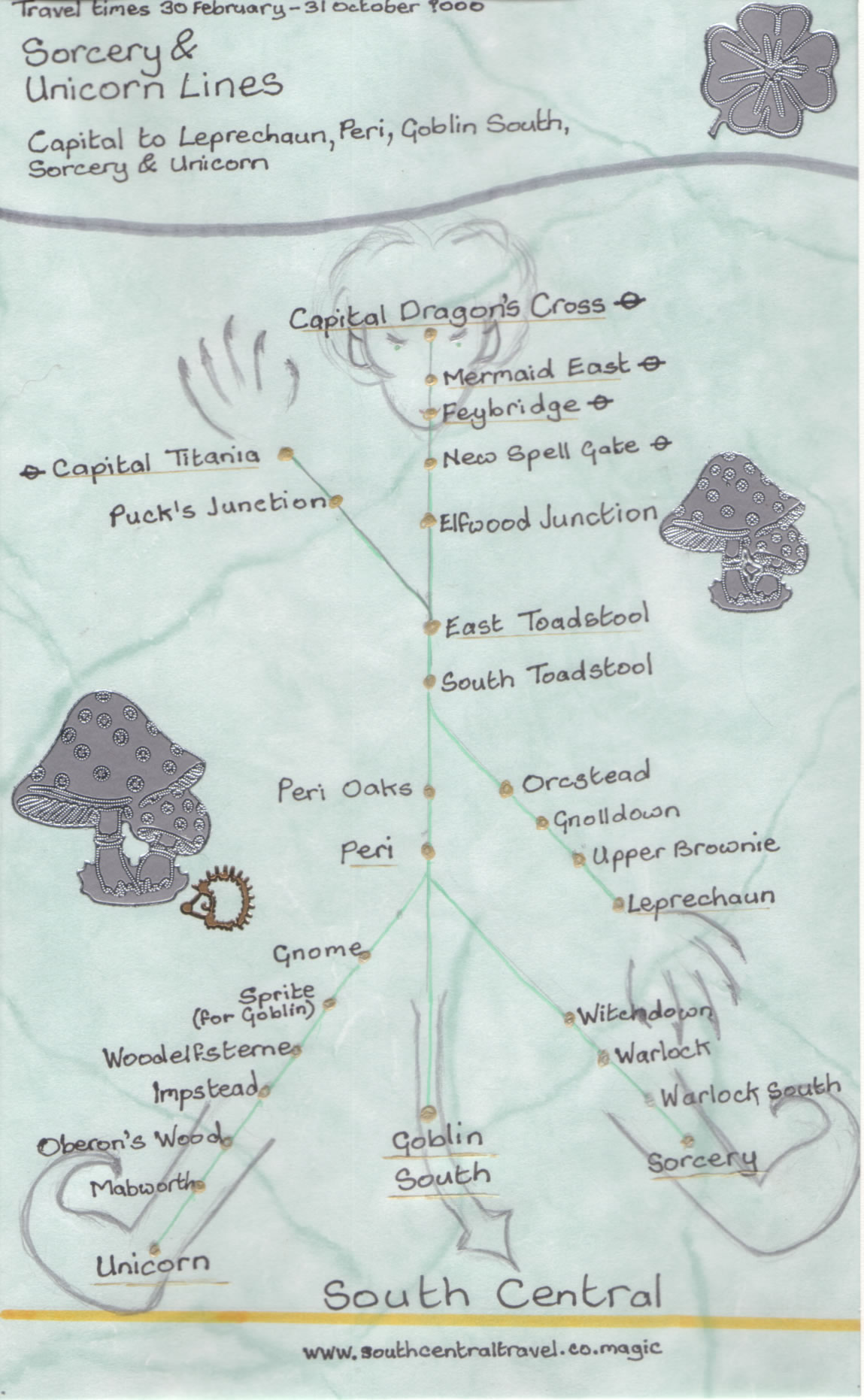
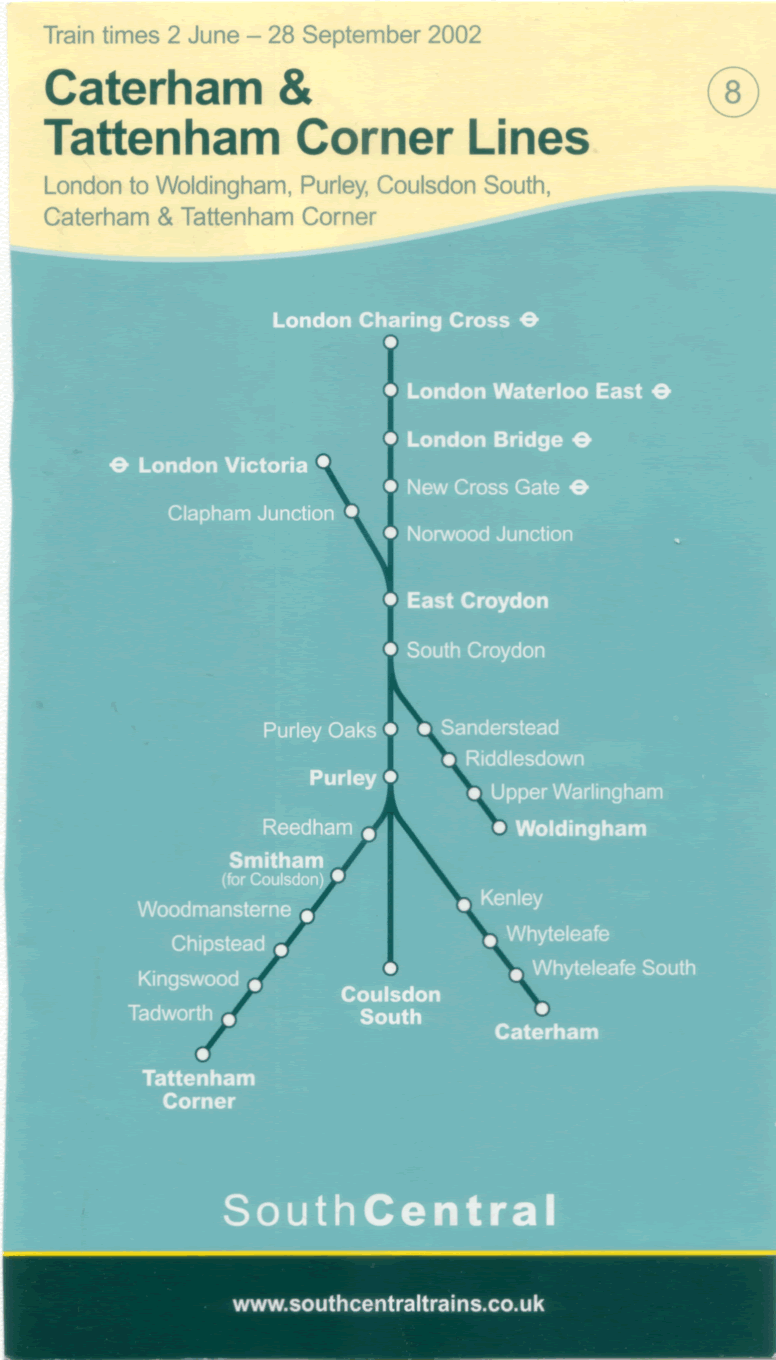
Once upon a time, when our daughter lived near Croydon, I became familiar with South West Trains, particularly the Caterham and Tattenham Corner lines, because they were the easiest way to access central London. I had started writing my fae saga, and I suppose fae were on my mind. We (my daughter and I) went to the Tate Modern where I saw some wonderful ‘maps’ with different names of all sorts imposed on actual maps. Then we went home by train and I picked up a map of our route. I played about with the names and the shape of the lines until I was reasonably happy with them.

I thought I’d share the result with you. I’ve included the real map too, for comparison purposes. I don’t imagine the rail company will care about their copyright as it’s a very old map and definitely out of date (and possibly out of print). We usually alighted at Gnome…

I wonder whether, during the lockdown, and the reduced train services everywhere, the fae might have crept out to play again, and whether they would approve of my station names! And whether any of you might spot them, out of the corner of your eye, when travelling.

I photographed the unicorn at a forge just south of Croydon where there was a fabulous display of mythical creatures.

Black Lives Matter

Where to start?

I spent much of my career in antiracist education. We produced teaching materials which were going well in schools but were overtaken by the National Curriculum. We worked with children, especially in ‘all white’ areas, and with teachers, both longstanding practitioners, trainees and their trainers. We attended conferences and marches, and helped organise both. When I say ‘we’ I include colleagues and close friends from all ethnic minorities, ethnic majorities and political persuasions. All our work was, it would seem, for nothing. That, I think, sums up my own long term stance on the matter.

I could and should also mention that I am white, with all the privilege that includes, and that my best friend ever (met at uni) was black, of Caribbean origin. She died of cancer in 2005 and I was devastated. I valued her friendship and also her opinions on the world, including her views – personal, professional and political – on issues such as racism. Towards the end of her career she was the first black female professor of law in the University of the West Indies and on her retirement which was imminent, she hoped to work with UNHCR who were, I think, looking forward to her services. Sadly, that was not to be.

My last service to her was to act as her executor. One of her nieces, who inherited some money in her will, is a young black woman from Trinidad and is currently practising in medicine in New York. Slightly ironic, I suppose, in the way it connects me, at however much of a distance, with current events in both the pandemic and the protests. (I am not in touch with the young doctor, only with one of her aunts.)

When I was doing a postgraduate diploma in antiracist studies I wrote my thesis on literature in English (not in translation) by writers who were not from the obvious first world countries. Most of the work I considered was from authors in places like India, South Africa, The Caribbean, Bangladesh, etc. I argued that works like this should be included in the British school curriculum alongside our teaching materials on history and antiracism. My work was well received – and part of it was published in an educational magazine. Again, it would appear all the effort was wasted.

Not wasted for myself, of course. I read countless novels and poems that enriched my life, and helped inform me about the experience of people from other countries and cultures. And at the very least I am able to understand the current riots, arguments, etc. without having to do any further research.

Which is just as well, because all my notes including all references to sources went up in flames in our Portuguese fire. So no, I can’t recommend any specific books. Blame climate warming…

The protests are totally justified. Totally. No arguments. If there is state-condoned thuggery and violence, there will and should be protests. Even the violence of a tiny minority of protesters is explained by the way the protests were triggered. And of course the state will use that as a distraction from those same triggers. The protests elsewhere are heartening. There has been systemic racism and poor policing in countries such as UK, France and Australia. The current US riots, along with lockdown and the internet have brought about a world outpouring of rage which I can only applaud even whilst wishing it had happened decades earlier.

Toppling statues? I think they should have been toppled long ago and feel ashamed that in the twenty first century we feel able to glorify men who were involved in the slave trade. We would not welcome statues of Hitler, however much he did for things like German motorways. So yes, I think the statues should be removed if the person commemorated had a personal connection with slavery, and maybe if they didn’t, if ‘just’ their family (and their wealth) was involved the statues should either be taken to a museum or given a plaque or one of those display information boards. Yes, toppling a statue is a violent and ‘lawless’ act, but how would any of us feel and react if for example a present day murderer was honoured with a statue? Or someone like Jimmy Saville for his charitable work? And what do we think about people who broke Nazi laws? No, I am not comparing our governments to a Nazi regime, but there are points of similarity which cannot be ignored.

What can we do? All live matter, of course, but black lives are being treated as expendable in so many places. So our focus should be on those at present. In policing, in the effects of the pandemic, in education, and so on. There’s a useful petition you could sign: https://petition.parliament.uk/petitions/324092/signatures/new

You’ll have gathered that I have very ‘violent’ views on this. I am sad that my age and state of health stop me from participating in marches or any public protest. All I can do is write my blog and hope it gives either information or comfort to someone reading it.

As always, if you want to discuss the matter further I am here for comments or you can email me. I can probably dredge up a few titles and authors to talk about, but for now, scroll back in my blog to read in depth reviews of works on racism by modern Black British authors.

(The illustration is my current FB photo which is why it has a camera in the way…)

May reviews

TV and films

A Midsummer Night’s Dream (Russell T Davies version)***** Absolutely gorgeous with lots of magical effects and slight twists on characterisation. BBC but I think it’s available to buy.

Valerian and the city of a thousand planets***** A re-watch. I love it. Lots of well done aliens and an underlying standard thriller plot with endearing main characters.

Science and Islam (BBC 4)***** I’ve watched one or two of this history of science series. Excellent. (I knew most of the history but my grasp of the science was shaky…)

Vera Series 3***** Still loving this – set in my native region with a quirky but extremely competent female detective.

Books

The brilliant non-fiction

Becoming Human: New Scientist Collection***** Excellent collection of articles about up to the minute research about evolution.

Pale Rider by Laura Spinney***** The Spanish flu of 1918 and how it changed the world. Excellent historical research. Stunningly relevant to our current pandemic even though it was written a couple of years ago.

Myths of Gender by Anne Fausto-Sterling***** As the author says:‘…an extended argument against lodging social difference in the body’. Fascinating account and critique of research into gender differences.

How Baking Works by James Morton*****
This really explains why we whisk, fold, etc. and how ingredients can be substituted. Kept for reference though I would prefer a hard copy.

The brilliant fiction:

Girl, Woman, Other by Bernadine Evaristo*****Wonderful interweaving of black female lives in modern Britain. Amazingly good use of tense changes to underpin different periods and points of view. (And that’s something I never thought I’d say!) Well worth the Booker Prize!

A Carriage of Misjustice by Charlie Cochrane***** Vol 4 of the Lindenshaw series. As usual, I enjoyed the mystery and loved the dog, Campbell, who somehow manages to cement the relationship between the policeman and his teacher husband. A masterclass in how to juggle large numbers of suspects and witnesses – something I really needed for the book I was writing at the time.

Finders Keepers by N R Walker***** Heart warming story of two guys brought together by a dog (who gets lost) on Australia’s Gold Coast.

Thicker than water by Becca Seymour***** Thatch and Callen are shifters in law enforcement in Australia. Interesting characters and location.

The good:

You let me in by Lucy Clarke**** Psychological thriller with a very gripping plot but the final mystery had no real clues in story which I found disappointing. I guessed ‘whodunnit’ or rather ‘wasdoinit’, but the why was totally unclear until the last chapter.

Song for the Basilisk by Patrician Kilip**** Lovely story about music and magic with fascinating characters. However, too much purple prose with no breaks became hard to read.

The readable:

Thicker than Water by J D Kirk*** Sequel in the DCI Logan series. Well written and plotted but not as exciting as the first one. ‘Tartan noir…’

The poor and the dire:

Lost Hills by Lee Goldberg**
First in the Eve Ronin series. Poor world building and some unpleasant characters

Canis Falls Academy: Year One by Imani L Hawkins* Dire structure, characterisation, plot…..

And the abandoned: (Only one this month)

Sword Dance by A J Demas. A confusing Graeco-Roman/mediaeval Japanese world with fantasy and mm elements being introduced too slowly. I simply gave up.

Short stories

Not highly recommended but others might like both these:

Under the Law by JP Bowie*** More of a novella, perhaps. Tired tropes and unmemorable plot but the writing was competent and anyone who likes short mysteries with an mm focus might enjoy it.

Australia: a Romance Anthology. Various authors.***
OMG. I bought this because the profits went to Australian wildlife victims of the fires. Good value with a lot of stories, all but one of them het romance (and the mm one was a vampire tale). Too many were spin-offs from series but could be read stand-alone. However, I will never (?) complain about the amount of explicit sex in mm romances again. I am still reeling from the content of some of these! One or two really good pieces; all readable.

Fanfic

I frequently recommend Small_Hobbit and some of her collaborators on things like the Marylebone magazine. I do enjoy their writing but I think the main reason they keep cropping up here is that their work, as well as being good, is often accessible to readers who don’t share their fandoms. This month I also read a number of stories by Brumeier (another writer I like) but they all needed in depth knowledge of SGA for true enjoyment.

Five times Lucas met Pooh Bear and friends by Small_Hobbit***** (all you need to know is that Lucas, Adam, Ros and Harry are spies and that the inhabitants of the Hundred Acre Wood sometimes stand in for Sherlock Holmes) https://archiveofourown.org/works/24352783

Welcome to Castle Elsinore https://archiveofourown.org/works/24004696 and On to March Ides Woods https://archiveofourown.org/works/24115366 *****by Small_Hobbit. Imagine a coach tour and people the staff and tourist groups with characters from Shakespeare, The Hobbit, and other classics. Short but powerful!

Reclaim (poem by okapi)**** https://archiveofourown.org/works/6848800/chapters/58468873

Lockdown (a poem for 2020)

The first thing
we noticed was the way the birds seemed to sing
louder, day by day. Then,
as the skies grew bluer and the sun invariably shone,
living under a flight path we inevitably noticed the planes had gone.
Traffic became something exciting when we occasionally heard it pass
(and not to be confused with the noise a neighbour made mowing the grass).
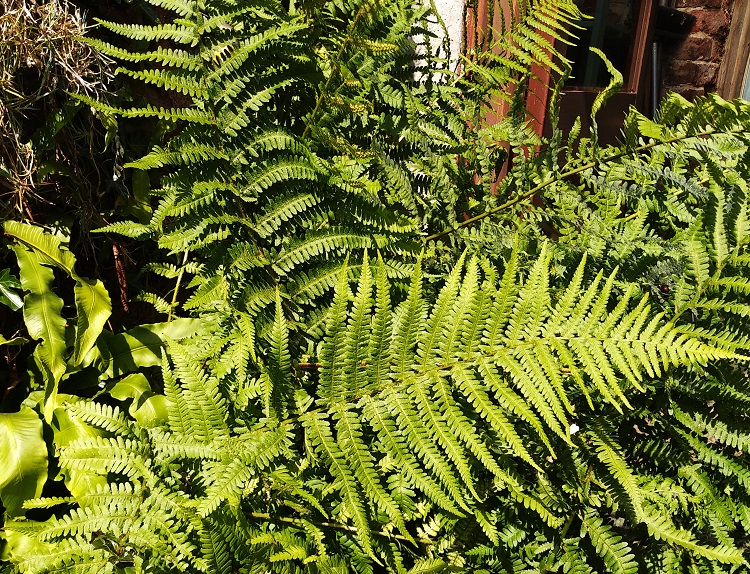
Ferns, made bold by the cleaner air, grew twice as high as before,
twining around the garden chairs and blocking the back door.
Yesterday a plane flew over and as we wondered
at the noise and the white trail, I pondered.
When we leave house and garden for a more usual way of living
Will we remember, and will we regret the softer way the birds sing?

Fictional towns


(from a photograph by Mihail Ribkin on Unsplash)

I have been irritated recently by the insertion of fictional towns into landscapes I know and love. I have just read two crime stories set in Northumberland, my home county, and in both cases the crimes were set in completely fictitious towns. I kept trying to work out which towns were actually being described (they weren’t) and that distracted me from the stories. (See April reviews, the post immediately before this one.)

I realise that it’s perfectly possible that the same thing happens with novels set in e.g. Australia or US and that I’m simply unaware of the fact. Residents of those countries might share my annoyance and anguish.

It isn’t that fictional towns are always a no-no. I have enjoyed two entire series set in fictional towns – Porthkennack, which is supposedly in Cornwall, where a group of writers have set their historical tales and their modern romances, and Trowchester, a town created by Alex Beecroft for Trowchester Blues. In both cases the town itself is brought to life with a lot of detail and an obvious love of the well-imagined place. I had no objection to Starsky and Hutch operating in Bay City rather than anywhere real. There are plenty of fictional towns out there functioning happily in my imagination as well as that of their creator.

However, when a town is used simply as a place where there is a generic police station, a generic hospital and a generic town hall, etc. I feel annoyed. Why can’t the detectives, victims, etc. go to the perfectly good police stations, hospitals, and so on in towns that do exist? Somehow, it seems rude to ignore their existence. And how have these modern towns sprung up in countryside where there are sparse populations, little or no industry, and no apparent historical foundation? I suspect a lazy desire to avoid having to research the actual centres of population in the region. Porthkennack has the fishing industry and tourism to sustain it. Trowchester is in busy middle England. In neither case do people refer to other local towns, only to London or regional centres such as Birmingham. They ‘exist’ in their own right and could easily be true.

I could, to be kind, assume the authors who upset me were trying not to associate crime with real places. But plenty of crime and horror stories take place in well known locations, just as they do in real life. So do romances and adventures. Even urban fantasy and science fiction. Nobody ever seems to complain that their town should not be used as a setting.

So for anyone out there thinking of creating a fictional town: give it some life, some depth, some believable history, some detailed description, etc. Think about why it might be where it is. Think about its history and its name. Think about who lives there, what jobs they do, where they shop… You don’t have to go quite as far as Marquez did in his creation of A Hundred Years of Solitude, but you do have to get me to believe in the place.

A warning: I know most of Britain and a lot of Europe quite well, and am likely to be disappointed and to some extent shocked when a town turns up in the middle of nowhere for no good reason!

April reviews

April

TV and films

The excellent.

Dark Crystal: The Age of Resistance***** Stunning animation series – homage to Jim Henson. Also watched fabulous episode about the making of the series. Available on Netflix. You don’t need to have watched the original film to make sense of this – I’m going to watch it again later. This is a prequel.

Pangolins: the World’s Most Wanted Animal*****
(BBC2) I love them and I’m so sad they are heading for extinction.

Witness***** – Harrison Ford in romantic thriller based around life in Amish community.

Vera Season2***** ITV seem to have temporarily given up treating us to the entire series, maybe because they hope we’ll pay for BritBox. (Not going to happen.)

The good.

A Monster Calls****
Rather frightening for kids and rather preachy for adults. Good animation etc.

Various SGA episodes – no stars because watched for fic I’m writing for Fandom Trumps Hate so more like work than entertainment… But overall I’d give the series 4 stars because the main characters hooked me.

Front Row Late Series 7 Ep 1 Mary B intros the Atwood puppet show ****
(See short stories) Interesting use of household props.

Twin****
Norwegian drama with Kristofer Hlvju (GoT) playing both twins. Well acted in lovely scenery.

Holst and Vaughan Williams: Making Music English**** Interesting.

The annoying.

The Truth about Traveller Crime (Dispatches)*** Raised as many questions as it pretended to answer. I was annoyed because Ch 4 are usually more politically aware.

Books

The excellent

Sporting Chance by Alexa Milne***** media problems beset a new relationship between a rugby star and a teacher in Wales.

Night and Silence by Seanan McGuire*****Vol 12 in the October Daye series. Perfect, as usual. No real spoilers but after the cliffhanger of the previous volume I was relieved to find the wedding is still going ahead.

Mysteries of the Human Brain. New Scientist Collection.*****
Some fascinating articles.

Trial by Impotence by Pierre Darmon*****Looks at ‘the legal procedures for the dissolution of marriage on grounds of impotence’, particularly in France, from the middle ages to the twentieth century. Fascinating, horrifying, hilarious and sad.

Mere Mortals by Erastes***** Sort of gothic horror thriller with mm twist – intriguing and extremely well written.

Narrow Dog To Carcassonnne by Terry Darlington.*****
What it says (with Monica, his wife and Jim, his dog). Must get sequel. Really funny and interesting.

The Making of the English Landscape by W.G. Hoskins***** fascinating and informative look at hedges, ditches, trees, etc. from pre-Roman times to just post-war Britain. Get the hardback if you can – nearly as cheap as the e-book and you’ll want to refer to the maps and study the b&w photos. Written just after WWII before motorways carved up the countryside.

Semper Fi by Keira Andrews.***** Jim and Cal – WWII then an Apple Farm in NY State. 1942-1945 interspersed with scenes from 1948 and an epilogue in 1957. Clever writing and structure.

The recommended

Nobody’s Groom by DJ Jamison**** Nice as part of the Marital Bliss series but not very memorable on its own account because the characters are less interesting once Colby has got his head round being possibly gay. Well written as usual.

The ones I didn’t enjoy much but you might.

Alice Teale is Missing by H A Linskey*** Poor editing (Penguin, so I feel entitled to complain) – very repetitive and also features a fictional town in my native county. It doesn’t really work and I kept being distracted by its unreality.

The Lost Ones by Ben Cheetham*** well written thriller/chiller (better editing than Penguin) but with an unbelievable plot and characters – another one with a strange fictional town sort of dumped in the wilds of Northumberland (my home county).

DS Billings Victorian Mysteries by Olivier Bosman*** (boxed set of three) – possibly realistic if depressing psychology but unlikely thriller plots.

New Year’s Resolutions by Crystel Greene*** an mm romance in Westminster… Weird view of British politics and especially Wales. If the queen is 100 how did Larry the Downing Street cat survive?? OK, it’s an AU but AUs need some supporting world building.

Thin Air by Lisa Gray*** (Jessica Shaw bk 1) Great concept – weird structure with flashbacks in victim pov. Didn’t like the style much though quite well written.

Short Stories

The highly recommended

Suffer a Sea Change by Seanan McGuire***** sequel and counterpoint to Night and Silence (see Books). One of the exceptions – I don’t often give a short story five stars.

The rest

Bear and Fred by Iris Argaman***
Children’s story about wartime teddy bear. Not as good as Judith Kerr’s When Hitler Stole Pink Rabbit. Maybe a younger target audience but not sure in that case that enough context is given.

Man Crush by Isobel Starling*** So short I was just getting into it when it was over.

Silken by Isobel Starling*** BDSM with too much explicit detail for me.

The Masque of the Red Death by Edgar Allan Poe*** Read prior to watching Margaret Atwood’s puppetry interpretation. (See TV) Too short, and the preaching distanced the horror.

The White Man’s Liberation Front by Bernadine Evaristo*** Present tense put me off. Clever but very aware of its cleverness. (Published in the New Statesman Spring Special.)

Abandoned
Murder by the Minster by Helen Cox. Lost me at redwoods by the Ouse in York. (Cornus or Dogwood doesn’t work, either…)

The City of Brass by S.A.Chakraborty (Daevabad trilogy bk 1) Djinns and demons and ghouls….

Fanfic

No stories to recommend this time, but I would like to mention some poetry. Please note that originally these were in the Sherlock fandom but have wandered off into their own delightful AU.
Five Poems from the Pen of Inky Quill by okapi **** https://archiveofourown.org/works/6848800/chapters/56437762

What are you reading at the moment?

What are you reading at the moment?

This, with variations, is a common question on social media. I suppose it’s due to the extra time some people are finding they have to read, during lockdown, working at home with no commute, etc.

The trouble is, I never know quite what to say. I usually have at least three books ‘on the go’ and sometimes more.

Let’s start upstairs.

The bathroom (with toilet) is dedicated as a rule to the week’s print magazines – at least New Statesman and New Scientist, with an occasional Private Eye (not at the moment because we’re random buyers and there’s a lockdown) or National Geographic (passed on by a friend and similarly absent). If those run out I have a carefully selected book: it must be something I can dip into and out of in between magazines. Not fiction, then. Mostly, books of art, poetry, etc. or perhaps things like Culpepper’s Herbal, or Harry Potter: A History of Magic (British Museum), a Dictionary of English Place Names. I’m sure you get the picture. I just finished The Making of the English Landscape and have given it five stars.

The bedroom has something non fiction but that nevertheless needs longer and more concentrated reading times. I don’t often read lying in bed – I find it uncomfortable and my glasses don’t quite cope – but I’ll sit propped up or on the edge. Currently I’m reading a fairly scholarly book about myth and gender. You’ll get a brief review eventually.

Downstairs next.

In the kitchen I often have two books. One will be recipes I have already read but need to re-read, finding and noting the ones I might actually follow rather than just enjoying in the abstract. The other might be fiction or non-fiction, in paperback. Something I can pick up while I’m waiting for things to cook, or take out into the yard with a cup of coffee. It should be something that can stand being abandoned when the potatoes boil or when the phone rings and I have to rush in. At the moment I’m alternating between Jamie Oliver’s Veg and Bernadine Evaristo’s Girl, Woman, Other. Both fascinating (both Christmas presents 2019) and I mustn’t let the pans boil dry. That happened with my previous kitchen book, Narrow Dog to Carcassonne.

Then there’s the lounge book which might be the one you’re asking about… It will almost certainly be fiction and equally almost certainly on my e-reader (though last week I had a Seanan McGuire urban fantasy paperback). It will stay in the lounge unless I’m going out (not likely just now) in which case it’s easy to slip into my bag if I remember. If I remember the book I will probably remember my mobile phone, and vice versa. I tend to ring the changes in my e-books. I like fantasy, crime, sci fi, mm romance, general romance, and some historical novels. If I find something that combines two or more of these, I’m really happy. Today I’m reading You Let Me In – a chiller that I’ve borrowed from the Amazon Prime Library. It’s very well written but I haven’t got far yet. I also keep dipping into an e-book about baking, written by one of those GBBO stars. I don’t really like reference books on e-readers because I worry about finding things again. I know there are bookmarks but somehow I’m not good at those till it’s too late. I just finished Keira Andrews’ Semper Fi which was a lovely mm historical novel. And I abandoned City of Brass even though it came highly recommended. It was another Amazon Library book so I had no qualms about giving up.

So there you have my reading habits. I should also say that I keep crosswords, sudoku and logic puzzles in the kitchen, bathroom and car, just in case…

And yes, I read the ingredients on sauce bottles, cereal packets, etc. In case you wondered.

Spoof bookmarks or reviews.

Once upon a time someone linked me to a post on Tumblr (I have now lost the link) which gave spoof AO3 reviews of famous authors as though they were current fanfiction writers. The ones I’ve chosen were not included in the post I read. The reviews are couched in commonly used fanfiction Fanlore or Bookmark terms.

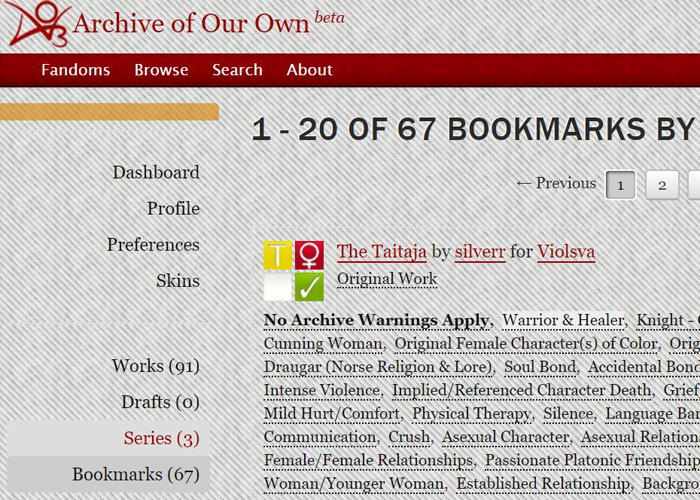
(The screenshot is of my AO3 bookmark page and the first bookmark is a fic I have previously reviewed here, giving it five stars.)

J.R.R.Tolkien:
Excellent world building and descriptive passages but unable to get to the point of the plot quickly. Stereotypical villains. A lack of female characters has led to some feminist rants in comments. An attempt to focus on non-fictional aspects such as timelines and alien languages has resulted in a warning for violation of the policy on non fanworks and an explanation that these must be appended to actual stories and not published as separate works.

G.R.R. Martin:
Not to be confused with other pseuds containing unnecessary Rs. Writes long WIPs and teases fans with promises that are not kept. Denigrates other fanworks as unimaginative. Works in series do not always contain adequate Archive warnings for major character death, rape/non con, incest, child abuse or graphic depictions of violence.

J.K. Rowling:
Another user who enjoys initials and has pseuds which are possibly intended to confuse her readers. Her early works were directed at younger fans and encouraged a lot of underage internet users to seek out the Archive (AO3 cannot allow under-13s to hold accounts because of data protection laws but they are welcome to read, preferably under adult supervision). Hints about the backstories of some characters have kept LGBT readers following her work. However, a lack of warnings for triggering situations regarding pets has meant the Policy and Abuse team has received a heavy volume of reports about which they can do nothing whatsoever.

Anthony Trollope:
Writes a great deal of mostly het fiction in which there is a fade-to-black as soon as sexual situations arise. His excellent detailed depictions of nineteenth century Brit society could serve to educate writers from elsewhere about the same period. Long series could be better numbered for smoother reading enjoyment.

Joanna Trollope:
Claims family links with Anthony. Similarly detailed social ‘world building’ with interesting characters but her works tend to lack plot which cannot be said of her illustrious ancestor.

Robert Jordan:
This user started a long series which lost itself in ever decreasing circles. The writer then died, but had fortunately designated a Fannish Next Of Kin who took over the account and finished the story to the relief of readers. The FNOK contribution is actually better in many respects than the last few original works by Robert.

Lewis Carroll:
A pseud under which a respected academic writes fantasy about little girls interacting with rabbits, queens, caterpillars and madmen. Much reported with allegations of paedophilia which are never sustained because of lack of evidence.

George Gordon Byron:
Sometimes known as Lord Byron due to his aristocratic breeding. Writes epic stories in verse but is frequently in violation of the Terms of Service due to wilful mistagging and rating of his work. Author of a poem which ends with a knight arriving at a dark tower, which gave rise to other works such as those of Stephen King. Frequently deserves, but does not always get, an ‘inspired by’ citation.

Stephen King:
Cleared of charges of plagiarism, King was still required to cite Byron as inspiration for his Dark Tower series, with a prominent link to the other writer’s work. (There has been recent debate as to whether citations are enforceable.) His other works are usually tagged ‘author chose not to use archive warnings’ and are not rated, because everyone knows that they have to beware when reading anything by this writer. He also writes meta, intended to encourage younger writers.

Dorothy Sayers:
A one-theme writer who relies too heavily on the college AU.

Agatha Christie:
This writer uses worn out tropes for her mysteries which involve stereotyped characters. She was forced (by her rather strident commenters) to re-title one work which was held to be racist and intended to harass or offend her audience.

Serendipity

(A free flashfic for Easter)

It started in a shared taxi. The rain was bucketing down and they both seized the door handle, each asserting themselves and their right to a ride, to get out of the weather.

No, wait, it started at the concert, when their eyes met across the auditorium, quite by accident.

But it started before that.

*****

James was walking up from the beach, musing on the wonder of rocks and patches of thrift, when he saw the discarded wrapper. He picked it up automatically, intending to find the nearest bin. Green was both his surname and his nature. As he was about to drop it in, muttering about litter louts and the environment, something made him look at it properly. It was the outside paper strip from a foil wrapped chocolate bar; as well as advertising the name of the product, it claimed in loud letters: YOU MAY BE A WINNER. James shrugged, but something, the weather, serendipity, environmental gnomes, made him put it in his pocket and continue homewards. He phoned the number, amused at himself and faintly guilty at the cost; these prize numbers were all about making money through the phone charges. It seemed he had won a ticket to a concert at the huge new arena. A pianist was performing a varied programme and he was free on Saturday evening – as usual. A serious (and unattached), gay environmentalist who didn’t enjoy ‘the scene’ was rarely out at weekends.

Even then, at the last moment he almost didn’t go. The sky was stormy and he had a new DVD to watch. But his sister phoned and told him he ought to get out more, so, although he didn’t think this was quite what she meant, he set off.

The young man at the ticket office appreciated the dark gold curls and the honed physique of the prize winner but didn’t even dare flutter his eyelashes at the aloof expression on the conventionally handsome face. He told James to enjoy himself and watched him head for the stairs, then turned his attention to the next in line.

*****

Iain stared petulantly at the computer screen. He was so tired of trying to conform. His wife had worked out his ‘secret’ so his ‘good’ behaviour counted for nothing, and their acrimonious divorce had left him struggling to make ends meet, so ‘bad’ behaviour was unlikely to occur with any regularity. He surfed the net and ended up on eBay, bidding without much hope for a ticket to see his favourite pianist at a local venue. To his surprise, he won the bid at his lowest, rather than his highest figure, and hurried to pay the seller and wait for the post. Meanwhile, he continued to work at the programming assignment he’d accepted.

On the day of the concert he did grocery shopping in the afternoon and got drenched in one of the sudden downpours that seemed the norm for the month. By the time he’d showered, changed and dried his long black hair, scrunching it back tightly into a pony tail, he thought he might be too late for the concert, but public transport was on his side for once.

He gave a quick glance at the people in the queue, glad he had his ticket already, and didn’t need to wait for fate to be kind, then followed a group of people up to the doors that led to the stands of seating.

*****

During the interval, James looked round, wondering why this particular concert had attracted such a huge audience. It was good, but not, he thought, good enough to merit such a turnout; it wasn’t as if they could all be prize winners. He noticed the rapt expression on the face of the dark haired man directly across the aisle. He must have been looking hard, because their eyes met, in a sort of recognition, although they had never seen each other before. He was sure of that.

*****

Iain was still in a music-induced reverie when he felt eyes on him, and looked up to meet the gaze of a blond stranger. He turned away, flushing slightly and cross with himself at his automatic response. He was free to look, now, but when he did, the other man had turned his head and the moment had gone.

*****

Except that when they left, it was raining.

The entire crowd was trying to find taxis, which are as rare as jewels, especially when the weather makes them desirable.

If they hadn’t, if it hadn’t, and so on. But they had, and it did, all by happy accident. Their hands met and they shared the taxi.

*****

Yesterday.

Yesterday he had been solitary, slightly sad and somewhat serious.

Yesterday the most important thing in his life had been his job as a park ranger.

Yesterday he had been accustomed to living alone, to having to rely on fantasy for fulfilment.

Yesterday he had expected to continue in his self-imposed isolation, withdrawn from the social whirl that had sickened him with its superficial pleasures.

Yesterday his greatest loves had been the red squirrels and the quarrelsome gulls of the coastline he guarded.

Yesterday he had sighed when his sister told him to ‘get a life’.

Yesterday it had rained.

Today, there was Iain, and the sun was shining.

*****

A whirlwind spring and summer were followed by a whirlwind wedding and a hastily organised honeymoon.

The hotel was perfect, golden stone dreaming in the sun, and a room with a view of the mountains, snow-capped as he’d hoped. The place was run by a gay couple who made the atmosphere as comfortable as the rooms. Iain was pleased with their choice and hoped James was too. After freshening up and a few hugs (they’d keep the main course till later), they decided on a walk before dinner and went out to explore the village.

*****

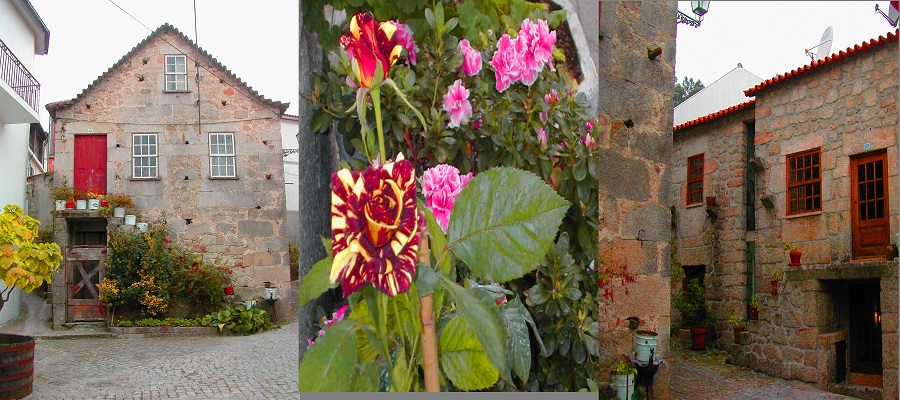
The steep, narrow, stone stairs that stood in for streets started from the hotel’s back courtyard. Strings of onions and garlic hung from wooden balconies and pots of geraniums and chrysanthemums straggled up the smaller steps at each entrance. One doorway boasted a smart rose with striped petals and an air of modernity at odds with its surroundings. Further up a woman was washing her steps, and the rest of the street by default as the water gushed then trickled down the hill. Ian wondered if the rose looked forward to a daily deluge. James thought it was merely being brave and bold in the face of adversity as roses should always be.

There were people about. A couple of builders stood by their open-backed trucks blocking the cobbled main street (mercifully not stepped), chatting and exchanging news with passers-by. Iain was bemused by the strong similarity of all the men he saw. The younger ones, from tradesmen to homeward-bound clerks, were all short, dark-haired and stocky, quite handsome despite a decided lack of sophistication in their manner and clothing. At about sixty they turned inexplicably into replicas of garden gnomes, gnarled and stooped, prone to wearing outlandish caps and scarves. Despite the cloudless sky they all, young and old, carried umbrellas slung across their shoulders or hung from the back of their collars. He felt like a giant and even James, shorter than him by a good few inches, towered over the locals. He felt feckless, too, unencumbered by any protection from the unlikely rain.

The women were shorter still, dark-haired and pretty, calling to each other across the narrow lanes from one balcony to another. The sixties rule seemed to apply to them too. James said he thought the origins of northern European witches might have started here in these mountain villages. A crone whose nose almost met her chin shouted a cheerful greeting to them. James thought his Portuguese good enough to reply with a cheerful ‘bom dia’ but the woman cackled and repeated her ‘boa noite’ just as the church bells rang a dolorous seven, echoed thirty seconds later by a slower church clock, further down the valley.

*****

Iain laughed at James’s mortified blush and pulled him down yet another street stair. Perhaps they could return to the hotel a different way. The small post office was still open but the only postcards on offer were tired views of the last skiing season in the mountain. It was a good job not many of their friends would expect postcards from a honeymoon couple. Their parents were a different matter and they would have to look further afield. A few of the gnomes were gossiping on stone seats around the bandstand that evidently served as a village centre. Faded posters advertised delights that by the pictorial content included grape harvests, new wine and dancing.

The lane narrowed further, taking them between gardens full of glowing flowers and ripening grapes. A dog suggested they were trespassing and was shouted into silence by its owner. A cat watched them pass and merely licked its tail, settling more firmly on the gatepost. They came out at the front of the hotel again, seeing the late summer reds and oranges of the vines on the slopes beneath them and hearing the clink of glasses in the outdoor dining area.

It was, Iain reflected, like a film-set, perhaps for a fairy tale or fantasy, and yet he’d never felt so real, so alive. He turned to his partner and found an answering smile. Yes, he concluded, they’d chosen the perfect place. And the perfect person to share it with.

As they entered the hotel they heard music over the loudspeakers in the dining room. It was piano music and was, Iain realised, ‘their’ piece, the one played just before the interval in which their eyes had met. He looked at James and knew he’d recognised it too. And so they went in to dinner accompanied by the sound that had brought them together in the first place, and brought them here.