Novels versus shorter writing.

OLYMPUS DIGITAL CAMERA

I’ve been musing about the differences between novels and shorter fiction – novellas, short stories, ficlets, flashfic and drabbles (and all variations on these). I’ve played with all these kinds of writing and I’ve chosen to read all of them, too. But I think I have to say my real preference is for the novel, whether to read or to write. Taking Nanowrimo’s definition as a yardstick I’m talking about fiction that is over fifty thousand words long. This is an arbitrary measurement, dictated by print publishing, but it allows us to use a common description.

Characters can be allowed to develop at their own pace in a novel. This is satisfying for a reader who learns about a character slowly, with lots of twists and turns of plot and personality. It is also satisfying for the writer who can hold back secrets, allow for events to influence development and look at the reactions of a character to all kinds of happenings. The plot, too, can take time to unfold, and can contain sub-plots and underlying themes that could never be fully explored in a shorter work. This is even more true of a linked series of novels, where there is the pleasure of remembering past incidents and building up a whole detailed history.

As a writer I like to immerse myself in whatever I am writing. I emerge later – sometimes hours later – knowing I have been living in a different world which is every bit as real to me as the one where I need to shop or prepare a meal. My favourite books are the ones where I have been able to lose myself in the world the author has created and I would seriously like to provide that kind of alternate universe for my readers. For me, it never seems possible in a shorter story. It takes me time to enter wholly into a fictional universe and until that entry is complete the demands of everyday life tend to summon me back again. So usually, with someone else’s short fiction I can admire, but not love, and in my own, I am always to some extent an outsider telling a story, not submerged in the ‘dream’.

I read very quickly, which is probably a factor in my preferences. A short story is over almost before it has begun and certainly before I have had a chance to fall under its spell. As I always write what I want to read this means my own short works are over too quickly, as well. Of course, stories dictate their own length and some have only one strand, which will last for ten or twenty thousand words and no more. Any attempt to expand the idea will produce repetitious and turgid prose that an editor would rightly cut. This is, incidentally, just as true of longer stories and some huge novels could benefit by being pared down to a slimmer size.

I notice that Writing Magazine lays great emphasis on the short story. Maybe it’s because there are more possible outlets for the beginner to try with submissions; there are magazines galore and calls for entries for competitions and anthologies.  Maybe people feel they can write something short because it will, they think, take less time out of their busy lives. There is also a mistaken perception that short stories are somehow easier than the novel; their lack of length makes them less daunting and more likely to be achieved. One only has to look at ‘classical’ short stories to know this isn’t true, but the idea persists.

I have been made more than normally aware of all this by the amount of ‘advent’ fiction that has come my way this month. Various writers, some I call friends and some I know of and ‘follow’ have been treating their readers to short fiction, sometimes a piece a day, in the run up to Christmas. This is happening in the worlds of original fiction and fan fiction alike. Some of the offerings are very good indeed and it is lovely to have such ‘gifts’ online to open each day. But there is something unsatisfying about a diet of brief glimpses. I was looking at some of my own flashfics, wondering whether to work on one or two to offer here. But I couldn’t really get into any of them again, whereas I was doing a final proof reading of one of my novels and had to be very strict with myself to concentrate on punctuation and spelling and not get carried away by my own story!

I know I feel happy that my own work next year will focus on novel length works. Two (at least) for final editing and formatting, and one (at least) to write. I shall no doubt get happily lost in them, and it seems likely that things like mealtimes and necessary household tasks will suffer!

Some of you, I know, enjoy shorter fiction, and some of you write it for various reasons, including the perfectly good one that it can be an excellent way of breaking the dreaded writer’s block. I’d love to hear your thoughts on the subject.

Questions and Answers – a poem

OLYMPUS DIGITAL CAMERA

I wrote this last Christmas in a slash fanfic context but as I didn’t give the characters names it could apply to any couple involved in law enforcement or other dangerous occupations. The voices alternate and it should be fairly clear that one  of the pair is naturally much more reckless than his companion. So you could try guessing which couple I wrote it about.

 Questions and answers.

(a conversation for two voices)

So if I were to say to you, ‘Take care!

Protect that face and body that I call

my own, my world, my universe, my star,’

would you be thoughtful, heed my words of love,

draw back from conflict, take the quiet road,

or would you laugh and disregard my fears?

#

I’d rather take you by your willing hand,

pull you all helter-skelter down the way

of danger, laughing, yes, but smiling, too,

and leavening the peril with a kiss.

I think you’d follow me and soon forget

your fears, your very thoughts, your warning words.

#

I scarce can think. And if I followed you

all thought would soon be lost to me indeed.

Whirling around the planet of my love

I’d come to see the wild raw atmosphere

as usual, familiar, naught to fear;

and caught up in your smile I’d laugh at death.

#

We’d welcome all the winds of danger with

a kiss of friendship and a loving gun.

Together we could make the stars our home,

forget mere mortals with their slow concerns.

We’d run from earthly plots and mundane crimes

towards the splendour of the undying sun.

#

And yet I have to spare a fleeting thought

for those we fight for, those who need our care.

Without that conscience which should underpin

our actions, would our feelings sour and die?

The stars might fail to note the earth’s concerns

but if we did not heed, could we still love?

#

My feelings are as constant as the stars.

Whatever creed or ethic underlies

our deeds I care not, only that you should

be mine, and follow where I lead and be

my constant sun, the light by which I steer

my life; my follower and my final goal.

#

I’ll follow you. I’ll chase you through the heavens,

careless of danger, laughing in your wake,

but if I am your sun then let my rays

shine on this earth and lighten what they see,

then we can watch and smile and kiss and dream

free in our starry skies, safe in our love.

#

Then take my hand, come fly with me and see

what wonders we can find, what legends make.

Let’s kiss and  let our love spill out and down

upon the lesser mortals if you wish.

So long as you are mine I am content

and will go gladly to our destiny.

#

Consider me content too, but I must

tell you again I’d rather have that face,

that voice, that body whole and in my arms

than gathering glory in the void of space,

so take me by the hand and lead me on

but listen when I say to you, ‘Take care!’

###

Does anyone know how to persuade WordPress not to put extra line breaks in poems? I’ve tried pasting in plain text.


November reading and viewing

OLYMPUS DIGITAL CAMERA

Reading

3Nov Skin Deep by Drew Zachary **** After reading a few books by him I know the author can be trusted to deliver a good story, well told. This is an erotic romance, set in a world where there are magic users. Razi possesses the power of glamour, and, after a childhood made miserable by abuse, is terrified that nobody will ever want the real person behind the magical beauty and glitter. It’s up to Dannan to prove Razi’s fears are groundless. The magic is beautifully described, and the gradual change to a normal relationship is both heart-warming and full of lessons for the reader which are all the better for not being too heavily presented. I would have liked a little more of both worlds, the glamorous and the prosaic, and a little less sex, but the publishers clearly wanted this to sell as erotica and the sex was at least well written.

6Nov Casket of Souls by Lynn Flewelling**** This is the sixth book in the Nightrunner series, and I enjoyed it, but thought it lacked some of the sparkle of its predecessors. The characters are as engaging as ever, and the plot is satisfyingly complex. The world building is detailed and competent. I thought the structure of the story was more prosaic and less exciting than the previous tales; the reader knew what was going on almost before the protagonists did, which reduced the tension. I also found the language at times less well-edited than is normal for this writer. I was engrossed by the story but somehow hope Ms Flewelling turns her attention to new characters for her next novel; I suspect she has, at least temporarily, run out of interesting things to say about Seregil and Alec, and also out of convincing mysteries for them to unravel. The pair still command affection but there seems to be little more to learn about them, and their country has perhaps had its fair share of national and city-wide disasters and triumphs. Whilst the plot hinges, as usual, on magic, the overall magic is waning. However, for anyone who has been following the series, this book is to be recommended. For anyone else, it probably wouldn’t make sense.

 9Nov Gleams of a Remoter World by Fiona Glass*** This is a romance mixed with a ghost story set in Ireland on the coast of Galway where a ruined rectory (next door to an equally ruined church) is haunted by a murder that took place during the first world war. Investigative journalists are sent to cover the story and the results change their lives, bringing an end to their already rocky relationship then creating better futures for everyone. I enjoyed the location and the plot was mysterious enough, but I never really took to the main characters, and the confusing spirit manifestations were never altogether convincing. Well done but perhaps not totally to my taste. When it comes to paranormal tales, as opposed to absolute fantasy, I am hard to please.

13Nov Sidetracked by Henning Mankell*** The third of the Wallander books I bought. Unfortunately I read them in the wrong order and realised who the criminal in this one was before I should have done which rather reduced themystery element. The plots are quite intriguing but I think I shall avoid them in future because the constant short sentences have a staccato effect that I find very irritating.

15Nov Ashes of Honor by Seanan McGuire***** The sixth volume in the October Daye series. I absolutely adore this beautifully written urban fantasy series with the changeling private detective and all the forays into faerie. I can even forgive the American spelling of the title, because, after all, the author is American and the stories are based in San Francisco. This time, October has to stop an uncontrolled changeling teenager destroying the foundations of the fairy lands.The books need to be read in order otherwise a lot of things woudn’t make sense, but I can thoroughly recommend them to anyone who likes a hefty dose of magic and lots of different fae races mixed with a violent thriller-style plot and a helping of romance.

17Nov Transforming Hades by Drew Zachary*** I was disappointed in this. It’s an erotic romance set against a sci fi background (terraforming planets for human occupation) and the world building and characterisation are up to the author’s usual standards. But the plot is too slight to support the amount of sex and too short to really engage the reader.

21Nov Half Moon Chambers by Harper Fox***** I love this author’s work. I was pleasantly surprised by the fact that there were no paranormal elements included. Recently, Harper’s stories have all had hints of ghosts or other beings and whilst I sometimes don’t mind at other times I find it interferes with the narrative. This was a straightforward romance between a cop and a witness, with plenty of police procedure, violence and suspense. When it went ‘live’ Harper asked her fans to take a survey about their e-book reading preferences, e.g. formats, online stores, etc. and I was one of the lucky ones picked at random to get a free copy of one of her books. As I have them all, I’ve been promised the next one!

28Nov The Scottish Prisoner by Diana Gabaldon***** I really like the Lord John Grey novels and novellas by this author but am less keen on the Outlander series for which she is so famous. Time travel in anything other than science fiction really isn’t my ‘thing’ and I find it very hard to suspend disbelief. So I approached this novel cautiously as it contains elements of both series. I was relieved to find that twentieth century Claire was missing from the plot except when her husband, Jamie Fraser, thought about her, and everything was firmly grounded in eighteenth century England and Ireland. The story was complex and fascinating and the writing was brilliant. That’s true of the Outlander books, too, but I’ll stick with John Grey and his military entanglements. Jamie, a Scot captured after Culloden, is a paroled prisoner under the control of John Grey, and is persuaded to help foil a new plot to put Charles Stuart on the throne. He agrees, because he knows (from Claire) that the plot will fail and he wants to spare his friends death and destruction.The growing friendship between the two men is overshadowed by Grey’s position as parole officer and also by his declaration (in an earlier book) that he loves  and desires Jamie. The characters are drawn in such detail that the reader feels they are real acquaintances by the end, but I suspect that a knowledge of the earlier books, at least the John Grey ones, is needed to make sense of some of the events. Highly recommended if you already know the series.

Some excellent reading this month!

Viewing.

5Nov Legend of the Seeker Season 1*** I’d read most of the books and wanted to see what a TV series had made of them. The world building in the books is fantastic and kept me reading, but the films used what looked like the same woods, the same studio villages and the same ‘palaces’ over and over again. The acting is wooden, the fights are badly choreographed, and the plot wanders away from the source material. This was cheap television. Something I disliked about the books was the emphasis on pain, but the worst volume was reduced to one episode. Something I liked about both books and films was the focus on friendship and family. I have season 2 and will probably watch it at some point. I know the series ended when the funding was withdrawn and does not cover all the books but I would be interested to find out how far it gets.I stopped reading the books but I know the show doesn’t get as far as the volumes I read, anyway.

 7Nov The Dictator** This wasn’t as funny as some of Sacha Baron Cohen’s earlier work. It tried too hard and the humour became too heavy handed to make me laugh. The plot concerns a dictator who tries to keep his country from becoming westernised. There are echoes of North Korea, Afghanistan, Iraq and other states, but Wadiya is not a real place, just a symbol of oppression. During a trip to the US to talk to the UN the dictator meets an American girl and his world view gradually changes. He tells the US that they are the real dictatorship then goes home determined that his country will never fall into western ways. As a satirical concept it works, but as a film it is never great, and occasionally boring.

10Nov Firefly: Serenity.*** LoveFilm sent me Disc One, which had the film on it, and two of the series episodes. I suspect I should have seen some episodes before watching the film, as I never really engaged with the characters. It was quite an exciting sci-fi story with a lovely space ship, and a visit to a planet with echoes of the wild west but I won’t mind much if I never see Disc Two.

11Nov The 10th Kingdom** I really wanted to see this and missed the TV series so was thrilled when a friend gave me her copy of the eight episodes. I was disappointed. I had been lured with tales of fae characters in New York. In fact, after the first episode, most of the action takes place in the nine kingdoms of Fairyland with a father and daughter team from New York expected to save the day. The concept was good but the humour, the horror, and the romance were all heavy handed. The story was based around fairy tales such as Snow White, Red Riding Hood etc. with walk-on parts for nursery rhymes such as Little Bo Peep. I didn’t think it was nearly as good as The Brothers Grimm.

13Nov Inspector Montalbano Season 2**** I really enjoy the Sicilian locations and the glimpses of the Sicilian way of life. The main characters are very pleasing, too. There are flaws. The plots, which I believe are taken from novels, are convoluted and sometimes hard to follow, probably because they are condensed into hour and a half or two hour episodes. Some of the humour is also hard to understand via subtitles. However, I’ve been quite involved in watching the series and will probably watch the next season.

24Nov The Lincoln Lawyer**** A courtroom drama that turns into a thriller with a lot of twists and turns. Competent and engaging.

 25Nov DCI Banks**** TV series. I’ve forgotten which season this was. It’s a police drama series with the main focus on Banks (Stephen Tompkinson) but with a good supporting cast. I love the Yorkshire locations and the attention to detail that makes this show so real and believable. I tried the books it’s based on but was less than impressed by the writing style.

28Nov The Young Victoria***** I was really surprised that I liked this film so much. I wanted to see it because of all the reviews but half expected it to be boring. The acting and direction were superb, and it was a lovely glimpse of Victoria’s youth and marriage. We have such firm views of the queen, coloured by time and hindsight and we forget that she was young once. This is a romantic film but it also shows a great deal about politics and about the relationship between the monarch and government. Highly recommended.

29Nov Secret State***** Four part Brit political thriller highlighting the links between the banks and the petrochemical industry versus the government of the day. Well acted and scripted. Interesting and intelligent.

A mixed bag of viewing this month with a couple of highlights at the end.

I did it!

I finally did it!

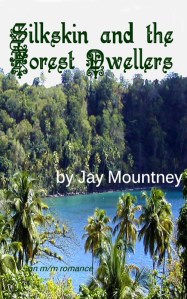
Some time ago I was very excited because I self-published my novella on Smashwords: Silkskin and the Forest Dwellers.The excitement died down when I made only one sale, after having the book free for a month and getting lots of (free) downloads. Obviously my marketing techniques are less than brilliant. However, this was primarily by way of experiment and learning and at least I got to grips with the self-publishing system.

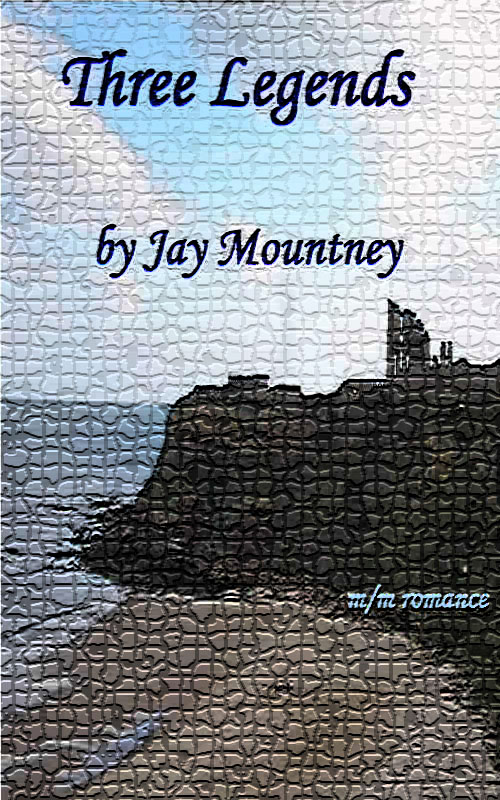
I have at last published two other books on Smashwords, another novella, Lord of Shalott, and a collection of three short stories, Three Legends.  I also published these, plus Silkskin, on Amazon. They have all gone ‘live’ although Smashwords hasn’t approved the new ones for distribution to sites like Apple yet. (That can take about a week.) So at least I have kept one of my New Year’s resolutions, which was that this was the year I would self-publish these three books.

Here are the links to my ‘author’ pages. On Smashwords, make sure you have the adult filter off. These are adult books with some mild erotic content.

http://www.amazon.co.uk/s/ref=nb_sb_noss?url=search-alias%3Daps&field-keywords=Jay+Mountney

http://www.smashwords.com/books/search?query=Jay+Mountney

I read a lot of self-publishing advice and I thought for ages about the marketing ploy of making Silkskin free, but it backfired. New titles get some interest but are quickly buried under a mass of other publications. By the time I set a price, interest had waned. So for the other two, there’s a charge from the start. I’ve kept them very cheap, and I’m hopeful. If they go well I might do some giveaways later, and meanwhile I do have some Smashwords discount codes (100%) to hand out to anyone who’s desperate or – and this  may be the main thing – willing to leave a helpful review. I can’t do that for Amazon – it’s free for all or none there.

I should perhaps say that I did everything – writing, obviously, but less obviously formatting and cover art – myself. You’ll realise if you read my last post that it was an arduous process and I’m quite proud of the results. It rather took over my life for the last few months and has been the reason I haven’t done much actual writing recently. Soon I intend to start on the formatting of a couple of my novels but at least I now know what I’m doing!

If you are interested, you can find the books on Amazon, or on Smashwords, under the author name Jay Mountney. You don’t have to be interested in the books themselves to comment here about my work on the formatting etc!! I’m always delighted to discuss those issues and ideas about cover art.

Apart from Silkskin, which was originally written for a fanfic challenge (yes, fairytales are a fandom, but of course there’s no copyright so the lines are blurred), the stories were not recent efforts. But they have been polished recently and I’m happy to have them out there as samples of my work.

Here are the covers for your entertainment, a little larger than they appear on the sale pages but not, of course, full size.

Surviving the Self Publishing Minefield

Last January I made a resolution. I declared that 2012 would be the year I finally got some of my work self-published in e-book format. In June I put one book (a short story) on Smashwords. For a variety of reasons, mostly my marketing failures, it did not do well once I set a price on it. However, I still wanted to keep my resolution. I was determined to do everything myself and spend as little as possible on the process. I am finally ready to launch two other books – another short story and a collection of three flashfics – on both Smashwords and Amazon. It has been a steep learning curve and I thought I would share the main aspects of it with you.

I have spent approximately six months researching and practising. I have read widely about the phenomenon of self-publishing. I have investigated the myths surrounding tax issues and ISBNs. I have wrestled with the great god Formatting. I have learnt how to construct a linked Table of Contents. I have grappled with new cover dimensions. I have explored and come to terms with Word10. It has been exhausting. I hope it has also been worthwhile.

I was amused to realise that learning all this has taken me longer than writing the three books in question. In one sense, of course, that is not true. I wrote the first of the three in 2005 and it has taken a long time to polish my work, to have real confidence in it and to decide to launch it on an unsuspecting world, a world that might well take little notice. But I have definitely spent more hours on the practicalities of publishing than I ever spent writing or editing. Thinking is harder to quantify, but the same probably applies.

So what have I learnt? I will summarise my new knowledge here and anyone who wants more detail on any of the issues is welcome to email me. I wish I’d had someone to guide me through the minefield. That isn’t to say that my friends haven’t helped; they have, enormously. That includes some of you. They have shared their findings, allowed me to use them as sounding boards (and occasionally to rant), and encouraged me. They have attended conferences and courses and passed on the notes. They have pointed me at websites, blogs and books. None of them had the full set of answers to my queries, and many of them subscribed to the ‘myths’. This is even true of Writing Magazine, which I tend to use as a handy reference guide. And I still have one query, which I will leave to the end.

1. Self-publishing. During the past year, the self-publishing industry has really taken off. Last Christmas was the first time people started talking about the way e-readers were taking over the reading public, and the traditional publishers started worrying. There will, I think, always be a place for traditional publishing, especially for reference books, art books, the books we call ‘coffee table books’, maps, some children’s picture books, some ‘comics’ and other publications that don’t lend themselves well to an e-reader, or even an iPad or laptop screen. But for the bulk of ordinary fiction, the e-reader is just fine. It is small enough to slip into a shoulder bag, or even a capacious pocket, it has a long battery life, it lets you carry a whole library of books on a journey or on holiday, and it suits the way people nowadays interact with the world. Most people are easily converted to using e-readers.

There are issues related to piracy and copyright that need to be solved, there are arguments over pricing structures and distribution, and there are other problems that will be dealt with and yet others that will arise. They shouldn’t worry the writer. The things the writer needs to worry about are writing and editing. The writing needs to be good if the book is to stand any chance against all the thousands of other books competing with it. The writing also needs to be well edited and proof read; readers are soon turned away by too many typos or misspellings, never mind other errors.

Self-publishing is no longer synonymous with vanity publishing. The stigma is disappearing very quickly as longstanding authors appreciate how much control they have over a self-published book, how much greater the royalties might be, and how long, in comparison with a printed book, their work remains available.The only thing the big publishers still offer is marketing, and I gather they don’t do a great deal of that. They also offer validation, but so do sales. So for the new writer, there is no reason not to try self publishing but I should stress that you need a good editor and beta reader to help you polish your work.

2. Tax Issues. I did a separate post about this when I got my EIN and was wildly excited. So many people told me I needed an ITIN which would have been costly and difficult. In the end, I got my EIN which exempts me from American tax, for the cost of a phone call to Philadelphia. I used Skype so the cost was negligible. Now all I have to do is download the W8-BEN form and send a completed and signed copy by snail-mail to Smashwords and to Amazon once I have actually sold some books. Again, postage to America. All told, the entire operation will probably have cost me less than £2.

3. ISBNs. Basically, you don’t need one for Amazon, which has its own internal numbering system, and you don’t need one for Smashwords. You do need one for some of the other retailers e.g. Apple, but if you distribute to them via Smashwords, Smashwords will very kindly provide you with a free ISBN – provided you click on the right box on your dashboard.

4. Formatting. This is much harder than tax or ISBNs though it doesn’t initially engender as much panic. You need:

The Smashwords Style Guide (free pdf)

Building your book for Kindle (free download; you can read it on Kindle for PC, also free)

Word. Yes, really. You can write in any program/word processor you like but you need a Word document for upload to Smashwords and Amazon. No exceptions.

Notepad This should be in your ‘accessories’.

Calibre. A free download that does a good job of converting things into e-book formats.

Patience. In really large quantities, probably accompanied by tea or coffee but preferably not alcohol as you will need all your wits about you and wish you had more – wits, that is.

Go through the guides, make sure you understand them, go through again and memorise as much as possible, go through again and make notes, and go through again just in case. Practise what you have learnt. Use text that doesn’t matter – I used some flashfics I was never going to publish. Add chapter headings, add italics, add a title, add anything you think you might want till you know the rules backwards. Use Calibre to convert your formatted text into ebook format and use either Kindle for PC or Adobe Digital Editions to check how things look. Learn from your mistakes and make notes. Then apply the rules to the text you do want to publish.

Something you need to learn quite early is that Amazon and Smashwords are not singing from the same hymn sheet. Most of the instructions are similar but the devil is in the details so don’t get over-confident. For both, however, it is worth applying what Smashwords call the ‘nuclear method’. Copy/paste your book into Notepad (which should be in your ‘accessories’) then copy/paste from Notepad into a fresh Word document that has had the formatting you want set up. This clears previous formatting and lets you start with a clean slate – invaluable. By fresh, I mean close Word down and open it again; don’t just start a new document.

Once you’ve done your best with the formatting you need to save two documents – well, more, because you need back-ups, but two types. For Smashwords you need a Word document in .doc format. For Amazon you have to save your text as a filtered web page. Make sure you get the right formatting saved in each kind… There are all sorts of pitfalls. Read your notes! Read the two guides again!

(If you’re considering selling your book from your own website, you still need to do all of this – then you can create a mobi version, an epub version, a pdf version and an html version – which should satisfy most needs.)

5.Table of Contents. You have to have one, even if you are publishing a single short story. You have to have a linked, navigable one. Why? Well, because e-books can have them, so retailers think they’re smart, so…  There are various options.

(i)Smashwords version.

If your work is a novel with standard chapters, you just give all your chapters the heading Chapter…. and Smashwords will create your ToC. You format your chapter titles using a heading style.

If your work doesn’t have chapters, maybe because it’s a short story or a collection of stories, you have to build the ToC yourself and this is as difficult as the initial formatting. You mustn’t use the heading style but have to creat a custom style for your headings.You use Word’s bookmarking and hyperlink functions and they can be seriously strange. Even when you’ve finished, your converted book (via Calibre) might show anomalies. This whole process is not for the faint hearted and has made me resolve never to write anything else that doesn’t have ordinary chapters.

There’s a minor query here. You are advised to add a link to your end notes ‘about the author’. I formatted the heading for that exactly the same as the stories I had put together, but in the final ToC the line ‘about the author’ insisted on centring itself even though all the rest of the ToC was left justified. I decided to leave well alone rather than risk having to do the whole thing again. Mystery…

(ii)Amazon version. You use the heading styles and then you use Word’s ToC generator, which you must not touch for Smashwords….

(If you’re selling from your own website you don’t have to go through all this but your readers might expect aToC so you could use either the bookmark method or the ToC method to produce one. Of course, they don’t work in pdf which has another system altogether but then any reader who buys a pdf isn’t going to expect a live ToC.)

6. Cover dimensions. Recently, both Smashwords and Amazon issued new guidelines about the size of the covers they expect. Smashwords have chosen to align themselves with the new standards set by Apple and by Barnes and Noble. Amazon just seem to be following the trend. The new sizes are approximately 1500×2500 pixels. Huge. The reasoning appears to be that as screens of all kinds get better and better the covers need higher resolution to look good. Whatever the logic  or necessity of this, new uploads have to follow the rules. There are a couple of problems. You might, like me, design your own covers, using your own photographs or free/cheap stock photographs and a cover generating service. You might use a cover artist and pay them to produce a design for you. Whichever route you used you might well have designed your cover or had it designed before the new rules came into being earlier this year. You or your artist might have been working while the editing and proof reading was going on. Or you might be issuing a new version of a book, with a new cover. The trouble is, your beautiful cover might have an original file source that is too small to look good in the new dimensions.

Smashwords warn against merely using a photo editing program to re-size because it can cause pixelation and a rough outcome. If you’ve paid an artist you might have to go back to them and pay them some more to fix things, which might be easy cheap) or difficult (expensive) depending on the originals they used. Or, if you did the work yourself, like me, you might have to spend a great deal of time… I even downloaded a trial version of a seriously posh and expensive editing suite which promised the earth and did not deliver anything better than I already had.

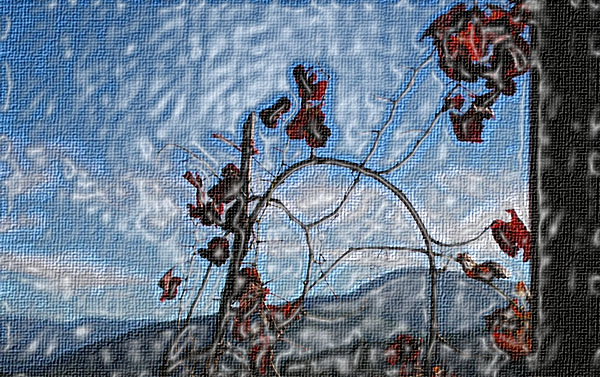
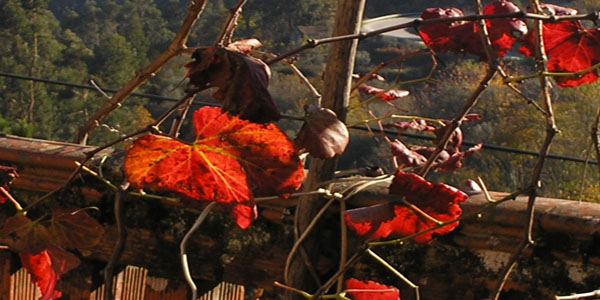
I use Photoshop  and Fireworks, and sometimes use online editing sites for special effects. I am a keen amateur ‘artist’ and enjoy designing covers, cards, icons, etc. I eventually found that if I used the filters in Photoshop I could end up with a re-sized picture that was slightly different from the original but which had no pixelation or strange halo effects round the fonts. That last point is quite important because not all fonts work well at larger sizes. There are a number of filter effects that work but the ones I liked best were mosaic tiles, and sandstone texture. In future I will make sure I start with a larger source picture and will only use filter effects for effects, not for hiding problems! The photo at the top of this post is taken from my bedroom window in Portugal, in autumn with vine leaves showing autumn colours, then the picture has been subjected to Photoshop’s ‘plastic wrap’ filter effect.

7. Word10. There are probably those amongst you who are perfectly happy with Word10. Spare a thought for someone whose computer crashed and who had to get used to Word10 overnight with lots of documents that were already written in Word 2003-2007, Open Office, or RoughDraft, and which had all undergone beta and editing and tranfer through different programs, different computers, and so on. I don’t normally write in Word because I like RoughDraft – I like its tab system, its notepad system, etc. etc. I don’t mind copy/pasting into Word once I’ve finished and of course Smashwords’ ‘nuclear method’ helps. However…

I have dealt successfully with almost everything but still have one serious glitch and would welcome advice.

Both Smashwords and Amazon advise writers to format fiction with Times New Roman 12pt,  indents at the start of paragraphs and no line space between paragraphs. Fine. In theory you can set normal style in Word10 to produce exactly this effect. It works, for new writing. But I can’t get it to work for anything that has been imported in block paragraph style from elsewhere. I get the first line indents and the correct font. The extra line spacing between paragraphs remains stubbornly in place. If I work in compatibility mode and use Word 2003-2007 as default the problem remains, even when the imported work was written in that form. My crashed laptop was recovered, and the only workaround I have found is to reformat the work on that  (in Word 2003-2007) – which happily removes the line spacing, then copy the work via a pendrive to my current laptop which accepts the new layout of the text with no problem. So what on earth is going wrong and how do I fix it? I’m wondering whether to remove all my documents that matter from the current laptop, use Word’s reset to default function, and start again but that seems drastic and in any case might not work. Has anyone ever had a similar problem and if so, what did you do? (Feel free to be reasonably technical – this is someone who can understand the Smashwords Style Guide…)

Now all I have to do is actually upload the books. 🙂

Unicorns

I have used unicorns as characters in my series of ‘fae’ novels. A few years ago I was looking for art to decorate the fae blog I was writing to expand my ideas, when I came across a website of unicorn illustrations and ‘information’. I got into online conversation with the site owner and ended up writing a poem for the site. The site is not actually to my taste – the unicorns there are too sweet and innocent – which is why I’m not advertising it here. But I thought you might like to see what I wrote. The piece is another series of haiku-style verses. I am, by the way, well aware that these are only a modern and western approximation of the haiku, and not true to the Japanese concept.

Unicorns at play 

In the moon’s white light

We play in our soft meadow

Dancing over grass.

Beneath the gold stars,

Piercing the dark of the land,

Our bright horns shimmer.

While the black clouds roll

Our manes flicker with lightning

And our hooves thunder.

At dusk in the trees

You may see a faint shining

Welcoming the night.

When dawn opens day

Our shadows might still linger

In a loving heart.

As you can see, I still haven’t persuaded Word10 to agree with me on line spacing, and by the time whatever I’ve typed reaches WordPress the spacing seems to be set in stone. I’ve tried retyping, to no avail.

October reading and viewing

Reading

10Oct P Ice, Wind and Fire***** – Mel Keegan. An excellent thriller featuring a pair of gay investigative journalists who are holidaying in Jamaica when they run foul of organised crime. Exciting, interesting and well written. Even the explicit sex scenes, which are frequent, were always carefully designed to further character development and plot. I borrowed this from a friend and was glad to be introduced to such a competent author.

 13Oct P Firewall*** – Henning Mankell. This is one of the Wallander series, made popular by two TV shows, one Brit, starring Kenneth Branagh, and the other Swedish but shown in UK with subtitles. I haven’t watched either but am assured that the Swedish version is better. I think the same might be true of the books. The plots are complex and fascinating, and the characters are well drawn but the language, I suspect, suffers in translation. Almost all the sentences are short and simple which gives a staccato effect. Occasionally two simple sentences are joined with a conjunction which comes almost as a relief. The plot, which centres around internet crime, must have been original and startling when the book was first written in 1998. Translation took ten years and was probably only undertaken in response to the TV shows. The story is no longer ‘cutting edge’ but is still very plausible.

16Oct P Death’s Head***** – Mel Keegan. Another exciting m/m romance, this time sci-fi. There were, for me, too many detailed battle scenes and these could have been cut without affecting the basic story, but I’m sure a lot of readers would be enthralled by the futuristic armour, weapons and strategies. A pair of ship captains are involved in policing drug running and riots  – one stays with the ship while the other goes undercover. They want each other but the service doesn’t approve of involvement that might endanger missions. When one is caught by the drug lords and forcibly addicted the other agrees to a permanent empathetic bond to save his friend. The results are fascinating. An unusual and interesting novel.

19Oct P Love Song**** – Charlotte Bingham. This was a traditional romantic tragedy with a helping of hope at the end. It was, in some ways, over sentimental but it was beautifully written and interesting from a point of view of studying the writing technique. It follows the dissolution of a marriage and the growth of a new love, with sub-plots detailing the lives of the adolescent children. I thought the epilogue was unnecessary and the few things it told us about the future could have been worked into the body of the novel, but apart from that I found the story gripping and could only admire the execution. It was also wonderful to read a book that had no typos or other infelicities. Not my usual choice of reading matter but I enjoyed it.

23Oct Before the Frost*** – Henning Mankell. Another Wallander story – I picked up three at a charity stall. I didn’t enjoy this one much although the translation was slightly better (or the original writing was…). At the end of the previous book I read, Wallander’s daughter is about to join the police force, and this book is written from her point of view. I found her a less interesting and sympathetic character than her father, even though the case revolved around some of her friends. The plot grows out of the 1978 James Town massacre of the Christian sect led by Jim Jones but the beliefs of the supposed survivor are not well explained.

28Oct Anguished English** – Richard Lederer. A book of idiotic abuses and misuses of our language by students, politicians, newspaper headlines, etc. Something to dip into rather than to read at one sitting.  I imagine that when it was first published readers split their sides laughing. The trouble is, so many of these readers have since shared their favourite quotations with the rest of us via ‘joke’ emails that the originals no longer raise a smile.

October in general… I have been reading some online zines, especially Beneath Ceaseless Skies. Each issue contains at least two short stories or a short story and the first (or second) part of a slightly longer one. From time to time the zine publishes an anthology of ‘the best of’. I loved the cover pictures and thought there would be plenty of sci-fi and fantasy. I was very disappointed in the contents. Most of the writing was pretentious and quasi-experimental. There seemed to be a ‘fashion’ for setting the stories in a pseudo-oriental world with the addition of magic. Altogether disappointing. I also read a couple of issues of Silver Shorts – free short stories by authors who publish with Silver Publishing, presumably intended to showcase and advertise their skills, and available to people who purchase from the publisher’s site. These were better, for the most part, than the Ceaseless Skies offerings, but were too short to appeal to me much – I like to get really into a story and settle down to enjoy it. The occasional ficlet can be entertaining but a diet of them left me feeling cheated.

I have also been spending a lot of time reading the stories in a fandom ‘big bang’ which is when writers and artists join to provide a diet of illustrated novellas spanning a month. As I was one of the authors I felt a need to check out the offerings of my fellow contributors and spent a great deal of October enjoying their work and entering into fandom discussion about it.

Viewing

11Oct A Very Long Engagement**** – French film about a girl searching for her fiancé – she does not believe reports of his death in the first world war. Exquisite filming and direction, and some good acting, but the film was long, dark and quite depressing, with gruesome footage about the trenches, so I had mixed feelings about it. However, I had wanted to see it for ages, and am glad I eventually did.

19Oct Taken*** – Liam Neeson as a CIA operative rescuing his daughter from sex traffickers. I kept getting distracted (this was on TV) and followed the main story but never got truly involved.

23Oct  Bride and Prejudice** – The Bollywood version of Pride and Prejudice. I have heard about this film for ages and finally rented it from LoveFilm. It crashed, twice, and the second time, I gave up, because I wasn’t particularly enjoying it anyway. I find musicals tend to bore me, Hollywood, Bollywood, or otherwise. The plot adaptation was clever, but didn’t live up to Miss Austen’s standards. The acting was mediocre. So I haven’t actually watched this film to the end, but I can imagine the ending because I know the original story so well.

25Oct Priscilla-Queen of the Desert*****- some excellent acting. Terence Stamp was amazing as Bernadette. I loved seeing parts of the Australian landscape again, and the plot was endearing. I had heard of this film but never seen it, and LoveFilm sent it quickly as compensation for the breakdown of Bride and Prejudice. I enjoyed it. I wish I had seen it before I saw the play Ladies Down Under at the theatre (which a friend produced) because I now realise that the play was in some senses a kind of homage to the film. I think the cross references would have been fun to recognise at the time. One thing I hadn’t known in advance was that the Priscilla of the title was a bus.

31Oct Going Postal*****. This is the third in the Terry Pratchett DVD trilogy of films my sister-in-law bought me last Christmas. I absolutely loved it and found it really exciting even though I have read the book and knew perfectly well that the hero was going to survive. Well, I thought I did, because of course Terry himself endorses these films. But it’s a measure of both the original story and the film version that the ending is truly gripping. The filming is superb, with wonderful attention to detail in both the locations and the ‘machinery’, and all the acting, from a host of well-known names, is great. David Suchet, for example, makes a fantastic villain, and Charles Dance is convincing as the enigmatic Lord Vetinari. Highly recommended, and one I will re-watch.

Wheee! I have an EIN.

I am feeling really good today. I finally managed to get an EIN number for US tax exemption. I blogged about the problems ages ago and Martyn Halm was kind enough to point me at a fantastic WordPress post by Catherine Howard and David Gaughran, which explained how to get an exemption number with little hassle and at almost no cost. The only drawback was phoning a US number and risking being put on hold for ages, sending our BT phone bill sky high. Then my daughter bought me some headphones with a microphone for my birthday, and I downloaded Skype when I realised it could be used to phone landlines. Even then, I was reluctant to do anything. Smashwords have only sold one copy of my short story so the world wasn’t going to end if I didn’t get a tax exemption on it. Amazon didn’t seem prepared to let me open a publishing account without a number, and without an account I didn’t feel inspired to investigate formatting any further, so everything ground to a halt. However, my daughter was nagging… I made copious notes from the helpful blog and associated comments, and took a deep breath. Everything was finally in place.

It took ten minutes at a cost of 20p.

It is totally amazing to me that I now feel able to tackle the formatting and publishing hurdles. The tax issue was clearly affecting me more than I realised. Amazon publish a formatting guide (Building Your Book for Kindle) and the latest edition is evidently intended to wrestle with Word10 so I have hopes. It is a Kindle book, so not as useful for search/research purposes as the .pdf version which is available to customers in US, but I’m sure I can make notes as I go through it.

Feeling more confident about the technical side of things has made me feel more inclined to write. I was restricting myself to creating fanfic whilst I thought publishing was out of reach.

For anyone reading this who wants to know more about EINs or who has friends who are asking, the blog post that changed my life is: http://catherineryanhoward.com/2012/02/24/non-us-self-publisher-tax-issues-dont-need-to-be-taxing/

Stumped by software

At the beginning of October I had a severe laptop crash. Everything on my Compaq froze and so far as I know is still frozen. A family member who is an IT expert has taken the offending machine away but has not as yet had time to look at it. Meanwhile, a friend had recently refurbished my old Vaio so I am not actually divorced from the internet.

The good news was that I was able, in safe mode, to rescue all my documents, photographs, music, etc. to an external hard drive. I have been frantically backing up everything to other places just in case the hard drive fails….. But for the time being, all is well.

The bad news is twofold. The Vaio no longer works with a battery and has to be plugged into the mains which means that it isn’t exactly portable. However, I can cope with that for the time being. The software is the major problem. First of all, I am missing most of my software and only realise when I want to use it. At that point I have to use the admin user setting – something I’ve never had to deal with before but which was set up to give an option of more than one user on the machine. So far, I have resisted downloading any photo-editing software and have decided I can manage with online photo-editing sites. I enjoy tinkering with my pictures but I am not a serious graphic artist! I am also missing my bookmarks, which I hadn’t backed up recently… And I miss my beautifully configured Calibre library though I can re-establish it (if it can’t be rescued) once I know whether I can use the Compaq again or whether I should consider buying a new laptop – the Vaio will only ever be a back-up machine because of the battery issue.

My main gripe and the subject of this post: the refurbishment involved taking the Vaio back to factory settings and then installing programs again. For some reason – presumably with the best of intentions – our friend installed Word 10. I am now foaming at the mouth and cursing Microsoft. I was happily using the pre-2007 version of Word and had spent absolutely ages getting used to formatting. I had made copious notes and really thought I had a handle on it all. Word 10 is quite different. Apart from anything else I have to remember to save things in .doc instead of .doc.x or half my friends can’t read them and they aren’t suitable for various purposes., including transfer to my Compaq if that becomes an option. Then, I carefully removed all the auto formatting , changed the default font etc. and heaved a sigh of relief. But I am still having problems with line/paragraph spacing and in a final document all looks well until the text is converted into e-publishing formats whereupon spaces at the end of chapters turn into capital As with accents over them. Is Microsoft insane? I understand their desire to cater for business needs but templates should deal with that and leave the rest of us able to format easily for self-publishing purposes. And even for business documents, it must be irritating for those who keep their files on their Kindles to find strange As all over the place!

I downloaded OpenOffice – and yes, I know it’s less than optimal for self-publishing but I wanted something that would let me at least do posts like this with no problems – but the latest version seems to have copied Word and inserts far too many line spaces.

The trouble is, I don’t really want to spend hours on this, when it’s possible I might get my old system back… Everything is already taking longer than usual, which is why I have been somewhat absent this month.

Meanwhile – do any of you know of any formatting guides that help with Word 10? The Smashwords Guide is brilliant but doesn’t have much to offer beyond Word 20007. And what would anyone recommend if I get a new laptop – are there cheap copies of earlier Word versions available or should I try to adapt myself as soon as possible?

Symbiote – poetry

I recently posted about fanfic and thought I would share with you a poem I wrote as a gift for a fellow fan. The fandom, for those of you who are not sci-fi lovers, is Stargate SG1, in which a race of symbiotes tries to take over the universe through all the humanoid races it can find. I chose the photo of one of our Portuguese lizards to complement the reptilian nature of the symbiotes. The poem is a sequence of linked haiku-style pieces.

Symbiote.

Whenever bipeds

Step through the liquid circle

We have to wonder.

Will we symbiotes

Emerge intact or might our

Slender forms be changed;

Submerged in the flesh

Of our imprisoning slaves?

But still we travel.

Needing to conquer,

Defying space and logic,

We quest to survive.

Perhaps if they knew

Our needs truly, our hosts would

Close the gates firmly.

Keeping separate

Their lonely planets they could

End our dominance.

Without the journeys,

(Despite the risk of changing),

We would surely die.

I have been somewhat MIA recently – the problem has been a crashed laptop and time spent trying to get to grips with a refurbished old one, with an unfamiliar operating system. This also explains the annoying formatting that seems to have invaded my poem – I have so far been unable to get rid of the double spacing within the verses, which was not present in the original document.