The dam that didn’t break.

(This is a photo taken from a television account of the affair.)

The eyes of UK, and probably of much of the world, have been on Whaley Bridge where the dam on Toddbrook Reservoir threatened to collapse. If it had, the town would have been washed away, not just flooded.

Our eyes have been totally glued to the news. Whaley Bridge lies only a few miles from our house, and we have friends there. In fact, during the near-disaster we were looking after some dogs for friends who live in Whaley Bridge but were on holiday in Brazil. Their house, like those of others we know, was perfectly safe, being uphill of the reservoir, but they were watching the news from Brazil, and watching our FB posts with my husband’s photographs which charted some of the events.

Whilst there was total panic (or so it seemed) about what might happen downstream in the valley of the River Goyt if the dam broke, we weren’t personally threatened as our house is well above any potential flood level. However, we were very much affected by the entire affair. Roads were closed – sometimes arbitrarily, we all thought – and we had difficulty accessing the garage that looks after our cars. Bus routes were diverted, the Manchester-Sheffield rail line that goes through Whaley Bridge was closed, and you can imagine the knock-on effects on the whole area. Traffic chaos, rumours, and a lot of disbelief.

We had always known the dam was there, of course. But whoever allowed people to develop the little town on Whaley Bridge below it must, we thought, have been convinced it was all safe. Even now, with the reservoir empty and all danger averted, it seems foolhardy to drive along the main street, but it really is necessary at times! (For example, returning the dogs to their family…)

We have since seen short video footage of various local roads including some of the ones up in the hills; they were turned into rivers and will be needing repair for some time to come.

The reservoir was built by the Victorians and was intended to feed into the lock system for the local canals. We know a couple of people with narrow boats who were affected by the lock closures. Admittedly this aspect of things was ‘trivial’ in that it only affected leisure activities but it still added to the general regional disruption.

Obviously the people of Whaley Bridge who were evacuated were the ones who suffered most, and our hearts went out to them while we watched the weather forecast and hoped against hope that the reservoir would be emptied before further downpours. We had some sympathy for some people who refused to leave – apparently there was confusion about their animals and whether they could also be evacuated.

The army, police, fire service and lots of volunteers did a wonderful job, and in the end, the disaster didn’t happen. That was a matter of luck. Panorama (BBC) is currently filming interviews for a programme with a focus on Whaley Bridge but looking at a lot of UK reservoirs and dams. Let’s hope we don’t get any repeats of this summer’s events!

‘Why I write’ meme adapted for original works.

I promised to adapt this set of questions for my original work so here it is.

1 What made you start writing original stories, poetry, etc?
My first ‘work’ was a play performed by our local Brownie troop. I was five, and because I had written it I was allowed to join the big girls and be onstage. I think this must have gone to my head… I continued with plays, poems and stories until I left uni. Working as an English teacher meant producing work as a ‘role model’ for pupils, and I had neither the time nor the creative energy left to write anything else. When I took early retirement, one story was already in my head so I was itching to get to the keyboard.

2. Which of your own works have you reread the most?
I think sections of my Living Fae series. The story started in a ‘muse’ journal on LJ and by the time I decided on publication it needed a great deal of collection, collation, and decisions about what to include. As a result, I read and re-read various parts till I almost knew them by heart. At first, they were a pleasant surprise as I’d forgotten quite a lot. Later, I just wanted to get them sorted out and sent off to my editor.

3. Describe the differences between your first published work and your most recent.
When I decided to self-publish I used two novellas and a collection of three short stories as ‘practice’. So they were comparatively short. They were all based on legends and fairy tales, twisted into fresh forms. I was lucky enough to have seriously good editors and I learnt a lot from them.
My most recent publication was a short story – a contemporary romance. I wrote it some time ago, initially for a prompt in a writing group then, in a longer and edited version, for inclusion in a now defunct online zine. I decided to publish it myself and it went through a further editing and formatting process until I was satisfied with it. It has no fantasy and no connection with fairy tales.

4. Do you think your style has changed over time? How so?
I think and hope I use different styles depending on the kind of story I am telling. For example, my novella The Lord of Shalott, and the first volume of Living Fae are told in first person. I write novels, novellas, short stories, flashfic and poetry. I also write reviews and critiques. Obviously I need to use varied styles for all these. I don’t think my style has changed much in recent years; it has changed since I was a teenager, of course, but that’s to be expected.

5. You’ve posted a work anonymously. How would someone be able to guess you’ve written it?
As I said in the fanfic meme with the same questions, I once did this when the online writing group suggested we all write a flashfic in the style of my Living Fae material. Nobody was able to guess who had written what; I assume part of the reason was the choice of similar subject matter, characters, etc. Beyond that experiment, I can’t think how anyone would guess I had written something unless I included locations that people who know me know I’m familiar with.

6. Name three stories you found easy to write.
No real answer to this.

7. Name three stories you found difficult to write.
All writing is easy for me. It’s the editing, proof reading, formatting, etc. that causes headaches.

8. What’s your ratio of hits to kudos?
This was a fanfic question and I assume I need to consider ‘success’ as a writer. The world is drowning in self published material and I am not alone in sinking without much of a trace. My royalties about keep us in pizza and we don’t eat that every week. They also cause intense irritation to me when my tax returns are due. Most people who both like fantasy and actually find my books are complimentary, but too few find them! The same applies to my fanfic and I think the bottom line is just that I’m completely hopeless at marketing.

9. What do your fic bookmarks say about you?

Another fanfic question (specific to AO3) so I’ll refer to my to-be-read list instead. I read widely and voraciously, and at any one time you’d find mainstream novels, genre novels, short stories, poetry, and non-fiction in the queue. I think it just says I like reading! I also keep a record of e-books I’ve read, partly to stop myself re-purchasing them and partly so that I can recall the titles and authors to recommend to other people. That list says I like history, fantasy, mm romance, crime, biography, science (especially the natural world), finance, politics, and cookbooks.

10. What’s a theme that keeps coming up in your writing?
Culture clash, which is something that interests me.

11. What kind of relationships are you most interested in writing?
I have a tendency to focus on mm romantic relationships, though not to the exclusion of anything else.

12. For E-rated fic what are some things your characters keep doing?
I will assume we are talking about books that would be suitable for general audiences. That means my Skilled Investigators series, and as the name implies, the characters keep finding crimes and mysteries to investigate. Other than that, like anyone, they eat, sleep, talk, etc.

13. Name three favourite characters to write.
1. Harlequin, the main character in Living Fae. I call him my muse and he lives in my head and tries to influence all my writing.
2. Genef, the main character in Skilled Investigators. She is training as a detective and I like both her attitude to her work and her ability to question herself. She doesn’t live in my head, and although female, has almost nothing in common with me.
3. Scratch, the dragon who helps Genef in Skilled Investigators. I love writing from a dragon’s point of view, thinking how he might see human and elf behaviour and what he might say about it.

14. You’re applying for the [fanfic] writer of the year award. What five works do you put in your portfolio?
I’d have to think about things that are published somewhere, including my WordPress site. My work wanders around between genres and I don’t think they’d ever be regarded as award material for original writing. However, if I had to put together a selection:
1. Lord of Shalott: a novella set in Arthurian legend and inspired by Tennyson’s poem The Lady of Shalott.
2. Growing up Fae: volume 1 of Living Fae, told in journal form by Harlequin, a modern fairy living on Alderley Edge in Cheshire.
3. Answering Amanda: a children’s story based on Harlequin’s little sister’s letters to a human child. This is ready to send to anyone who asks for it using the information at the end of volume 3 of Living Fae. It was, in fact, the springboard for the entire world/series.
4. The Zoo: one of my poems, based on an actual day at Chester Zoo. It’s on my WordPress site. I might create a volume of poems to put on Smashwords; poems always get more ‘likes’ than anything on WordPress.
4. The Scroll: volume 1 of The Skilled Investigators and the one that introduces Scratch, the dragon.

Why I write fanfic.

A friend (on Dreamwidth and in real life) posted a meme about her fanfic writing. This inspired me and I promised to do my own. I also intend to adapt the meme for my original writing.

1. What made you start writing fanfic?

My daughter knew some of my tastes in books and linked me to a Yuletide story in Arthurian Legend. At about the same time I was asked to teach an upper primary class English Language using Tennyson’s Lady of Shalott (note this was a language class, not a literature one). I was annoyed with the national curriculum approach to poetry and felt able to write to the same standard as the Yuletide fic so I wrote Lord of Shalott which I originally posted as fanfic. A lot of editing and additions later it turned into a self-published novella… I was already writing original work but was panic stricken at the thought of submitting to editors. The Lord of Shalott enabled me to try putting my work ‘out there’ and to explore self-publishing. Once I’d started, in both original and fanfic writing, the floodgates opened.

2. Which of your own fanfics have you reread the most?
I don’t usually re-read my fanfics unless I need to refer to something in a series and then I just skim or do ‘find’ (with no ‘replace’). I have re-read First a couple of times when people have asked to quote from it.

3. Describe the differences between your first fanfic and your most recent fanfic.
Lord of Shalott was historic fantasy, inspired by a poem. It was written in first person, it had a focus on cross-dressing, it referenced various myths and legends and it involved a longing for a relationship. My most recent work (other than some meta and drabbles) was …to catch a thief, a mediaeval AU for a cop buddy fandom (Pros), where I wrote part 1, a friend wrote part 2, we co-wrote part 3 and part 4 was my most recent fanfic. It had an established relationship (from the first three parts) as the focus and was a mild mystery story, told in third person. So although both were ‘historical’ fics they had totally different inspiration and were in different fandoms. In the first, I needed to echo the tone of the poem, and in the second I needed to capture the voices of the modern actors.

4. Do you think your style has changed over time? How so?
I use a number of different styles and I don’t think there has been any particular change over time. I try to alter my style to suit the canon I am writing for, but I know some of my work will be recognisable anyway.

5. You’ve posted a fic anonymously. How would someone be able to guess you’ve written it?
I tried this in a writing exercise I did in a Yahoo writing group – we all wrote a fanfic of part of my Living Fae series. Nobody was able to guess immediately which effort was mine. Presumably the others were attempting to copy my style!

6. Name three stories you found easy to write.
The first version of Lord of Shalott just poured out of me, probably fuelled by anger at the way we were supposed to ask children to view poetry and literature. The result wasn’t actually suitable for young children but that’s beside the point.
…to catch a thief was easy, too, because all the period research was already done for the first three parts and all the names etc. were in my head.
The Thing (SGA) was easy because I just went with the prompts people gave me and didn’t have to think about the story in advance.

7. Name three stories you found difficult to write.
This is an impossible question because I don’t find writing difficult. Editing, yes, research, yes, and proof reading, yes, but not writing. I sometimes find it difficult to motivate myself to start a story but that’s a different matter.

8. What’s your ratio of hits to kudos?
I haven’t the faintest idea. I vaguely know which of my fics get most hits and kudos and it seems to be linked to the general popularity of the fandom. (LotR and Grimm). Beyond that, I don’t know and the idea of trying to work it out dismays me. Besides, why would I?

9. What do your fic bookmarks say about you?

I usually bookmark a fic if I want to recommend it. I don’t have private bookmarks as a rule – I either subscribe to an author or series, or I download something I want to read eventually and it lurks on my hard drive. So I suppose my bookmarks say I’m a reviewer. They also show I’m extremely multi-fandom.

10. What’s a theme that keeps coming up in your writing?
I suppose mm romance.

11. What kind of relationships are you most interested in writing?
It varies with different fandoms. I quite like relationships that grow slowly and involve a lot of banter. I also like the kind that connect with a lot of minor characters, both canon and OC.

12. For E-rated fic what are some things your characters keep doing?
I had to Google this and I gather it means gen fic. I don’t write much of this and if I did, I hope my characters wouldn’t keep doing anything, other than sleeping and eating… I suppose they’d talk? I like writing dialogue.

13. Name three favourite characters to write.
Another impossible one. I’m too multi-fandom to have favourites. I should think my favourites are the ones I’m writing at the time.

14. You’re applying for the fanfic writer of the year award. What five fics do you put in your portfolio?
I wouldn’t apply, but if I had to, on pain of death or losing thbe right to be considered a fanfic writer, then:
First (Rome)
Blame Daniel (SG1)
The Morning Gift (Pros AU)
Elegy for a hanged man (Spooks)
Paths of the Living (LotR)

Things I dislike in books, films, etc.

I thought it was time, as a reviewer, that I posted about the things I dislike in books and films (including TV); the things that throw me out of a story, the things that make me abandon a book or a series and the things that stop me buying. Some of the following might result in a bad review. Some might prevent purchase. Some are just a warning sign and I might like a book despite their inclusion. Some are very personal dislikes and don’t say anything about the book or film. But you deserve to know where I am coming from! In alphabetical order:

* Bad language in the sense of curses and similar.
I know it might be realistic, but when it’s constant, I can’t read or listen to it. Recent examples include The Wolf of Wall Street who used f…g as every other word, and Dominus, a novel about ancient Rome that had so many curses and uses of ‘s..t’ that I just couldn’t carry on. We all use expletives from time to time but most people, particularly people with even a modicum of education, reserve them for important issues (like hammering your thumb…) and I think constant usage diminishes their impact in real life and is bordering on unlikely in scripts and novels. At any rate, I thoroughly dislike it.

*Bad language in the sense of poor grammar, spelling, etc.
I don’t mean typos though those annoy me when they come thick and fast.

I do mean the misuse of vocabulary where either the author either hasn’t a clue what the right word is, or cravenly believes their wordchecker’s correction.

I also mean the dizzying switching of tenses or points of view within one section of text.

I mean, too, the frequent use of poor punctuation (which a wordchecker would soon put right). (Punctuation should make a text easier to read.)

I mean, in addition, the frequent use of things like ‘er’, meant, I think, to add verisimilitude to speech but actually just making it hard to read. (When we listen to someone who hesitates we ignore the hesitations, but that’s harder when they’re written down and we are forced to process them.)

I certainly mean poor grammar – not what Word’s spag checker regards as bad grammar but what the average English teacher means. As an ex-English teacher, I am always annoyed by it and it almost always throws me out of the story and ensures I won’t return to the author. I’m aware that grammar isn’t every writer’s strength, but that’s what editors are for.

*Forced comedy
I hate comedy that seems to be telling me I must laugh. I am highly amused at some jokes, cartoons and situations but I rarely enjoy stand-up comedians or comedy shows, I often have to switch off if there’s canned laughter, and I don’t enjoy books that employ similar techniques. I realise I’m in a minority here! My sense of humour tends more towards irony than banana skin slips. I say ‘tends’ because there are exceptions but they’re few and far between.

*Fundamental objections.
It should go without saying that I don’t appreciate any attempt to ‘sell’ me racism, sexism, or fundamentalist religion of any kind in the guise of fiction. I actually binned a couple of children’s books given to my daughter with these themes, because I wouldn’t let her read them till she was old enough to ‘see through’ the message (by which time she wouldn’t enjoy the stories) and I didn’t want to be responsible for unleashing them on others via a charity shop. Not quite book burning, but yes, a kind of censorship. I would, of course, defend the right of the writers and publishers to produce these, but at the same time defend my own right to decide not to have anything to do with them and to discourage others.

*Insistence on using experimental prose.
I appreciate that some people think this is clever, and certainly it isn’t something that is actually wrong. It just strikes me as pretentious and annoying, whether it’s done by a Booker prize winner or a fanfic writer. For example, Hilary Mantel does it in A Place of Greater Safety – the whole style changes from chapter to chapter, with some of it reading like a TV script, and some like a history book. Irritating.

*Plot devices that are almost guaranteed to make me abandon the book or film.
I personally dislike stories that are told from the point of view of the villain or criminal. I feel cheated, because I enjoy crime stories where I try to work out ‘whodunnit’ or how they did it alongside the detectives.

I dislike ambiguous endings unless there’s a sequel in the pipeline, though obviously I won’t know till I reach the ending and just end up feeling furious.

The same goes for endings that are not consistent with the story and seem to be a kind of ‘how on earth can I end this’ attitude on the part of the author. As a teacher I used to dislike children’s stories that ended ‘and then I woke up’ or ‘and then I died’ and I find adults have similar tendencies at times… I think the worst book I read was one that was a crime story which ended abruptly. Apparently the author died and friends got the book published as a kind of memorial. The reader could be pretty sure who the criminal was, but there were so many unanswered questions I wanted to throw the book in the trash – some memorial!

*Plot holes.
I know some of these are probably not even noticed by the writer till after the book or film has gone public. They should have been noticed by beta readers, editors, etc. Oddly, I have seen more of these in books published by mainstream ‘big’ publishing houses than in genre fiction or fanfic. Maybe a lack of beta readers and discussion groups?

*Serious anachronisms and cultural errors.
I’m not talking about using modern language when the story is about e.g. ancient Rome. That makes the writing more accessible to the modern reader and unless the writer is going to write in Latin (and even then, Latin changed, as all languages do) it’s not something that worries me. Linguistic anachronisms do ‘throw’ me; the use of slang terms should be always be carefully researched. It’s no good using modern language for a book about e.g. mediaeval society and including slang that is obviously twenty-first century in origin. Yes, the mediaeval people would have used slang, but unless it is very carefully done, the text shouldn’t really include it. It’s easy to say something like, ‘he cursed roundly’ rather than have him saying ‘Shit’. So should the correct usage of period phrases be researched – like ‘methinks’ or ‘prithee’ though I really wish writers wouldn’t use them at all. Film makers can just about get away with it if they’re staging Shakespeare…

One type of anachronism that infuriated me was in a book that purported to be about the mediaeval popes and their families. A party was described and the meal ended with chocolates with exotic fillings. I instantly distrusted all the other historical research the writer had done.

Similarly, books by e.g. American writers who clearly have a foggy grasp of Brit geography, customs, or conversational norms annoy me, as do Brit books that play fast and loose with American (or any other) culture. Whilst I don’t think the exhortation to ‘write what you know’ holds water, I do think a writer should ‘know what they write’ which is a different thing and assumes writers do their research meticulously. I don’t think a writer who sets their work in the past or in a foreign country needs to be an expert, but they should make sure they don’t make glaringly obvious errors. Also, I am more likely to be annoyed if the blurb or the notes about the author try to suggest expertise.

Even fantasy or sci fi needs to be grounded in some kind of reality. I once abandoned the notion of having two moons on a world when I realised I would need to alter all references to tides, seasons, etc. Fairies and aliens work best when they follow ‘laws’ made clear in the story and not random ideas that have appealed to the author as pretty or interesting. If it’s a truly alien or alternate world, it needs internal consistency and sensible natural rules.

*Things I am less keen on but will try.
I am a lover of fantasy but I am not at all keen on books where the main character ends up crossing into another world or reality. I have read a few where it worked, but it’s not my favourite genre.

The same goes for time travel where I find it hard to suspend disbelief.

Mpreg is only acceptable for me if there’s a sensible scientific explanation e.g. an alien race with fluid gender roles, an experiment on humans, an alternative universe where this is the norm.

I am less than fond of vampires (I have read some good ones but hate Anne Rice…), the invasion of earth by monstrous aliens (they need to stay on other planets where the likes of SG1 or SGA can deal with them), and most m/m/f menage tropes. I am also reluctant to read about either zombies or superheroes. I think I like my protagonists to be flawed and human or ‘normal’ within their non-human community.

*Too much explicit sex.
I have no desire for a return to the ‘fade to black’ fashion of writing, whether the romance/marriage/hook-up/whatever is m/m, m/f, f/f or any permutation. However, I want the sex scenes to further either the plot or the character development. If they appear to be merely there for titillation, I skim them, and if they appear too often or are too long, I usually abandon the story. I don’t find the ‘tab A into slot B’ approach to sex scenes hot, in the least, just boring. I am much more interested in the emotions engendered by the sex (or lack of it). Some of my favourite romances don’t get the protagonists into bed until near the end of the story.

*Too much explicit violence.
Although I enjoy crime books and thrillers, I don’t particularly want battle or gore dwelled on lovingly by the writer or the film maker. I tend to skim or look away if any kind of violence lasts too long, and complex battle scenes pass me by in a blur. This probably explains my own difficulties in writing such scenes, even short ones, and I do realise they are sometimes needed to further the plot, but that doesn’t stop me hating them!

Also, while I will read some BDSM, I personally can’t cope with kinks involving things like blood, enemas, excreta, etc. The sex doesn’t have to be vanilla but I have personal limits though I understand that they really are personal and that violence and gore may appeal to some readers and can be well written. Also, I will read about darker things if they are essential to a crime investigation but still don’t like them described in too much detail. For instance, I can read about a detective seeing the aftermath of violence or even a pathologist finding out what happened, but don’t want a blow-by-blow account of the killer’s actions as they happen.

*Too much purple prose and too much description.
Descriptions are all the better for being sparse. Adjectives are overused by a lot of writers just starting out – maybe a hangover from their schooldays when they were encouraged to use too many, presumably to increase their vocabulary and add at least some interest to whatever they were producing.

In a novel, over-description jars the reader. Even world building, which is essential, is better done in very small increments with a lot left to the imagination. We do not need to know every detail of what every character (even minor ones) is wearing, and nor do we need an estate agent’s description of a building or its surroundings. Too many modern writers seem to think that descriptions of clothing will introduce characters to their readers. Actually, for me, it doesn’t work. I am so hung up on trying to visualise the dress, shoes, etc. that it’s hard to get back to what is being said or done. When I meet someone in real life I rarely notice every detail of their outfit though I might focus on a particularly attractive tie or scarf and on a general colour scheme. So I don’t expect to be forced to concentrate on itemised clothing when I meet a character in text, either. (I really don’t need to know what a detective is wearing at the scene of a crime, though it might be more relevant if he has to work under cover.)

Film makers are better in this respect. They get someone to make sure the costumes and location are perfect then just let them speak for themselves to the viewer. Basically, we would notice if things clashed or were not true to the period (which might actually be important if the character liked them that way). Otherwise, we can just leave them in their proper place, the background.

*****

It might seem surprising, in view of the above list, that I find so many books and films to love! That just means there are some seriously good writers and directors out there and they make me very happy indeed.

Book covers I have liked.

A friend and fellow writer on FB tagged me to do a meme. The instructions were to post seven book covers that you liked or were influential in your life, with a brief explanation, then tag other writers to do the same. This was to take place over seven consecutive days. Apart from the problem of getting my head around logging in and posting every day, which, incidentally, I managed, I was a bit worried because I lost a lot of my favourite or most important books in our fires in Portugal, and had to do a lot of googling to get approximate versions of the covers I wanted to use. It was hard to choose the covers. A lot of the books I read early in life had plain covers, and I can’t quite remember when modern covers became the norm. Also, I might like a book but not the cover, or vice versa. I decided to go with the first seven that pushed their way to the front of my mind. I thought you might be interested, so here they are. Obviously, if you read the FB posts you can now stop reading this!

********************

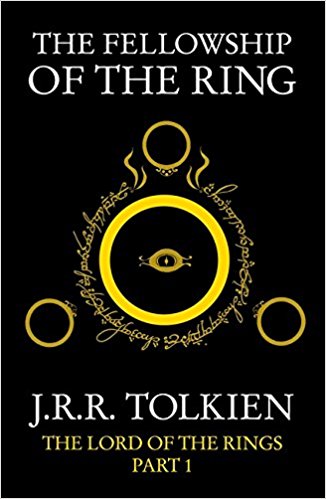
My first cover is of The Fellowship of the Ring, the first part of Tolkien’s trilogy. I ought perhaps to say that most of my books as a child and teenager had plain covers – often faux leather or the Penguin coded ones – and this came as an intriguing surprise. My own copy looks like this but is grey with black, white and red; I don’t currently have a scanner and Amazon don’t apparently have the old version. The elvish script and the way the shape reflects the title, the hint of exotic lands, heroic deeds and a group adventure – these all appealed to me as soon as I saw the book. I had no idea in advance what it would look like – a school friend had recommended it and I requested it as a Christmas present. It is a gift that has kept on giving, as I have read it numerous times, and have referred to the maps and notes when reading The Hobbit and after watching the films. My son-in-law assures me that if I hadn’t actually read my copies of the books they would now be valuable. They are valuable to me, in any case!

My second cover is perhaps a cheat. I have lost my copy, so even if I had a scanner I couldn’t scan it. So I looked on Amazon, in vain, and then googled images. This comes nearest but is not quite as I remember it.
George Macdonald’s The Princess and the Goblin was written in 1870 but still appealed to me when I came across it in the 1950s. The cover hinted at the themes of good and evil, of a child learning about hidden things, and of magical beings. I know my cover had the ‘fairy godmother’ element, and was, like this, a plain cover with a picture superimposed – actually stuck on – in the centre. I’m not sure it was exactly this one; I seem to remember more blueness.
I enjoyed the book and its sequel, The Princess and Curdie. I was never encouraged to read ‘fairy stories’, though perhaps this one was an exception because the author originally published it in a Christian magazine. This may or may not explain my current addiction to fantasy and all things fae! Anyway, I loved the story, though not really for the ‘good and evil’ aspect that the author was perhaps trying to emphasise. I loved the idea of the hidden world of goblins, of their possible interaction with ‘reality’ and the idea that an ordinary girl, albeit a princess, could be introduced to that world. I loved the cover, partly because of liking the contents, but also for its promise of secrets. It’s a precursor of stories like Mary Norton’s Borrowers and Pratchett’s Truckers for younger readers and CJ Cherryh’s Goblin Mirror for adults. It also echoes a variety of traditional tales such as the one about the elves and the shoemaker. I was, I remember, reminded of AA Milne’s Christopher Robin poem about the brownies who might have lived behind the nursery curtain.

Day three. My choice of cover is The Warden by Anthony Trollope. It is, of course, the first in the Barchester Chronicles, a series I loved before the BBC found it. I like the way this cover shows me a picture of rural England and suggests I can enter it and get to know the people and places in the books. It doesn’t try to impose a portrait of any of the characters, either from an artist’s imagination or from a film version, but lets me create them in my own mind. I originally borrowed the books from a friend and from the library, then my daughter bought me a set, (none of which had this cover). In any case, my copies were lost in the fire.
I enjoy the slow unfolding of Barchester life with its sense of place, the gradual character development, and the way the stories never follow traditional tropes or paths but grow out of the characters and their surroundings. I think I prefer Trollope to Austen, though it’s a close call. At any rate, I prefer both to Dickens or Eliot at least partly because there is less high drama and more recounting of gentle individual joys and sorrows. I like nineteenth century novels with their measured pace, so at odds with present day ideas of story-telling. I like modern novels too, but variety is good!

My fourth cover has to be The Colour of Magic by Terry Pratchett, the book that introduces the Discworld series. Paul Kidby’s covers (to the whole series) complement the stories. Both the illustrations and the stories are detailed, funny, wise, and refreshing. They teach us about ourselves and our world in the guise of fantasy tales and pictures, and repay frequent visits! I had all the books and have rescued some. I also had a calendar of covers which might still be around, buried in a box. I love looking at the pictures and finding the characters mentioned in the story. Needless to say, I love the books, too. I love all their covers and have just chosen this first one to represent the rest.

For the fifth day I’ve chosen The Ancestor’s Tale by Richard Dawkins. This was the cover of the copy I had (before the fire) but my version was a softback. It was quite hard to read in the physical sense – heavy, and difficult to keep open, with shiny pages that didn’t do my eyesight any favours. I had to use a lap tray and be careful about lighting. However, I loved the book and the cover seems to point to the wonders within! I can be irritated with the typical Dawkins stridency about all kinds of things revolving round evolution (even though I agree with him) but this is a purely factual book, presenting the latest in research. It is structured in a way that echoes The Canterbury Tales, which is amusing and holds the reader’s interest. Dawkins and his co-writer Yan Wong take the reader from the very beginning of life on our planet to the present day, taking their time, and exploring all kinds of byways as they go. I enjoy reading about biology, and evolution, and this book is excellent. It is also perfectly accessible to the ‘lay’ person, even though the research is, of course, excellent. If I repurchase it, I will not be going for the landscape softback edition even though the orientation suits the illustrations. It was too hard to deal with, and as a new copy would be mainly for reference purposes, a ‘normal’ book would almost certainly suit me better.

My sixth cover is for A Suitable Boy by Vikram Seth. It’s a straightforward romance though it’s far more than that and it’s very long (and very satisfying).The story concerns an Indian girl from a ‘good’ family, and the search for the right bridegroom. In the course of the novel the heroine and the reader meet a variety of possible husbands, and it is interesting that the western reader’s choice might well be quite different from the eventual decision reached by the heroine and her family. The book follows the numerous suitors’ lives in some detail, and gives us a lot of insight into life and culture in modern India, including politics, religion and gender issues. I loved the novel, was deeply immersed in the various lives and loves, and was quite startled by the final approval of the suitable boy. My copy (lost) had this cover, which I think gives a good idea of the contents: a gateway to the world of the upper class Indian in the second half of the twentieth century, not long after the partition from Pakistan. The peacock represents India, of course, but also refers to some of the candidates for Lata’s hand, as well as, perhaps, to Lata herself.

My final cover is one I do not possess (and have never had it) but which is firmly on my wish list. Harry Potter – A History of Magic, produced by the British Library, is the book of the exhibition. I don’t often visit London and when I did, I was unable to get a ticket to the exhibition at a convenient time, but I saw the television programme based on it, and would love to have the book. I’d like the hardback version because I know I’d be using it as a reference book and for me, neither e-books nor paperbacks are adequate for that purpose on a long term basis. I love the cover. The phoenix encapsulates the Harry Potter connection plus the theme of ideas rising from unlikely or unusual origins to create a tradition of magic. Since some of my writing involves fantasy and magic, I would hope to find inspiration and information within the text and illustrations. The television programme was tantalising and has raised my expectations.

An introduction to me.

I saw a writer Instagram meme on Facebook and decided to join in. I don’t use Instagram but I extracted the questions and have done my best to answer them.

Introduce yourself.
I’m Jay Mountney. I’m a retired teacher, mostly of English and English as a Second Language, but all sorts of other things, too, such as law, which was my initial qualification. I live with my husband in Cheshire, UK, on the outskirts of Greater Manchester, in a seventeenth century house that defies mobile phone providers and isn’t quite finished yet. I no longer have any pets but I sometimes look after our daughter’s dog and I frequently entertain a neighbour’s cat. Until recently I volunteered for Organisation for Transformative Works on the AO3 Policy and Abuse team and I love fanfiction (both reading and writing it). Now, I concentrate on my original writing, which is almost all fantasy with an m/m element but very little explicit sex. I self publish and do my own formatting and covers though I use beta readers and proof readers, of course. I’m very interested in politics and read widely about that and associated issues. (As you might gather from my other answers I’m socialist.)

Back to work.
Now that it’s January I ought to get on with writing but have been procrastinating by tidying up my files, which desperately needed attention. So much so that I couldn’t find my notes or the beginning of my WIP.

Writing resolutions.
I intend to write every afternoon but that will include long posts for my WordPress and Dreamwidth blogs (such as this one) and my occasional poems. I also do a monthly review post for books (including fanfic) I have read, and films/TV I have watched. I have nine self published books at the moment and I intend to increase that to eleven this year.

Who/what inspires you.
I’m inspired from time to time by various writers, including Facebook friends, who all seem to be more organised than I am. I’m also inspired by the fantasy ‘greats’ such as Tolkien, Tad Williams, etc. Since I enjoy reading crime and mystery stories I have tried to merge the genres in my elf detective series. Another source of inspiration is location. I love the UK countryside and my books are grounded in descriptions of real places, but either peopled by fae or transported to alien worlds.

Anticipated read of the year.
I keep hoping the final Game of Thrones novel will appear and I suppose that would be my anticipated read if it happened. I have a large number of books awaiting upload to my Kindle but in 2019 I shall also be re-reading some of my favourite authors in printed books that we saved from the fire that destroyed our house in Portugal (2017). There were boxes of books in the garage which escaped the fire, and I am gradually getting reacquainted with my comfort reading: Heyer, Pratchett, Lindsey Davis. Sadly, my Anne McCaffrey books and my Melissa Scott ones did not survive, having reached the bookcases in the house. Lord of the Rings never left UK.

Where do you write?
I usually write in our lounge, with my laptop on my knee (on a lap tray). I sit in a recliner, with a side-table supporting drinks and my mobile phone. Nobody can actually ring me on it (courtesy of our thick stone walls) but people who know me communicate via Google Hangouts or Facebook Messenger. I can, however, write anywhere I can use a laptop. I can’t write more than a short email on a tablet or mobile with those virtual keyboards, and I can only scribble notes or short poems with a pen or pencil.

Favourite character.
My favourite character in my own books is Harlequin, the very modern fairy who lives on Alderley Edge in Cheshire. He sprang into my head fully developed and has insisted on acting as my muse ever since, regardless of what I’m writing.

My favourite fictional character written by someone else is harder to identify but I might go for Angua, the werewolf police officer in Pratchett’s Discworld. She satisfies my desire for a blend of fantasy and mystery or crime.

Teaser Tuesday.
I’m not sure what Teaser Tuesday refers to so will leave that out. (I strongly suspect it means snippets and I hate either choosing them from my own work or reading them from others.)

First line of WIP
(From Life on the Edge.) Peasblossom knew perfectly well that her brother had seen her at the pool, trying to scry her future lover. She knew, too, that he had seen the apparent emptiness of the reflection. 

Cover of WIP
It isn’t finished yet. I design and make my own covers and I know which photograph I’m going to use. Like the cover for the first book in the trilogy (Growing up Fae) it’s one of the photos I took on Alderley Edge but instead of a living tree, this one’s a fallen tree that looks like a cross between a bridge and a fantasy creature. I like playing with Photoshop and various online graphic manipulation programs.

Favourite Cover (not yours).
Heavens! What an ask! I really don’t think I have a favourite. However, I did a meme about special covers on Facebook and intend to copy it here.

Selfie Saturday.
If this means taking a selfie then count me out. I have a frozen eye which makes me look all kinds of ridiculous in still pictures though friends assure me they rarely notice in real life. I am also hopeless at taking photos with my smartphone which is a very recent acquisition.

Shelfie Sunday.
?????

Favourite read of last year.
I think it has to be The Science of Discworld (all four volumes) by Pratchett, Cohen and Stewart. I loved all the scientific explanation and discussion, interspersed with chapters of a fantasy story.

Time out Tuesday (what you do to relax).
Apart from reading, photoshopping pictures, etc? (I play with icons, avatars, etc. as a kind of rest from writing, and much as other people play with e.g. knitting.)Well, writing helps me to relax and certainly beats housework, any day. I love nature, art and architecture and follow TV documentaries about these. I enjoy swimming but I’m not sure it counts as relaxation as I find it increasingly hard work. I also like cooking but that’s something I have to do anyway. I like doing paper craft – things like 3D découpage. I play the piano (I lost my keyboard and my guitar in the fire). I listen to music – anything from rock and roll to classics with some modern stuff in between.

Movie/TV Adaptation.
At present I’d say the Lord of the Rings trilogy and The Hobbit trilogy, but Game of Thrones might just beat them into second place once it’s finished.

Currently reading.
I’ve just started Machineries of Empire by Yoon Ha Lee (SF) and I’m re-reading Good Omens by Pratchett and Gaiman. I’m wandering through the latest copy of Searchlight magazine, too. I’ve just finished In Case of Emergency by Keira Andrews and a re-read of The Toll Gate by Georgette Heyer. I also have a history book in the bathroom which is going slowly – Justice in the Sarladais 1770-1790 by Steven G Reinhardt, which is an excellent prequel to the French revolution.

Line last you wrote.
Obviously the last line of the last paragraph above but maybe that isn’t what’s wanted… I can’t really take a line from my current WIP as all the sections were written months ago and just need putting into some kind of order, possibly with linking paragraphs. So it had better be the last line of my latest publication (The Lantern):
The group flew on, the beginnings of sunset behind them, until Rath called them all to turn.
“We want to be back before dark,” he said, and then led the way to Lonis, Fel beside him, as though he had always belonged there.

Fave classic.
Does Lord of the Rings count as a classic yet or are we talking nineteenth century and earlier? If so, I adore Trollope’s Ayalla’s Angel.

Feel good read.
Anything by Pratchett, Heyer, Lindsey Davis, the Pern books (prior to McCaffrey’s son’s takeover), Lord of the Rings. Anything by Charlie Cochrane, KJ Charles, Rhys Ford, Alex Beecroft or JL Merrow. Game of Thrones. Poetry anthologies.

Recommend one of yours.
If you want a heavy dose of m/m in your fantasy, Growing Up Fae. If you prefer to focus on the crime angle, The Scroll. Those are both first volumes in their respective series. If you want a stand-alone novella, The Lord of Shalott.

Fave series.
Game of Thrones/Discworld. I’d have to toss a coin.

Five fun facts about you.
1. I’m a vicar’s daughter from the wilds of Northumberland. I went to the boarding school that featured in Jane Eyre and am still in touch with many of my classmates and with a couple of my father’s parishioners.
2. When I’m not writing fantasy I write fanfiction in a variety of fandoms – currently Lewis, Pros, and SGA. I will read almost any fanfic provided it’s both literate and long. I admit to a slight preference for Harry Potter, Bandom, The Hobbit and SGA.
3. I spent most of my teaching career working in multicultural education and race relations and was also heavily involved in trade union affairs.
4. Despite being 74 I am a dedicated ‘remainer’ (passionate about the EU) and a socialist and I am very technically competent (more so than a lot of younger people) in terms of using my laptop, and the various programmes I need.
5. My favourite colours are turquoise and plum – but not for furnishings where I prefer neutrals that can be dressed up with cushions etc.

Audio Book rec
I don’t really like audio books. I used to listen to them every Friday night on my drive across the Pennines to help care for my mother, but other than in the car I can’t cope with them because I get distracted and lose my place too easily. Since I no longer make long car trips alone, I don’t listen to audio books! When I did, my all-time favourite was Gaiman’s Neverwhere, which seemed to gain an extra dimension when read aloud.

Feature Friday.
?????

Fave secondary characters.
I feel like being sarcastic and saying any that don’t use ‘fave’ as an abbreviation but I’ll be sensible and say all the dwarves in The Hobbit. I’m also becoming more and more fond of Ariadne Sheridan in Charlie Cochrane’s Cambridge Fellows series; I loved Jonty’s parents and was devastated when the author killed them off.

Book that made you cry.
Most recently, Guernica by Dave Boling. It’s a novel about the bombing and the events surrounding it, with a focus on one (fictional) family.

Fave funny/humorous book.
Terry Pratchett’s Snuff. I love the way he tackled a really serious issue (racism) via humour.

Place you’d like to visit.
China’s great wall. We considered a trip but I’m not sure I could manage the amount of walking involved any more. (Helping to nurse my mother left me with back problems that limit my mobility.)

Current MC’s names.
I have two series in progress. The main characters in Living Fae are Harlequin and Yarrow. The main elf detectives in The Skilled Investigators are Genef and Rath (plus Scratch the dragon).

Words of Wisdom.
Goodness! I can quote various people but I have nothing unique to offer. I like a few sayings and ideas such as:
*Not all who wander are lost./ I know I’m in my own world. Don’t worry, they know me here./ Sorry I ignored you; I was writing fic in my head.
*I read therefore I am./ Reading can seriously damage your ignorance.
*Who does not hold within them vast worlds?/Every human being has hundreds of separate people living under their skin. The talent of a writer lies in giving them their separate names, identities and personalities and have them relate to other characters.
*Those who don’t believe in magic will never find it.
*There are three rules for writing a successful novel: the trouble is nobody knows what they are.
*Why I write. Because kidnapping people and forcing them to act to act out your interesting make-believe worlds is technically illegal.

Trope meme

The meme said:
Offer me a trope (freeform, or tvtropes terminology — your call), and i’ll rank it on a scale of no/rather not/dunno/i guess/ sure/yes/fuck yes/oh god you don’t even know, and possibly sprout a mini-rant along with it. in response, you’re getting the same number of tropes from me, which you can either take as a prompt to do the same thing, or ignore altogether.
So I read a friend’s answers with interest and asked them for my own set. If you really really want, I can give some to you in comments.

This is what they gave me:

    1.Mathematician’s Answer

Well, since I don’t enjoy mathematics, the brief answer is no. But I love the idea of the answer to Life, the Universe and Everything being 42, and I was intrigued by Flatland which uses geometry to explore social prejudice. I also enjoy the way John and Rodney in Stargate Atlantis are both mathematicians. So I suppose the longer answer is maybe? It will depend on the context and the style…

    2.Mixing genres

Yes, definitely. I enjoy a lot of different genres but the books (and films) that really appeal to me usually contain more than one genre. I especially like historical or fantasy stories with a crime mystery or romance. Somehow, dealing with more than one genre at once seems to help authors to build seriously three-dimensional characters and well-developed worlds. My own writing combines fantasy with romance and mystery and I write, initially, for myself.

    3.Species Lost and Found

If we’re talking about sci-fi, yes, I love aliens – it doesn’t matter how sentient they are. If we’re talking about our own planet I prefer the lost or found species to be in non-fiction accounts of exploration and discovery. But that’s something I like reading about so yes to that, too.

    4.Dying Declaration of Love

This has to be a definite no! I dislike major character death in most cases. Even Romeo and Juliet is not really my ‘thing’. So dying declarations just don’t cut it, unless they’re merely a clue for detectives to follow. I’m aware, in saying I dislike major character death, that for historical novels, which I enjoy, the characters are inevitably dead at the time of reading. But I like to leave them at the end of the novel thinking they will have a normal life. I am also aware of killing off murder victims in my own work, but they are never major characters!

Would you rather…?

Seen on a friend’s blog and stolen because it fascinated me and I desperately need to post something. We’ve been really busy with family problems and social media has had to take a back seat for the last few weeks.

Anyway: would you rather…

1. Download music // buy a CD

Download.

I lost all my CDs in the Portuguese fire so I’m now creating playlists on Spotify to fill the most urgent of the gaps. I don’t think I’ll buy too many more CDs because I use either the radio or my laptop. But there are one or two favourites that don’t seem to be available on Spotify so I might buy those again.

2. Use MP3 player // Use CD Player

Use MP3 player.

My CD player went in the fire, too. There’s one in the car but I forget to take CDs out with me unless it’s a really long journey so I usually listen to the radio. I use the laptop in the house at the moment. I’m not sure about the future but may buy new devices.

3. Watch a movie at a theatre // Rent a video

Rent a video.

I lost all my DVDs too. I’m now a member of Amazon Prime so I can watch some things on that. I have bought one or two DVDs and borrowed some as well. I’m not wild about the cinema – the sound is almost always too loud, and recently we went to a showing where the heating failed and I froze. I quite like big screens for special effects but films with those are few and far between for me. We had a DVD projector and screen and those went, too.

4. Amusement park for the day // Picnic in a park for a day

Picnic.

I am willing to go to an Amusement park for other people but I hate the rides myself – and really always have done, even as a child. Places like Alton Towers are OK because there are the gardens to enjoy, though the entry price puts me off! I enjoy picnics though a whole day sounds excessive… We usually picnic to break a journey and I quite enjoy planning the contents of the picnic basket!

5. Read a magazine // Dollage with a magazine

Read a magazine.

Actually, I have no idea what Dollage is and Google was singularly unhelpful. I don’t read many magazines – mostly New Scientist, Private Eye, and National Geographic – and not every issue of those but I do enjoy them. I will flick through something in a waiting room – usually go for the glossy ones about house furnishings. I used to subscribe to a couple of writing magazines but found they got a bit repetitive.

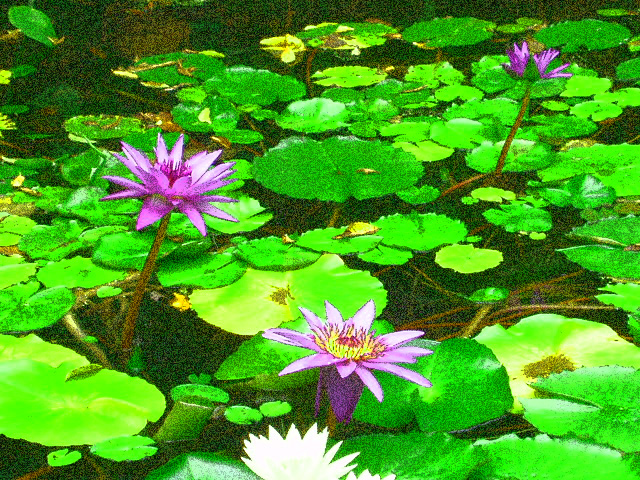
So – that’s May dealt with… Hopefully June will see a return to normality around here. The photograph for this post was a sort of cheat – I took it a couple of years ago (at this date) but the pool was in an indoor ‘water park’.

I have issues with advertising…

I have no objection to companies like Google advertising to me. If that’s their model for providing a free email service and all the rest of it, fine. I don’t need to click on the adverts. Ever so occasionally, I do, and have even been known to buy something. Similarly, I don’t mind seeing ads on friends’ posts and hope they don’t mind seeing them on mine. My LiveJournal is a permanent account which is ad-free. My Dreamwidth account is ad-free anyway. My WordPress account is free and may have advertising. I really don’t care. Facebook doesn’t bother me, either; I just scroll on by. I don’t mind having to wait till the end of an ad to access YouTube content.

However, I do have some serious issues with online advertising. My main problems occur on sites where I have paid for my content, like my daily online copy of The Guardian. I accept that to provide me with good journalism, sites like The Guardian need more than my annual subscription. In printed newspapers I am used to seeing adverts and as with social media I can choose whether or not to read or take any notice.

But…

I have some slight visual problems. I have a ‘frozen’ eye that gives me two somewhat irritating issues. My pupil doesn’t contract, and I find it impossible to re-focus quickly, so I am badly affected by both bright lights and flickering and rapid scrolling. As a result, some adverts are a nightmare and actually prevent me from reading the page I am visiting. The use of these ads strikes me as discriminatory. I object quite strongly. The ones I object to most are the ones that are at the side of an article, and cannot therefore be ignored. They have changing images – scrolling or flickering. They are almost painful, and I feel intense resentment towards the advertisers. . I have written to The Guardian stating my feelings. I did not get a reply.

The very worst online ads, for me, are the ones that open a video, with sound, as I scroll down the page. This happens more often on American media sites where friends have linked me to articles of interest – it can be for goods that are not available in UK or it can be linked articles or new video. I use my laptop in our lounge, where other family members might be watching TV, listening to music, or simply talking. I might be alone, but then I will probably have music playing. Unexpected and unwanted sound is, for me, a total invasion of privacy and usually results in closing down the page altogether in a knee-jerk reaction. Even when I manage to see that there is a small discreet close button and I just get the ad/vid switched off, I still feel offended.

I also have a sense of annoyance at the ads that interrupt Spotify. I listen to radio programmes (especially in the car) which have the inevitable ads before the news, and I just sigh and ignore most of them (except when they include a sound like a car horn or other car sound, which is to my mind dangerous). Just occasionally they are interesting and I will Google the company when I get home. I accept that Spotify, like the radio programmes, needs advertising to fund the service. Not a problem. But sometimes the ads interrupt a track, or interrupt me while I am trying to save something. That annoys me big time and is quite counterproductive because whatever the ad is for, I can guarantee I will not follow it up.

Another set of adverts I hate are those on DVDs. Invariably, they are for films I have already seen or do not wish to see. They try to tell me something is ‘coming soon’ when actually, it came a few years ago. I would almost prefer cinema-type ads for luxury goods and services. At least I could just ignore those and not get so irritated.
Note that all the above applies whatever the ads are for. In fact, I’m usually so affronted I don’t even notice what they’re trying to sell me. Indeed, all these are likely to be a turn off. So why do they do it??

You’d think advertising would be designed to attract the reader…

Female characters

There was a meme going round that asked for your favourite female characters in books and films and perhaps in your own work. I thought I’d expand that to talk about female characters in general.

I always loved the Shakespeare female characters who stepped out of the ‘normal’ roles for their time, either by their work (Portia as a lawyer) or by cross-dressing (Viola in Twelfth Night). I was less invested in the ones like Miranda in The Tempest who seemed to conform to all the stereotypes of daughter, girlfriend, etc. As a child, I wallowed in Tales from Shakespeare and was taken to the theatre well before I could really get to grips with the scripts of the plays. I think Viola, in particular, had quite a strong effect on me.

I was presented, at the same time, with the opportunity to read my way through all the Anne of Avonlea books by LM Montgomery, and loved Anne, with her fiery temper and ambitions. I never really put myself in her place; my best friend was a redhead and I think I envisaged Anne as her, with myself in some kind of supporting role. Again, a strong influence. The same people who lent me the Anne books introduced me to Little Women but that was never one of my favourites.

Later, at boarding school, the Brontë sisters were rather shoved down our throats, since Charlotte attended the same school. I disliked Jane Eyre, and thought the heroine allowed herself to be manipulated by events and by other people. I did not find a man who kept his mad wife in the attic a particularly romantic proposition, either. As for the characters in Wuthering Heights, I simply found them tiresome.

I really love Terry Pratchett’s Discworld novels and my favourite characters are Granny Weatherwax and the werewolf Angua. Both seem to epitomise independent women with sensible attitudes to almost everything. The Discworld novels are ‘comfort’ reading for me (along with other series that don’t have especially memorable female protagonists). I also love Georgette Heyer’s Regency romances and like best the ones where the heroine is compelled to use cross-dressing to survive. This harks back to my feelings for Viola, I suppose, and is odd, because I have never felt even vaguely inclined to masquerade as the opposite gender in my real life.

I have always enjoyed cop buddy TV series and particularly liked the female detectives in NYPD Blue and in Cagney and Lacey. Recently, I enjoyed Kono’s role in Hawaii 5.O. My favourite shows at the moment are Spiral (French cop show Engrenages) with the lead detective Laure, and The Bridge, with the Swedish detective Saga, who appeals to me on another level because of my interest in autism.

I adored The West Wing and liked CJ, Alison Janney’s role, best of all the characters. I was also fascinated by Donna.

My own female characters are a mixed bunch.

The heroine of my elf detective series, Genef, is quite dear to my heart. She sprang to life when I wanted a story that combined some of my favourite themes and tropes: fantasy, crime, strong female lead, mm romance, and dragons (which are a sub-genre of fantasy, yes). Genef’s mother and sister play little part in the stories but the twins Jinna and Janna, with their own secret language, and Loriela, a young girl, confined to a wheelchair, who is Genef’s brother’s pupil, are all prominent in some sections, as is Princess Briana, a friend to Genef and a licensed pirate.

My fae saga, Living Fae, has two males as the major characters but Harlequin’s sister Moth was actually the trigger for the whole series. She came into being in answer to a child’s letters to the fairies at the bottom of the garden, letters I was asked to answer. Moth generated an entire series about her family (as well as giving her name to my friends-locked social media) and whilst she is not one of the main ‘players’ I feel a great deal of affection for her. Her sisters, Columbine and Peasblossom, have larger roles and are both, I hope, interesting characters. The same goes for their mother, Flame; although I dislike her intensely, I love writing her.

There. That’s over twenty female characters introduced as having affected me in one way or another. Obviously there are others, in the books and shows mentioned above and in my own writing. None of my own are, I hope, any kind of Mary Sue. I have never wanted to be a detective. (If anything, I identify with Fel, Genef’s teacher brother.) Nor are any of them without flaws. Even Genef doesn’t find a solution to everything and has to rely on her brother, her mentor and her dragon in most cases.

I do enjoy reading, viewing and writing strong female characters, and it is interesting to look back at those that have perhaps influenced me over the course of my life.