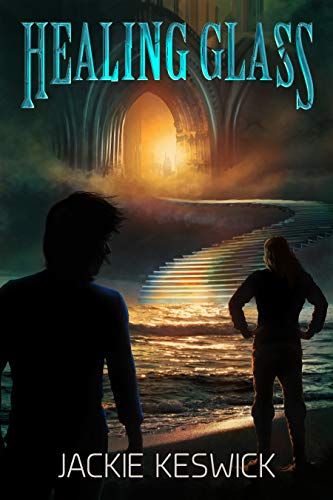
Healing Glass: A Gifted Guilds Novel by Jackie Keswick. An in-depth review.

I received an advance review copy of this book but I can assure you that if I hadn’t liked it I wouldn’t have reviewed it at all here!

I loved the story of Minel and Falcon and their strong bond. I enjoy fantasy novels, not least for their fascinating world-building, and this was no exception. The floating city of glass, with its possible sentience, is a wonderful concept and the author helps the reader to see it clearly, along with a thrilling awareness of the ‘invisible’ steps that lead to the shore.

At the beginning of the story, Minel, a glass master-craftsman, is suffering from a severe and probably fatal disease, one which we gradually learn was contracted by more than an unlucky chance. We are also given a glimpse, or clue, in the prologue, of the fact that all is not well with the city, its craft-masters and its council.

Falcon, a warrior captain, is desperately anxious for Minel to live. I enjoyed their growing relationship and the way their society was depicted so that same-sex love is never presented as anything unusual, and the culture clash that always appeals to me in stories is between craftsmen, warriors, commercial experts and councilmen or administrators.

There is sufficient angst and mystery to grip the reader, the descriptions of both locations and characters are detailed and excellent, and even the most minor characters come alive in the hands of a competent writer. There is magic, but it never overwhelms the plot or becomes unrealistic. The two main protagonists and their friends are highly gifted but at all times there is stress on how much hard work has led them to the flowering of their abilities.

I was, towards the end, slightly disappointed that we didn’t learn more about the wider context of the world in which the story is set, but it appears there will be sequels, or at least books set in the same world, so hopefully this will be remedied. Meanwhile, there were other pleasures, such as the details of glass making, and other ways of life.

I would highly recommend this book and look forward to the next volume.

April Reviews

I’m sure April this year was even shorter than usual. (*glares at April*). And here we are, already a week into May.

TV and Film

Line of Duty seasons 1, 2, and 3 *****
After watching Season 4 last month we binge-watched these prior to watching Season 5. Well worth the effort! I absolutely love the concept and the characters and particularly the long interview/interrogation scenes which are totally gripping.

A United Kingdom *****
The story of Seretse Khama of what is now Botswanaland and his marriage to an English woman. They found prejudice in both their countries and a great deal of British political manipulation too, but overcame it to provide themselves and what was then Bechuanaland with a hopeful and positive future. Interesting and romantic.

Sergeant Pepper’s Musical Revolution*****

Howard Goodall explored the album and the work of the Beatles in a fascinating in-depth look at the band and their music. No longer available on catch-up but if it returns, watch it!

Classic Albums, Paul Simon: Graceland****
This looked at Simon’s collaboration with South African musicians and had some interesting footage but was not as exciting, for me, as the Goodall programme about the Beatles.

Natural World: Tasmania****
I enjoyed seeing the landscape and fauna of Tasmania, not a country we often get to see on television. As with most Natural World programmes, however, I found myself just enjoying the ‘eye candy’ and almost falling asleep.

Legend of Zorro **
I didn’t deliberately watch this but was not about to be driven out of the lounge. I wasn’t impressed. I gather from family comments that it wasn’t as good as the more famous prequel.

Baptiste: abandoned
I got irritated with this Dutch/Belgian/British police show. I found the plot unlikely and the main character never really came alive for me, possibly because I hadn’t watched the earlier show, ‘The Missing’. I gather this was a spin-off.

The Bay: abandoned
Another series with an unlikely plot and some unlikely police officers with dysfunctional families.

Books

The excellent

Harry Potter: A History of Magic published by British Library and Bloomsbury*****
This is the book of the British Library exhibition which I was unable to visit. The book is beautifully illustrated and I loved the way it tied a lot of scholarly research to J.K. Rowling’s work. There were some wonderful photographs of antiquities from various museums, and some delightful art by Jim Kay and by J.K Rowling herself. Unless, like me, you write fantasy and want a magical reference book, I would recommend ordering this from your local library. It’s worth looking at the pictures in all their glory in the expensive hardback edition. The articles are by a variety of writers, and are introduced by specialists in each aspect of the history of magic.

A Merciful Death, A Merciful Truth and A Merciful Secret by Kendra Elliot*****
This series consists of police procedurals set in a rural town that was Mercy’s birthplace. She is now an FBI officer helping to investigate deaths that have possible links to terrorism, and there is the added interest of a very slow moving romance between her and the local Chief of Police. The books gain an extra dimension from the detailed explanations about ‘preppers’, the people (like Mercy’s fictitious family) who prepare for The End Of The World As We Know It. I thoroughly enjoyed the first book and bought the next two. The series continues and I might buy more but not just yet. Recommended.

Midnight Flit by Elin Gregory*****
This is a sequel to Eleventh Hour and follows the later adventures of Miles and Briers in the 1930s. This time, there are threats to Miles’ parents and the duo have to protect them and themselves from mayhem and potential murder. The characters are well drawn and the period is wonderfully evoked. Highly recommended but you probably need to read the books in order.

Old Sins by Charlie Cochrane*****
This is a continuation of the series about Robin, a detective, and his partner Adam, a teacher. As well as being a gripping detective story it has a romance element (they are planning their wedding but finding it hard to decide on various factors) and a lot of well developed minor characters. Perhaps the main attraction is their dog, Campbell, a Newfoundland who enriches both their lives and their investigations. Again, highly recommended but start with the first book in the series!

Chaucer by Peter Ackroyd ****

I enjoyed this biography of the poet, which also contained a lot of detail about mediaeval London. I knocked off a star, not because of any criticism of the writing but because I had the paperback edition and found it irritating to be frequently referred to the coloured illustrations which I gather are only to be found in the hardback. I think a good editor should have dealt with this issue. There were black and white illustrations but these lost a lot of the detail I’m sure would be in the coloured ones.

Red Fish, Dead Fish by Amy Lane****

This is volume two in the Fish out of Water series and I found the continuing story of Ellery and Jackson trying to uncover high level corruption gripping and interesting. I have bought the third volume. However, I would criticise the structure of the book though this might be due to editing rather than the author. At the end, there are what are called Accompanying Stories. These, we are told, took place between volumes one and two, and are referenced in the main text. I think they could easily have been edited into the main story but if that was not the author’s wish, and if the publishers wanted to have them at the end I think at the very least this could have been highlighted at the beginning. The contents of the extra stories expanded and clarified parts of the main tale, and I found it annoying to be presented with them as what amounted to flashbacks after the volume was over. I have the third volume and am looking forward to it, and am very glad I read the extras.

The acceptable or even quite good.

Skythane by J Scott Coatsworth***
Absolutely no criticism of the writing but this was too much of a fantasy/sci fi mix for me. I prefer stories to be one or the other, and this straddled the two genres. There were winged people, a doorway between worlds, both those worlds in danger, and some worrying chases and villains. The characters were interesting, especially the young boy who ends up saving everyone. There is mm romance but it doesn’t overwhelm the plot and I never felt particularly keen to know whether the protagonists would end up together or not. There is some good world building but it didn’t seem to be able to decide whether the worlds were magical or science-based. I’m sure this doesn’t spoil the story, but it did mean it wasn’t quite for me. I’m not absolutely sure why. In some ways the concept (the joined worlds) echoes both the Harbinger series, which I’ve abandoned, and the Daughter of Smoke and Bone trilogy by Laini Taylor, which I adored. I suspect I have to empathise deeply with the main character or characters before accepting the rest of the cross-world trope.

Rune Witch Mysteries (complete series) by Victoria DeLuis***

Urban magic set in South Wales. The concept intrigued me and I liked the characters and location. By the end of the series (four books) these had become almost overwhelmed with generic magic, demons, etc. and I felt less empathy with Summer and Thomas than at the beginning. I actually think the author should probably have given Summer and her non-magical boyfriend more cases to solve before setting them out to tackle the disappearance of Summer’s father and the family problems of fae royalty. Some good writing, and the stories are very readable.

My Partner the Wolf by Hollis Shiloh***
I like werewolves and this one, a cop who can trace victims in his wolf form, is no exception. But I would have liked more cop work and less about the relationship between Sean and Tom. A certain amount was essential, to get Tom estranged from his ex and established with Sean, but more police procedural from a wolf’s viewpoint would have made this a stronger story.

Knit One, Girl Two by Shira Glassman***
Quite a sweet ff romance between a young woman who dyes knitting yarn and an artist who inspires her. It’s fairly short and has pleasant enough characters, Clara and Danielle, but the story, despite some angst-ridden moments, is slightly thin.

And the dire

Wranglers (Rodeo Boys 1) by Gavin E Black: no stars

This was very short so I did finish it, hoping to find a plot. I failed. It was in fact just a series of mm sex scenes and I certainly wouldn’t read any sequels.

Dangerous to know: The Chronicles of Breed: Book 1 by K T Davies: abandoned
I didn’t feel any empathy for the main character, a rather vaguely drawn half-alien rogue, which after a couple of chapters made me abandon the book.

Fanfic

All the Important Words Unspoken by blamebrampton. *****

https://archiveofourown.org/works/5494034 73,456 words
This is a Harry Potter AU mm/mf/gen/auror casefic. I suppose that needs some clarification. If all the events of the HP books had taken place in Victorian times… Then if Harry as chief auror and Hermione as his ‘boss’ decided to recruit Draco with his knowledge of herbs and potions… And if Narcissa, desperate to marry Draco off, had chosen Astoria, who actually preferred Charlie Weasley… Then throw in smuggling of magical creatures and some delightful vignettes of real life muggle politicians. There is romantic subtext but it never goes further than a chaste kiss. Altogether delightful and highly recommended.

The other fanfic I read this month was probably impenetrable unless you were immersed in the canon stories of The Hobbit or Stargate Atlantis though I have to say And Maybe a Little Bit Wiser by Goddess47 puzzled me. There was no apparent connection with the SGA canon characters other than the names. The author admitted the story had initially been original then she decided to edit it to suit SGA which she’d had in mind all along. She didn’t do a very good job of it. I loved Small_Hobbit’s A Hobbit Bingo, a series of drabbles and ficlets with a short AU detective story featuring Thorin in the 1930s. However, I decided a detailed knowledge of canon was needed, not to enjoy it, but to appreciate it properly.

Why I write fanfic.

A friend (on Dreamwidth and in real life) posted a meme about her fanfic writing. This inspired me and I promised to do my own. I also intend to adapt the meme for my original writing.

1. What made you start writing fanfic?

My daughter knew some of my tastes in books and linked me to a Yuletide story in Arthurian Legend. At about the same time I was asked to teach an upper primary class English Language using Tennyson’s Lady of Shalott (note this was a language class, not a literature one). I was annoyed with the national curriculum approach to poetry and felt able to write to the same standard as the Yuletide fic so I wrote Lord of Shalott which I originally posted as fanfic. A lot of editing and additions later it turned into a self-published novella… I was already writing original work but was panic stricken at the thought of submitting to editors. The Lord of Shalott enabled me to try putting my work ‘out there’ and to explore self-publishing. Once I’d started, in both original and fanfic writing, the floodgates opened.

2. Which of your own fanfics have you reread the most?
I don’t usually re-read my fanfics unless I need to refer to something in a series and then I just skim or do ‘find’ (with no ‘replace’). I have re-read First a couple of times when people have asked to quote from it.

3. Describe the differences between your first fanfic and your most recent fanfic.
Lord of Shalott was historic fantasy, inspired by a poem. It was written in first person, it had a focus on cross-dressing, it referenced various myths and legends and it involved a longing for a relationship. My most recent work (other than some meta and drabbles) was …to catch a thief, a mediaeval AU for a cop buddy fandom (Pros), where I wrote part 1, a friend wrote part 2, we co-wrote part 3 and part 4 was my most recent fanfic. It had an established relationship (from the first three parts) as the focus and was a mild mystery story, told in third person. So although both were ‘historical’ fics they had totally different inspiration and were in different fandoms. In the first, I needed to echo the tone of the poem, and in the second I needed to capture the voices of the modern actors.

4. Do you think your style has changed over time? How so?
I use a number of different styles and I don’t think there has been any particular change over time. I try to alter my style to suit the canon I am writing for, but I know some of my work will be recognisable anyway.

5. You’ve posted a fic anonymously. How would someone be able to guess you’ve written it?
I tried this in a writing exercise I did in a Yahoo writing group – we all wrote a fanfic of part of my Living Fae series. Nobody was able to guess immediately which effort was mine. Presumably the others were attempting to copy my style!

6. Name three stories you found easy to write.
The first version of Lord of Shalott just poured out of me, probably fuelled by anger at the way we were supposed to ask children to view poetry and literature. The result wasn’t actually suitable for young children but that’s beside the point.
…to catch a thief was easy, too, because all the period research was already done for the first three parts and all the names etc. were in my head.
The Thing (SGA) was easy because I just went with the prompts people gave me and didn’t have to think about the story in advance.

7. Name three stories you found difficult to write.
This is an impossible question because I don’t find writing difficult. Editing, yes, research, yes, and proof reading, yes, but not writing. I sometimes find it difficult to motivate myself to start a story but that’s a different matter.

8. What’s your ratio of hits to kudos?
I haven’t the faintest idea. I vaguely know which of my fics get most hits and kudos and it seems to be linked to the general popularity of the fandom. (LotR and Grimm). Beyond that, I don’t know and the idea of trying to work it out dismays me. Besides, why would I?

9. What do your fic bookmarks say about you?

I usually bookmark a fic if I want to recommend it. I don’t have private bookmarks as a rule – I either subscribe to an author or series, or I download something I want to read eventually and it lurks on my hard drive. So I suppose my bookmarks say I’m a reviewer. They also show I’m extremely multi-fandom.

10. What’s a theme that keeps coming up in your writing?
I suppose mm romance.

11. What kind of relationships are you most interested in writing?
It varies with different fandoms. I quite like relationships that grow slowly and involve a lot of banter. I also like the kind that connect with a lot of minor characters, both canon and OC.

12. For E-rated fic what are some things your characters keep doing?
I had to Google this and I gather it means gen fic. I don’t write much of this and if I did, I hope my characters wouldn’t keep doing anything, other than sleeping and eating… I suppose they’d talk? I like writing dialogue.

13. Name three favourite characters to write.
Another impossible one. I’m too multi-fandom to have favourites. I should think my favourites are the ones I’m writing at the time.

14. You’re applying for the fanfic writer of the year award. What five fics do you put in your portfolio?
I wouldn’t apply, but if I had to, on pain of death or losing thbe right to be considered a fanfic writer, then:
First (Rome)
Blame Daniel (SG1)
The Morning Gift (Pros AU)
Elegy for a hanged man (Spooks)
Paths of the Living (LotR)

A Goblin Sweetheart – poem.


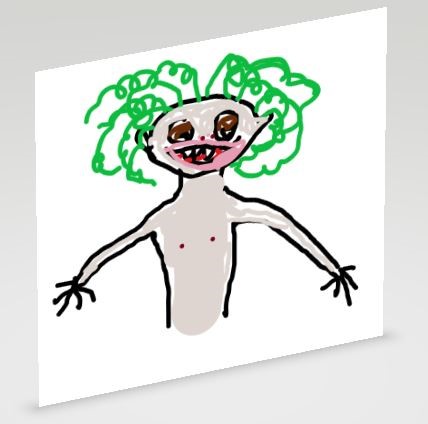
One of my online gaming characters was a young goblin who had just left home to seek his fortune – and maybe love. I wrote the poem in response to a call from a fellow player for poems related to our games. He printed it in his newsletter. The goblin’s name is pronounced Vu-ru-zu-vul. (Goblins don’t see the purpose of vowels.) The Cannis Sea was in our gaming world, sadly defunct but still a source of inspiration from time to time. Vrzvl also scribbled a picture of what he thought his sweetheart might look like…


Vrzvl’s haiku dream


Hair as green as leaves

Tangled like curling spring ferns

Round a grinning face.


Eyes as big as moons,

Deep as the dark Cannis Sea,

Full of wild mischief.


Teeth as sharp as rocks

In a mouth wide as the sky;

Lips open for me.


Arms, thin, taut as wire

And hands like soft twig brushes

Caressing my face.


In my dreams you walk.

Where shall I find you in life,

My goblin sweetheart?


I have vague intentions, some day, of writing a novel or novella with Vrzvl as one of the characters.

March Reviews

I know we’re nearly half way through April. I’ve been busy…

Films and TV etc.

The excellent

The Crimson Rivers*****

Really good French cop series that keeps suggesting supernatural explanations but always ends up with human criminals. Interesting cops.

Paddington*****

OK, late to the party – we didn’t think grandson would like it because of the death of the uncle near the beginning, so I never saw it… Lovely!

Shetland*****

Good cop series set on Shetland. I liked the cop team, the landscape and the plot.

Line of Duty Season 4*****

Cop series centred round an anti-corruption team. Gripping! So now we need to binge watch 1 – 3 before embarking on 5.

Early Man*****

I always like the animated clay productions. The humour was great and so were all the references to modern problems in this look at early man.

The good.

A Very British History ****

Excellent series looking at the history of various immigrants to UK (Gipsies/Black Brummies/Leeds Jews/Ugandan Asians).. Whilst it was good that each episode was told by someone who was part of the community, I would have liked something tying the programmes together.

Inside Europe: Ten Years of Turmoil****

The lead-up to the current Brexit problems. Well done but I would have liked more ‘before and after’ context, however brief.

Elizabeth Gaskell’s Heroines**** (see separate WordPress post)

Interesting lecture which included a look at the recently refurbished home of Elizabeth Gaskell in Manchester.

The Yorkshire Ripper Files****

The programmes had a focus on the victims and their families. It was interesting to see how and why it took so long to catch Peter Sutcliffe, and to see how police and media attitudes to women have had to change.

The poor.

Be Mine **

Very slight shortish film. It was mm romance so I thought I’d watch to see what the cinema did with it. Not a lot… Also, it was hard to work out what was flashback and which character was which.

And the ones where I gave up.

Baptiste: abandoned

Retired cop starts trying to find a missing woman and ends up involved in international crime. I missed an episode and found I couldn’t be bothered to catch up. I wasn’t keen on either the main character or the plot and found it hard to suspend disbelief.

The Bay: abandoned

I got annoyed with the policewoman from the start, and with her inability to organise her family, let alone her work.

Mums Make Porn: abandoned

In theory they were making a porn film that respected women, but in the process of doing so they interviewed and watched professional porn stars doing just that so I couldn’t see the point.

The Yorkshire Vet: abandoned

I loved this programme for the location (I used to live near there) as well as the animals, but the ops were so gory I gave up.

Shadowlands (not the CS Lewis story): abandoned

It was billed as three short stories about people seeking love. The first was a narcissist and the scenes were thoroughly nasty. I didn’t watch for long.


Books

The excellent

Dim Sum Asylum by Rhys Ford*****

I adored this cop story set in a fae San Francisco. I kept thinking I’d read it before but then realised it was an extended version of a story that appeared in the Charmed and Dangerous anthology, which I’d loved when I read it. This book is well worth the re-read at the beginning.

Rising Tide by Susan Roebuck *****

As usual, Susan Roebuck makes us feel as if we have been transported to Portugal. The hero and heroine, both part Portuguese, are brought together in a fishing village at risk from the manipulations of corrupt businessmen.

Set in Stone by Elin Gregory*****

A gripping and delightful short story with a supernatural twist. I shall file it with my Halloween stories and re-read it!

Spies, Planes and Automobiles by Elin Gregory and Charlie Cochrane*****

A nice short mystery where one of the heroes of Eleventh Hour meets the Cambridge Fellows.

State of Hate produced by Hope Not Hate*****

This year’s look at the state of the far right and their activities. Worth reading and worth keeping for reference.

Bitter Legacy and Object of Desire by Dal McClean*****

I couldn’t put these down! Exciting stories featuring a gay cop and two of his cases, set against his search for a lover. Each novel stands alone, but I think the way they’re interlinked adds to the pleasure. Excellent writing.

Rapid Response by DJ Jamison*****

Another book in the Hearts and Health series. This time it’s a firefighter and a paramedic who get together. The main pleasure of the series lies in getting to know the entire community, the hospital, etc. The story explores mild BDSM, being in the closet and being bi/pansexual.

Hidden Treasures and Late Fees by Marshall Thornton ***** (Pinx Video Mysteries 2 & 3)

Noah is a fascinating hero, since he is gay but HIV positive and still angst-ridden about his past. This is unusual since it gives us a story about gay characters without any sex, and as a result gives insight into gay Los Angeles. The city is described in detail and for the first time (and I’ve read quite a lot of books set there) I felt I might be getting to know it. The first of these sequels is concerned with aging cinema stars and their costumes, and the second has Noah’s mother come to stay and inadvertently involve him in a murder mystery.

Invitation to the Dance by Tamara Allen*****

A newspaper reporter and his copy editor are encouraged to go undercover to get information, by their editor. As well as the wanted social gossip they uncover criminal activities. Tamara Allen deftly brings the pre-WWII world of America to life

The good

Justice in the Sarladais by Stephen Reinhardt 1770-1790****

Interesting detailed look at social and criminal issues in the area around Sarlat just before the French Revolution. At times the book read like an expanded Ph.D thesis (which it might well have been) but it was an illuminating look at the social change in a rural area during the years leading to the revolution, and at the beginnings of the modern French judicial system.

Lord of the White Hell vols 1 and 2 by Gill Hale****

Some good world building and I liked the culture clash described as Kiram tries to adapt to Javier’s different country. However, towards the end I got slightly tired of the antics of the demon and was simply glad the heroes got together and seemed set fair for an interesting life together. I gather the next book deals with Elizar, who was not one of my favourite characters so I won’t bother reading it, especially because Hale’s books are very expensive, compared with other Kindle volumes.

The Broken Circle by Enjeela Ahmadi Miller****

An autobiographical account of how the author and her family escaped Afghanistan when the Russians arrived. The details were interesting and I was anxious for the family to survive and come together again. However, I could have done with slightly more context and perhaps more pointers towards the Taliban future. Maybe the author didn’t have these herself.

The Dodo, the Auk and the Oryx by Robert Silverberg ****

A friend recommended this and I was glad I bought it. It is out of print (it was originally published in the ‘70s) and in a sense it needs a new edition with some up to date statistics. It was a great introduction to extinction by both natural causes and human intervention, and would be a good starting point for further research. I bought it with my grandson in mind but although I will lend it to him, I shall keep it for myself. It’s a Puffin book but I think would be too hard for most children, as it assumes quite a lot of knowledge. I imagine the author and the publishers wanted to influence young minds. Silverberg is known to me as a sci-fi writer but I had never read any of his science writing.

The mediocre

Prism Cloud by Jeff Wheeler (book 4 of the Harbinger series) ***

I have got tired of Cettie and Sera and their inability to affect either their own empire or the other kingdom in this steampunk series. Both heroines started out interesting and determined but they now seem to be at the mercy of other people’s activities and agendas. The events that were, I think, meant to be startling were in fact quite predictable and the book was somehow flat. I don’t think I’ll bother buying the sequel.

The poor.

Spoonful of Flavour Leafy Greens e-book **

There were some nice recipes but I felt cheated. The book was meant to be a freebie for signing up to the author’s newsletter. It isn’t really an e-book, because frequently it catapults the reader back into the blog with navigational difficulties and a complete inability to copy/paste good recipes. All it has really done is make me unsubscribe…

Dominus by P Kenwood:  abandoned.

This came highly recommended but I didn’t get far. There was a great deal of ‘bad’ language which might well be realistic but throws me out of a story, there was some odd choice of vocabulary, there were startling point of view switches, and I simply found the general style unreadable.

Buttermilk Ranch by Patricia Logan: abandoned

The writing was very repetitive with occasional lapses into info dump. Again, I didn’t get far.

Fanfiction

(I only review the excellent, which I recommend, and mostly only fics that are accessible to readers who are not in the particular fandom.)

The Man with the Clockwork Heart by danceswithgary***** https://archiveofourown.org/works/16644200 6967 words

The story was written in response to art, in what’s known as a reverse big bang and both pay homage to Jack and the Cuckoo Clock Heart, an anime film, The fandom is SGA but this is so AU only the names really give the origins away. John is the one with physical problems and Rodney is the scientist who can put things right.

From the Pen of Inky Quill by okapi ***** https://archiveofourown.org/works/6848800/chapters/15633211 40,821 words (so far)

This is an excellent series of anthropomorphic crack!fic, poetry and ficlets set loosely in the Sherlock universe. It is added to from time to time and occasionally appears in my inbox to my delight.

 Tits v. Porny by jeeno2 *****  https://archiveofourown.org/works/18115103#main 5289 words plus the lawsuit that inspired it  https://docs.wixstatic.com/ugd/9757a1_8b7166541a084d5ebe957b896cdc8132.pdf

A fascinating look at copyright, publishing, porn, lawsuits, etc. with a very mild m/f love story holding everything together. It’s worth ploughing through the very real lawsuit as background; it’s relevant to writers everywhere.This story is set in the Starwars fandom but like the SGA one is so AU only the names are the same. As the summary says: Ben Solo and Rey Johnson are attorneys, working together to defend their client against claims of plagiarism and copyright violation brought by a published author of original A/B/O fiction.

A Sheppard’s Christmas Carol by Brumeier***** https://archiveofourown.org/works/17087363  7641 words.

Fresh and interesting retelling of A Christmas Carol with John (SGA) visited by the spirits. The author was very inventive with the spirits she used. Worth keeping and re-reading, probably at Christmas. Perhaps not quite as accessible to people who don’t know SGA but lovers of the Dickens story should find the treatment interesting.


Things I dislike in books, films, etc.

I thought it was time, as a reviewer, that I posted about the things I dislike in books and films (including TV); the things that throw me out of a story, the things that make me abandon a book or a series and the things that stop me buying. Some of the following might result in a bad review. Some might prevent purchase. Some are just a warning sign and I might like a book despite their inclusion. Some are very personal dislikes and don’t say anything about the book or film. But you deserve to know where I am coming from! In alphabetical order:

* Bad language in the sense of curses and similar.
I know it might be realistic, but when it’s constant, I can’t read or listen to it. Recent examples include The Wolf of Wall Street who used f…g as every other word, and Dominus, a novel about ancient Rome that had so many curses and uses of ‘s..t’ that I just couldn’t carry on. We all use expletives from time to time but most people, particularly people with even a modicum of education, reserve them for important issues (like hammering your thumb…) and I think constant usage diminishes their impact in real life and is bordering on unlikely in scripts and novels. At any rate, I thoroughly dislike it.

*Bad language in the sense of poor grammar, spelling, etc.
I don’t mean typos though those annoy me when they come thick and fast.

I do mean the misuse of vocabulary where either the author either hasn’t a clue what the right word is, or cravenly believes their wordchecker’s correction.

I also mean the dizzying switching of tenses or points of view within one section of text.

I mean, too, the frequent use of poor punctuation (which a wordchecker would soon put right). (Punctuation should make a text easier to read.)

I mean, in addition, the frequent use of things like ‘er’, meant, I think, to add verisimilitude to speech but actually just making it hard to read. (When we listen to someone who hesitates we ignore the hesitations, but that’s harder when they’re written down and we are forced to process them.)

I certainly mean poor grammar – not what Word’s spag checker regards as bad grammar but what the average English teacher means. As an ex-English teacher, I am always annoyed by it and it almost always throws me out of the story and ensures I won’t return to the author. I’m aware that grammar isn’t every writer’s strength, but that’s what editors are for.

*Forced comedy
I hate comedy that seems to be telling me I must laugh. I am highly amused at some jokes, cartoons and situations but I rarely enjoy stand-up comedians or comedy shows, I often have to switch off if there’s canned laughter, and I don’t enjoy books that employ similar techniques. I realise I’m in a minority here! My sense of humour tends more towards irony than banana skin slips. I say ‘tends’ because there are exceptions but they’re few and far between.

*Fundamental objections.
It should go without saying that I don’t appreciate any attempt to ‘sell’ me racism, sexism, or fundamentalist religion of any kind in the guise of fiction. I actually binned a couple of children’s books given to my daughter with these themes, because I wouldn’t let her read them till she was old enough to ‘see through’ the message (by which time she wouldn’t enjoy the stories) and I didn’t want to be responsible for unleashing them on others via a charity shop. Not quite book burning, but yes, a kind of censorship. I would, of course, defend the right of the writers and publishers to produce these, but at the same time defend my own right to decide not to have anything to do with them and to discourage others.

*Insistence on using experimental prose.
I appreciate that some people think this is clever, and certainly it isn’t something that is actually wrong. It just strikes me as pretentious and annoying, whether it’s done by a Booker prize winner or a fanfic writer. For example, Hilary Mantel does it in A Place of Greater Safety – the whole style changes from chapter to chapter, with some of it reading like a TV script, and some like a history book. Irritating.

*Plot devices that are almost guaranteed to make me abandon the book or film.
I personally dislike stories that are told from the point of view of the villain or criminal. I feel cheated, because I enjoy crime stories where I try to work out ‘whodunnit’ or how they did it alongside the detectives.

I dislike ambiguous endings unless there’s a sequel in the pipeline, though obviously I won’t know till I reach the ending and just end up feeling furious.

The same goes for endings that are not consistent with the story and seem to be a kind of ‘how on earth can I end this’ attitude on the part of the author. As a teacher I used to dislike children’s stories that ended ‘and then I woke up’ or ‘and then I died’ and I find adults have similar tendencies at times… I think the worst book I read was one that was a crime story which ended abruptly. Apparently the author died and friends got the book published as a kind of memorial. The reader could be pretty sure who the criminal was, but there were so many unanswered questions I wanted to throw the book in the trash – some memorial!

*Plot holes.
I know some of these are probably not even noticed by the writer till after the book or film has gone public. They should have been noticed by beta readers, editors, etc. Oddly, I have seen more of these in books published by mainstream ‘big’ publishing houses than in genre fiction or fanfic. Maybe a lack of beta readers and discussion groups?

*Serious anachronisms and cultural errors.
I’m not talking about using modern language when the story is about e.g. ancient Rome. That makes the writing more accessible to the modern reader and unless the writer is going to write in Latin (and even then, Latin changed, as all languages do) it’s not something that worries me. Linguistic anachronisms do ‘throw’ me; the use of slang terms should be always be carefully researched. It’s no good using modern language for a book about e.g. mediaeval society and including slang that is obviously twenty-first century in origin. Yes, the mediaeval people would have used slang, but unless it is very carefully done, the text shouldn’t really include it. It’s easy to say something like, ‘he cursed roundly’ rather than have him saying ‘Shit’. So should the correct usage of period phrases be researched – like ‘methinks’ or ‘prithee’ though I really wish writers wouldn’t use them at all. Film makers can just about get away with it if they’re staging Shakespeare…

One type of anachronism that infuriated me was in a book that purported to be about the mediaeval popes and their families. A party was described and the meal ended with chocolates with exotic fillings. I instantly distrusted all the other historical research the writer had done.

Similarly, books by e.g. American writers who clearly have a foggy grasp of Brit geography, customs, or conversational norms annoy me, as do Brit books that play fast and loose with American (or any other) culture. Whilst I don’t think the exhortation to ‘write what you know’ holds water, I do think a writer should ‘know what they write’ which is a different thing and assumes writers do their research meticulously. I don’t think a writer who sets their work in the past or in a foreign country needs to be an expert, but they should make sure they don’t make glaringly obvious errors. Also, I am more likely to be annoyed if the blurb or the notes about the author try to suggest expertise.

Even fantasy or sci fi needs to be grounded in some kind of reality. I once abandoned the notion of having two moons on a world when I realised I would need to alter all references to tides, seasons, etc. Fairies and aliens work best when they follow ‘laws’ made clear in the story and not random ideas that have appealed to the author as pretty or interesting. If it’s a truly alien or alternate world, it needs internal consistency and sensible natural rules.

*Things I am less keen on but will try.
I am a lover of fantasy but I am not at all keen on books where the main character ends up crossing into another world or reality. I have read a few where it worked, but it’s not my favourite genre.

The same goes for time travel where I find it hard to suspend disbelief.

Mpreg is only acceptable for me if there’s a sensible scientific explanation e.g. an alien race with fluid gender roles, an experiment on humans, an alternative universe where this is the norm.

I am less than fond of vampires (I have read some good ones but hate Anne Rice…), the invasion of earth by monstrous aliens (they need to stay on other planets where the likes of SG1 or SGA can deal with them), and most m/m/f menage tropes. I am also reluctant to read about either zombies or superheroes. I think I like my protagonists to be flawed and human or ‘normal’ within their non-human community.

*Too much explicit sex.
I have no desire for a return to the ‘fade to black’ fashion of writing, whether the romance/marriage/hook-up/whatever is m/m, m/f, f/f or any permutation. However, I want the sex scenes to further either the plot or the character development. If they appear to be merely there for titillation, I skim them, and if they appear too often or are too long, I usually abandon the story. I don’t find the ‘tab A into slot B’ approach to sex scenes hot, in the least, just boring. I am much more interested in the emotions engendered by the sex (or lack of it). Some of my favourite romances don’t get the protagonists into bed until near the end of the story.

*Too much explicit violence.
Although I enjoy crime books and thrillers, I don’t particularly want battle or gore dwelled on lovingly by the writer or the film maker. I tend to skim or look away if any kind of violence lasts too long, and complex battle scenes pass me by in a blur. This probably explains my own difficulties in writing such scenes, even short ones, and I do realise they are sometimes needed to further the plot, but that doesn’t stop me hating them!

Also, while I will read some BDSM, I personally can’t cope with kinks involving things like blood, enemas, excreta, etc. The sex doesn’t have to be vanilla but I have personal limits though I understand that they really are personal and that violence and gore may appeal to some readers and can be well written. Also, I will read about darker things if they are essential to a crime investigation but still don’t like them described in too much detail. For instance, I can read about a detective seeing the aftermath of violence or even a pathologist finding out what happened, but don’t want a blow-by-blow account of the killer’s actions as they happen.

*Too much purple prose and too much description.
Descriptions are all the better for being sparse. Adjectives are overused by a lot of writers just starting out – maybe a hangover from their schooldays when they were encouraged to use too many, presumably to increase their vocabulary and add at least some interest to whatever they were producing.

In a novel, over-description jars the reader. Even world building, which is essential, is better done in very small increments with a lot left to the imagination. We do not need to know every detail of what every character (even minor ones) is wearing, and nor do we need an estate agent’s description of a building or its surroundings. Too many modern writers seem to think that descriptions of clothing will introduce characters to their readers. Actually, for me, it doesn’t work. I am so hung up on trying to visualise the dress, shoes, etc. that it’s hard to get back to what is being said or done. When I meet someone in real life I rarely notice every detail of their outfit though I might focus on a particularly attractive tie or scarf and on a general colour scheme. So I don’t expect to be forced to concentrate on itemised clothing when I meet a character in text, either. (I really don’t need to know what a detective is wearing at the scene of a crime, though it might be more relevant if he has to work under cover.)

Film makers are better in this respect. They get someone to make sure the costumes and location are perfect then just let them speak for themselves to the viewer. Basically, we would notice if things clashed or were not true to the period (which might actually be important if the character liked them that way). Otherwise, we can just leave them in their proper place, the background.

*****

It might seem surprising, in view of the above list, that I find so many books and films to love! That just means there are some seriously good writers and directors out there and they make me very happy indeed.

February Reviews

Films and TV

The excellent (watch if you can and if they’re still available).

They Shall Not Grow Old*****
The special version of WW1 footage, edited and coloured under the direction of Michael Jackson. A fantastic feat, though beginning with a long section of flickering black and white might have been good cinema but nearly made me switch off with a headache.

Andrew Marr’s History of Modern Britain*****
Fascinating because it basically covered my life. While you’re living through events you’re not always aware of the wider picture.

Reginald D Hunter’s Songs of the South*****
I loved hearing the history of some of the American music, but even more, I enjoyed the road trip through the southern states. Whilst I knew perfectly well where they were it’s actually rare, on Brit TV, to see any film of that part of USA and I now feel I have a much more detailed mental map.

Grantchester Season 4*****
This is the first Grantchester season I’ve seen and I loved it. Since I was new to it, the departure of Sid didn’t upset me. I’ve always liked Robson Green and I enjoyed the mix of crime with the accurate and detailed look at the period, which was the time of my childhood, and as I was the daughter of a country vicar this was inevitably going to appeal!

100 Vaginas *****
Amazing, excellent, poignant, and intriguing. I think it’s still on catch up TV in UK (ch4) and if it is, watch it! It unravelled women’s attitudes to what is sometimes seen as a taboo subject with incredible photography and sensitive narration.

Desperate Romantics*****
Fabulous. I knew that with Aidan Turner as Dante Gabriel Rosetti it was likely to be good, but Millais, Hunt and Lizzie Siddall were good too. So was Tom Hollander as Ruskin. I bought it ages ago and forgot about it. Six hours of fantastic acting in a mesmerising story about some of our most famous artists. Plus, I’ve seen some of the originals of the paintings that were the focus of the story and have been to a number of pre-Raphaelite exhibitions. I wallowed in this and will be watching it again.

The good.

British History’s Biggest Fibs****
Lucy Worsley makes history interesting, as usual, but I think this started with an odd premise. Most people who studied any history beyond the age of about 14 (or just did a lot of reading) wouldn’t believe these fibs anyway, and the rest of the general population wouldn’t remember them. That’s as far as the Wars of the Roses, and the Glorious Revolution are concerned, at any rate. But maybe Victoria and the empire are a little more recent and people do look back to what they think was a golden age. And maybe this was an attempt to alter the public perception of the empire carefully slotted into a more general history lesson.

Dogs behaving (very) badly****
Really, it was the owners, in every case, who were behaving, if not badly, at least foolishly. The trainer gently but firmly put them on the right track.

Death in Paradise Season 8****
‘Cosy’ mysteries with a beautiful tropical background and an interesting ensemble cast. I felt nostalgia for my trips to the Caribbean, and I enjoyed the banter. There were plotholes galore but I would watch again for the humour and the scenery. I kept thinking about the ‘backstory’ in Lewis that had Lewis in the BVI after his wife’s death, and wondered why we never got a series about that period – maybe this was it?

The real Saudi Arabia: why I had to leave****
The young fashion designer who went to visit relatives in Saudi to see whether she could live there might have known it would end in tears, but she really did try hard. I was surprised by the ending.

The vaguely watchable.

Moulin Rouge***
Nowhere near as good as I was led to expect. When we went to Paris we stayed near the Moulin Rouge and the film didn’t give a real picture of the area. In fact, I found it unlikely and faintly annoying.

And the unwatchable.

Byzantium: A Tale of Three Cities – abandoned
I couldn’t stand the way this was presented. Not sure if it was the narrator’s voice but I found myself falling asleep despite the inherent interest of what was being shown.

Gavin and Stacey – abandoned.
It was supposed to be a romantic comedy but I didn’t think it was either… Not sure why I bought it in a charity shop but it’s going back there.

Master and Commander – abandoned
I was looking forward to this but… Too much sea and too much gore. Since I’d read some of the books I already knew the characters and there wasn’t going to be any element of mystery or development so I gave up.

Books

The really really good (highly recommended):

Raven Stratagem and Revenant Gun by Yoon Ha Lee*****
Both the second and final volumes of The Machineries of Empire were wonderful sci fi, with plenty of aliens, space battles, futuristic science, sex, and explorations of ‘big’ themes like gender identity, loyalty and democracy. I was dying to know what happened but didn’t want them to end. I was initially disappointed in the ending but then realised I just hadn’t wanted the story to end at all. It was perfectly satisfactory except that I wanted more! Highly recommended series for anyone who likes sci fic. And a huge thank you to the person on my DW f’list who recced it!

Snow and Secrets by RJ Scott (Stanford Creek series 3)*****
This was almost stand-alone but is actually part of a series. Nice characterisation and an interesting plot. The series as a whole deals with m/f relationships but this volume is m/m. I much prefer Scott’s writing when she is developing the story of a whole group or community. She is very good at locating the reader in a ‘place’ with ‘real’ people, and I would rather follow her series than read her shorter standalones.

Cops and Comix by Rhys Ford (Murder and Mayhem)*****
I love this series, with the dysfunctional but rich family, the cops trying hard to keep up, the background of valuable artefacts in the film and comic industries, and the mayhem that seems to follow everyone who gets anywhere near. Another writer who pulls the reader into a fully realised location and group of people.

My Anti-Valentine by DJ Jamison *****
Three stories here, all on an ‘anti-valentine’ theme and all well written and satisfyingly romantic in the end.

The Station by Keira Andrews*****
A fascinating story based in the convict days of Australia. The research was detailed and the reader learns a lot about the deportation process and about the outback in those early times.

Apple Boy by Isobel Starling*****
A gorgeous introduction to what promises to be a fascinating series. As I pre-ordered it, I was sent a beautiful map too. The world building is excellent, slow and detailed with no sense of any ‘info-dump’. The magic is unusual and interesting. I gather we will meet new characters in the sequels but already the minor characters are almost as well developed as the main protagonists and we can trust the author to introduce worthwhile personalities to inhabit her world.

Concierge Service by P.D.Singer*****
I loved the angst in this romance, with the main character desperate not to compromise his position as a brilliant metropolitan concierge at a top hotel despite falling for a guest. I liked the way the relationship developed and the fact that there was very little sex until the end. The UST was much more exciting than the more explicit accounts in so many books.

Two for the Road by Alexa Milne *****
A May/December story about a man who falls in love with his friend’s son, a young man who has in turn loved him since they first met. Most of the relationship is developed during the lifts to and from work which underpin both the plot and the title. I also enjoy reading stories set in my own part of the world (northern UK) especially when the author obviously knows the area well and loves it. I read this while I was doing the final edits on a May/December story of my own, so it was even more appealing.

The Holly Groweth Green by Amy Rae Durreson*****
This is a Christmas fairy tale (which is a kind of contradiction in terms). It takes place after WWII when a naval doctor, damaged by the war to the extent that he can no longer practise, is stranded in a snowstorm and meets someone living in a house in the countryside – a house that later turns out to be an uninhabited ruin. But this is not a ghost story, and although it takes place over the twelve days of Christmas, that’s because those are the days the fairies have chosen when they laid a curse on Avery. A fabulous story (in both senses) and one which I must read every Christmas. This year it didn’t reach my notice till February but now that I have it, I shall treasure it!

The good. Good enough to recommend but I probably wouldn’t re-read them (usually because they’re very short). All these are well written and are excellent examples of the art of the short story.

The Fall Guy by Chris Quinton****
A Pinkerton agent ends up following suspects across the Atlantic to London. I actually hope this might turn into a series.

Bad Valentine ****
Four novella by four authors, all well written and worth reading.
Love Magic by Jesi Lea Ryan ****
Oliver thinks Derrick is ‘just’ a conjuror but it turns out Derrick has real magic.
Quill Me Now by Jordan Castillo Price****
Dixon thinks he is a failed spellcrafter but when he meets Yuri he learns the truth about himself and his family.
Hidden Hearts by Clare London****
Ethan and Kel survive clumsiness and disasters to make something of a valentine date.
Temporary Dad by Dev Bentham****
Nick and Dylan work through minor deception and fantasy to a good relationship in the end.

His Spark by DJ Jamison ****
A very short story in which Josh and Dylan act the parts of Harry and Draco from Harry Potter but find their own personalities are better in the end. Nicely written but this is another author whose series appeal to me more than her shorts.

Valentine’s Day with Princess Petunia by K-Lee Klein****
How easy or difficult can it be to find romance when you’re a single dad? Bobby finds out when he meets Greg.

Drawing Love by Tully Vincent****
A short story with a focus on a drawing one of the main characters did in primary school. The love he was trying to convey then has lasted.

Blitz by Charlie Cochrane****
Two guys who fancy each other but have never acted on their feelings are thrown together sheltering from the blitz.

The readable (just)

Forgive me Father by PL Travis***
Jamie underwent an appalling childhood which is reconstructed in almost loving detail. The second half of the book deals with his experiences in adulthood when he has overcome his past, but it is told in a blur of events and people, with a lot of death and angst all round. Jamie has a good life in the end, but I wouldn’t read this again.

The Ultimate Greetings Card Book by Caroline Green (re-read) ***
Some of the techniques are good but most of them are already well known to me. A reasonable reference book but no really new ideas or anything I’d forgotten about.

The dire

Three Sisters (Emily Castle Mysteries 1) by Helen Smith *
I was mesmerised by just how awful the characters were, how unlikely the plot, and how garbled the explanations. I did finish it but only just. The style was irritating, too, with attempts at purple prose and experimental prose too.

Hunter’s Chase (The Edinburgh Crime Mysteries 1) by Val Penny – abandoned
I think this was making an attempt to be the next Inspector Rebus series. It failed.

Fanfic

I eventually finished the Lewis Christmas Challenge stories, the SGA Secret Santa ones, and the Bandom Big Bang. Lewis and SGA demanded in-depth knowledge of canon, but two of the Bandom stories would, I think, work well for the new reader. Both are m/m stories that use real people, or at least their media personas, to explore sci fi/supernatural themes. I really enjoy AU stories in Bandom, because nobody can complain that the stars are being unfairly treated – after all, everybody knows they don’t live in a world with space travel, vampires, werewolves, magic, etc.

ataraxia by akamine_chan https://archiveofourown.org/works/17224229 (3707 words) studies possible attitudes to androids, with obvious reference to canon stories and films in the genre. Frank meets Gerard on Venus and is excited to be working with him.

Ethici Strix by ermengarde https://archiveofourown.org/works/17212841 (2458 words) Gerard is job-hunting when he accidentally meets Frank, who is cool, but weird. An eventual vampire theme.

International Women’s Day

(First, a confession. The photo is taken from Tripadvisor. Yesterday was incredibly wet and I couldn’t take a decent photograph.)

My daughter and I and a couple of friends went to a talk on Elizabeth Gaskell’s Heroines at Elizabeth Gaskell House in Manchester on Thursday. The talk, given in honour of International Women’s Day, was given by Dr Diane Duffy and was well worth attending.

Dr. Duffy clearly knew a great deal about the Victorian novelist and her life and works, but also gave us plenty of food for thought. I had read a couple of Gaskell’s works and had watched the BBC costume dramas but too long ago to recall the details or the names of all the characters but our speaker soon made sure we all knew the outline of the stories.

She started by unpacking the word ‘heroine’, pointing out the recent de-gendering of the term so that we now have female heroes, and gave a slide presentation showing aspects of the way heroines had been depicted in Britain in the past in both text and art. Some of her listeners felt she paid too little attention to attitudes in other countries, and other literatures, but so far as Britain was concerned I think her points were valid, even if somewhat ‘parochial’.

We were asked to consider the attributes we expected to be assigned to male or female heroes, and to look at the true nature of heroism. This was interesting and thought-provoking, especially given the preponderance of ‘hero’ movies today. Even in an atmosphere of ‘liberation’ for women we are capable of automatic stereotyping and a failure to notice or admire characters who do not conform to those stereotypes.

It was clear that Gaskell tried to push the boundaries of what was acceptable to Victorian readers, just as other novelists did, particularly Charlotte Bronte, who was a friend of Gaskell’s. Some of the characterisation they developed might seem very slight to us but was really subversive in Victorian times. Women, then, were advised that if they were intelligent or well-informed, they should hide the fact, and in most publications it was thought obvious that a blonde beauty would not only be the main character but would also be ‘innocent’ and would ‘get her man’ whereas anyone with dark hair would inevitably turn out to be a villain. So a dark-haired heroine was a really new departure for the audience of the time. Some listeners made the point that Disney was in fact one of the first to go against the trend, and although their depiction of Snow White with dark hair was in keeping with Grimm’s text, it was also in direct opposition to the prevailing norms.

Gaskell had publishers to contend with, too; you can’t get a message across if you can’t get your book printed and sold. She was perhaps more subtle in her attempts to subvert the ‘normal’ way of thinking, and did not meet the same kinds of publisher outrage and panic experienced by Charlotte, or by Wilkie Collins. I know today’s publishers are driven by the profit motive just as much as their forebears were, and I wonder how far the current development of self-publishing and small indie publishers/co-operatives will allow more widespread questioning of the social order.

The talk was certainly relevant to anyone who writes female heroes and perhaps to all writers, given the way that prejudices and stereotypes were questioned.

The Elizabeth Gaskell House is a beautifully presented small museum just outside central Manchester. The building has been renovated by Manchester University and lovingly restored to its nineteenth century incarnation as a Unitarian minister’s house – and that of his wife who gave us some enjoyable and provocative novels. I would recommend a visit if you’re in the area!

Sale! (and some freebies)

I’m participating in the Smashwords Read an e-book week sale. All my titles have been discounted by 75% for one week, running from 3rd to 10th March. That means some of them are free and the rest are at silly prices. The discounts will be automatically applied when you add a book to your cart.

The Lord of Shalott (a novella) FREE
Silkskin and the Forest Dwellers (a novella) FREE
Silver Chains (a novella) FREE
Three Legends (three short stories) FREE
The Skilled Investigators (series):
The Scroll (book 1) FREE
The Market (book 2) FREE
The Crown (book 3) $1
The Lantern (book 4) $1
Living Fae (series):
Growing Up Fae (book 1) $1.25
Tales from Tara (book 2) FREE (I wouldn’t recommend reading this without reading book 1 first)

This is a pricing experiment to see if I can tweak my marketing somehow. No guarantees it will happen again so make the most of it if you’re interested in what I write!

Go to https://www.smashwords.com and search Jay Mountney in the search box at the top.

Silver Chains

chain-941229_1920 (1) - Copy

Shameless advertising. A short story, outside my ‘normal’ style. This one’s a contemporary May/December romance and is 99p on both Amazon and Smashwords. It’s been up for about 48 hours but then Smashwords had a hissy fit when I mentioned my Amazon page in the ‘about the author’ section, though Amazon didn’t seem to care about Smashwords. That delayed things a bit while I hastily edited so that Smashwords would send it out to other platforms.
Incidentally, I wrote it ages ago and it first saw the light of day in an online zine under the title ‘Angus’ (the main character) but I now have the rights back and have done some edits and changed the title. I know some of the zine group follow this blog and I wouldn’t like them to buy the story and feel cheated.
Links:
https://www.smashwords.com/books/view/924818