International Women’s Day

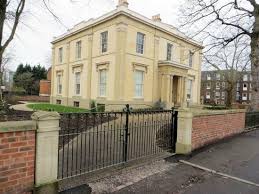
(First, a confession. The photo is taken from Tripadvisor. Yesterday was incredibly wet and I couldn’t take a decent photograph.)

My daughter and I and a couple of friends went to a talk on Elizabeth Gaskell’s Heroines at Elizabeth Gaskell House in Manchester on Thursday. The talk, given in honour of International Women’s Day, was given by Dr Diane Duffy and was well worth attending.

Dr. Duffy clearly knew a great deal about the Victorian novelist and her life and works, but also gave us plenty of food for thought. I had read a couple of Gaskell’s works and had watched the BBC costume dramas but too long ago to recall the details or the names of all the characters but our speaker soon made sure we all knew the outline of the stories.

She started by unpacking the word ‘heroine’, pointing out the recent de-gendering of the term so that we now have female heroes, and gave a slide presentation showing aspects of the way heroines had been depicted in Britain in the past in both text and art. Some of her listeners felt she paid too little attention to attitudes in other countries, and other literatures, but so far as Britain was concerned I think her points were valid, even if somewhat ‘parochial’.

We were asked to consider the attributes we expected to be assigned to male or female heroes, and to look at the true nature of heroism. This was interesting and thought-provoking, especially given the preponderance of ‘hero’ movies today. Even in an atmosphere of ‘liberation’ for women we are capable of automatic stereotyping and a failure to notice or admire characters who do not conform to those stereotypes.

It was clear that Gaskell tried to push the boundaries of what was acceptable to Victorian readers, just as other novelists did, particularly Charlotte Bronte, who was a friend of Gaskell’s. Some of the characterisation they developed might seem very slight to us but was really subversive in Victorian times. Women, then, were advised that if they were intelligent or well-informed, they should hide the fact, and in most publications it was thought obvious that a blonde beauty would not only be the main character but would also be ‘innocent’ and would ‘get her man’ whereas anyone with dark hair would inevitably turn out to be a villain. So a dark-haired heroine was a really new departure for the audience of the time. Some listeners made the point that Disney was in fact one of the first to go against the trend, and although their depiction of Snow White with dark hair was in keeping with Grimm’s text, it was also in direct opposition to the prevailing norms.

Gaskell had publishers to contend with, too; you can’t get a message across if you can’t get your book printed and sold. She was perhaps more subtle in her attempts to subvert the ‘normal’ way of thinking, and did not meet the same kinds of publisher outrage and panic experienced by Charlotte, or by Wilkie Collins. I know today’s publishers are driven by the profit motive just as much as their forebears were, and I wonder how far the current development of self-publishing and small indie publishers/co-operatives will allow more widespread questioning of the social order.

The talk was certainly relevant to anyone who writes female heroes and perhaps to all writers, given the way that prejudices and stereotypes were questioned.

The Elizabeth Gaskell House is a beautifully presented small museum just outside central Manchester. The building has been renovated by Manchester University and lovingly restored to its nineteenth century incarnation as a Unitarian minister’s house – and that of his wife who gave us some enjoyable and provocative novels. I would recommend a visit if you’re in the area!

What fanworks mean to me.

The Organisation for Transformative Works (OTW) which has Archive Of Our Own (AO3) as one of its projects, asked members for contributions to Fanworks Day on February 15th. One suggestion they made was 350 words (max) on ‘what fandom means to you’. I jotted down my thoughts then spent ages getting them into some kind of coherent shape and exactly 350 words. Then I found the ‘box’ in the communication form didn’t actually allow for 350 words… I emailed them but got no reply, so Fanworks Day passed me by. However, I thought my social media friends might be interested in what I came up with. (I shall also post it to my AO3 account as Meta.) Any omissions are due to the constraints of the word count. Today’s picture is my new membership icon/badge which arrived by email this morning. Clearly they’ve forgiven me for leaving the staff!

What fanworks mean to me: an A to E of fanworks.
A.

Fanworks mean adventure: they take me to places I never imagined. This applies to the ones I enjoy and the ones I create myself, whether they are text, art, video, crafts, or anything else. My life is enriched.

Fanworks mean ambiguity: I can now find subtexts and subtle new agendas in almost everything I view. My imagination is stimulated to find new perspectives and I can share those imaginings with others who will not think me mad!

B.

Fanworks mean belonging: a space where (mostly) women come together to share. It’s a homecoming, of sorts. Finding fandom was like sinking into a warm and welcoming bath after a lifetime of feeling ‘different’. It’s empowering to find others react to canon creations in a similar way.

Fanworks mean brilliance: some fanworks can be much better than a lot of mainstream creations. Yes, there is dross, but then there is in all creative output. Yes, there is a mass of material by young creators who may or may not improve; they have to start somewhere – and should!

C.

Fanworks mean community: the people who create, consume and critique them. People come together online and offline and have a common starting point.

Fanworks mean continuity: the characters and worlds I love get new life and fresh ideas. They don’t just die or remain encapsulated in their original form.

D.

Fanworks mean development: storylines and characters are developed beyond their origins by creators. The creators themselves, and their fans in turn, develop their skills and perceptions. Even the occasional disagreements contribute.

Fanworks mean discussion: comments and ratings, in archives and on social media add to the pleasure and interest of finding new works. In turn, they add to discussions among friends both at conventions, and in private conversations online and off.

E.

Fanworks mean enjoyment: the pleasure of seeing works from known and trusted creators and the pleasure of finding new ones.

Fanworks mean excitement: the thrill of seeing something from a totally new point of view, or in a new medium.

And if anyone wants to look at my fanworks, you can find my account under moth2fic (same as my Dreamwidth pseudonym).

Not all prize winners appeal to me.

I was wondering recently why I so frequently, in my reviews, reject lit!fic as mediocre whilst recommending genre fiction or fanfiction.

I think to appeal to me a story needs to have at least one character (preferably more) with whom I can empathise or sympathise: someone I care about, whose future actually concerns me. I have realised that in a lot of modern lit!fic this is not the case. Obviously it isn’t always the case in genre fic either, but I get more annoyed with lit!fic because I’ve usually paid more for it.

In two recent books that won prestigious awards I found I couldn’t care less about any of the characters. These were The Luminaries, and English Passengers. In fact I just wanted to get to the end, find out if there was an actual plot worth following, and feel virtuous about reaching the conclusion of something I’d paid for… This has been the case for numerous examples of the genre – and yes, I’m regarding lit!fic as a genre here.

I have no idea why there is a trend towards writing about people who are unlikeable. It hasn’t always been the case for general or literary writers. Dickens, Trollope and Eliot made sure we cared about their characters. Austen is perhaps a separate issue, falling into the romance genre whilst also holding a role in classic fiction. Later writers such as Greene and Forster made us want to know how their characters felt, reacted, etc. And I suppose there are modern writers who do manage it. I adored Vikram Seth’s A Suitable Boy, though perhaps it falls into the romance genre in some respects.

There have always been classics and literary novels I’ve disliked, but they’ve been, until recently, heavily outnumbered by the ones I enjoyed. I don’t particularly like books that are about a place rather than the individuals who live there. I like Marquez’s style but I enjoyed Love in the Time of Cholera (a romance?) much better than A Hundred Years of Solitude. Even then, I did care what happened to the town, whereas in the two books I mentioned above I almost gave up in despair.

Both were historical novels and I have read other similar books which got boring very quickly. History, for me, it seems, needs to focus on one or two well developed characters rather than a cast of hundreds. And novels with contemporary themes that are lauded to the skies are often equally boring.

There seems to be a focus, on the part of critics, on style rather than content. I get the impression that many of them don’t actually read any books in what they call genre fiction – romance, thrillers, fantasy, etc. So they wouldn’t know a good plot if it came and smacked them between the eyes.

I want plot almost as much as I want character. I am not interested in romance (mm or fm) that is all about sex and feelings. I want to know how the characters feel, yes, but only in the course of a story.
So I’m looking for character, plot and style. A big ask? Not really. A lot of genre fiction has all three. A lot of modern lit!fic, in my opinion, is sadly lacking in the first two. If you know otherwise, do please let me know!

15 favourites (and another 15)

OLYMPUS DIGITAL CAMERA

Fellow writer Sheenah Himes posted a list of authors. She said:

The Rules: Don’t take too long to think about it. Fifteen authors that you will always auto-buy
List the first 15 you can recall in no more than 15 minutes. Tag at least 5 friends, including me, because I’m interested in seeing what authors my friends enjoy and I always like to add to my TBR !!
By the way any one that sees this please feel free to join in on it!! I want to see as many authors as I can under this!!

I don’t auto-buy anything, even bread or milk, but I do look out for particular authors. I didn’t spend much time on this and I will have left out important names – yours might well be one of them! But some are absent either because so far I’ve only read one work/series and my mental jury is still out, or I’ve liked most of their stuff and then come across something they wrote that I found really dire and that has made me wary. Or, in one sad case (Ruth Sims) because the writer died so I know there’ll be no more. For the same reason my second list doesn’t include writers like Tolkien or Pratchett, or any of the ‘classics’. The names are not in any kind of order, either alphabetical or favoured! Just instant response.

I needed two different lists… (and it still only took 15 minutes)

1. m/m romance including detective/fantasy/contemporary

Rhys Ford

J.C. Charles

Harper Fox

Heidi Cullinan

Alex Beecroft

Charlie Cochet

Chris Quinton

Alexandr Voinov

Jaime Reese

Jordan Castillo Price

Keira Andrews

Tamara Allen

Joanna Chambers

Angela Benedetti

Sarah Granger

2. longer, less genre-specific (though some have m/m elements) novels including detective/fantasy/contemporary

Alyx J. Shaw

Anel Viz

Tanya Huff

Seanan McGuire

Naomi Novik

Ben Aaronovitch

Deborah Harkness

Tracy Chevalier

Sharon Penman

Stephen King

Neil Gaiman

Lindsey Davis

Kate Elliott

Phil Rickman

Ian Rankin

Consider yourself tagged, because, like Sheenah, I love to see what other people read and enjoy.

The picture is the story tree outside Marple library, in Cheshire, UK.

A spooky zine

glitterwolf ad

Once again I’m ‘advertising’ on behalf of a friend. I haven’t yet read any of the contents but I know her poetry and it’s good.

Glitterwolf is a UK-based literary and arts magazine celebrating the work of LGBT contributors from around the world. They publish fiction, poetry, art and photography.

This year they are also bringing out a special Halloween Issue with four variant covers to match the four main stories. The issue is full of seasonably themed fiction, art and poetry, including three poems from my friend Kat Soini, a Finnish poet.

FREE TASTER of Glitterwolf: Halloween

This year, in addition to our usual three issues, we’ve released a Halloween special full of queer, weird and dark fiction, poetry and art. We’ve released four variant covers featuring the stunning work of artist Jason Grim and featuring the work of writers and poets including Steve Berman, Tom Cardamone, Lou Dellaguzzo, Jeff Mann, James K. Moran, Evan J. Peterson, Amy Shepherd, and many more.

To download a taster of the issue, featuring roughly half of the full table of contents, you can

follow this link to download. Alternatively, just send us an email at freeglitterwolf@gmail.com with the subject ‘Halloween’.

If you enjoy the taster, then please consider buying the full issues, which are now available for purchase on Amazon.

If you feel like spreading the word about this in your own journal/elsewhere, that would of course be hugely appreciated.