Manacled/Alchemised: a kind of critique.

This started out as a comment to a journal but got a bit too long so I’m posting it here.

A friend writing about framing fanworks asked for comments on Manacled and Alchemised, the fanfic and subsequent published novel by senlinyu. If you are in the HP fandom you might know the fic in question and if you love it – fine, you’re welcome, though I’d in turn simply love to know why you do. It’s not my jam, as will become apparent in the following critique. If you haven’t read it, and think you might, – please don’t read my critique till afterwards because there are spoilers galore. This is not a review, as such. It’s more musings on my personal reactions to the book. And it’s a hefty book: 300,000 words plus. I haven’t mentioned the actual writing, which is technically good though slightly repetitive – just the contents.  

Manacled by senlinyu: a brief critique

I’m not sure where to start. Despite being a Harry Potter fan, I don’t think I was the target audience for this. I did manage to wade through to the end, but can’t imagine trying to read the novel Alchemised, because from the sample I looked at on Amazon, it’s the same – though all credit to the author for re-imagining a magical world in order to publish without breaching copyright.

It isn’t that I love the HP books. I read them with and for my students when I was teaching, and although I was impressed at the way JKR got teenagers to read long texts with no illustrations, I found the writing style rather flat and most of the characters two-dimensional. However, I liked the concept of the wizarding school and thought JKR did a better job with it than numerous other authors. Then I watched the films and fell in love, perhaps not least because the interior of Hogwarts reminded me of my own boarding school and also I was very familiar with the English education system. I am not at all keen on JKR’s current ‘political’ activities but am able somehow to separate the films from the books, knowing that many of the actors also disapprove of her position on trans women. I can understand not paying anything that will go towards funding her anti-trans stance but I don’t really see why the reputations and royalties of the film cast should suffer. And of course fanfic is not for anyone’s profit even though it may help to advertise the original author.  

So anyway, I embarked on Manacled expecting a type of slave fic with Draco and Hermione as the main protagonists.

I usually enjoy slave fic because it is interesting to explore the power dynamics. I also read rape fic when it results in hurt/comfort (including fics where the comforter is the original rapist). I will read war stories, too, though I’m not keen on the ones that focus on fighting and death.

I really don’t like fics, whether fanfic or original, where the author is clearly anxious to share their obsession with pain and suffering with readers, with very little action, character development, etc. I can only think I’m in a minority here, because so many readers seem to like Manacled.

Manacled fall into three sections: the first has Hermione manacled and enslaved, in a state of  amnesia, with Draco as her ‘keeper’; the second recounts the events that led up to the situation; the third takes the reader through the aftermath when Hermione has recovered her memories.

The first section is unremittingly miserable. Hermione and others are at the mercy of the death eaters. We learn that pregnancy might shake Hermione’s memories loose. The sex scenes are cold and clinical. Draco as rapist doesn’t appear to be getting much pleasure, either physical or psychological, from his actions. The memories Hermione does have are dreadful, telling us that many loved characters experienced awful deaths though it isn’t clear yet whether all these are true. It becomes obvious that Draco is protecting Hermione but not why. I wasn’t totally sure I wanted the walls of Hermione’s occlumency to shatter because what she did recall was bad enough. Her pregnancy ends the first section.

The second section is all ‘flashback’ and we see Hermione manipulated into a relationship with Draco who wants to help the Order to avenge his mother. He remains high in Voldemort’s regard and this gives him access to information. He also kills, usually humanely, which is not the norm for death eaters. The way Hermione’s friends and colleagues interact with her is almost as bad as enslavement. Needless to say, Hermione and Draco form a bond, though it is never really clear whether this is a kind of mutual Stockholm syndrome or a genuine growing feeling for each other. The section ends when Hermione, in order to protect Draco, puts herself in a position where she is captured. There are a couple of short sex scenes, both taking place in Muggle hotels, where we might see an actual link between the two characters if we squint but they are over too quickly to affect the general ambience. Knowing that enslavement is coming adds to the sense of doom whilst reading this section.

The final part of the book sees Hermione recovering her memories. Now they have to get rid of her manacles which enable Voldemort to track her. Draco does his best to protect her at great risk to himself. Eventually, Hermione works out how to remove Draco’s dark mark (also a tracking device) and to that end, amputates his lower arm. For some reason the author warns us about the details of the amputation and puts them between sets of asterisks so that readers can skim. I found this very strange given the enormous amount of detail about other medical issues. The author delights in creating worse and worse curses and then inventing some cures but not before dwelling on excruciating deaths and suffering.

Naturally, Hermione and Draco escape, Hermione creates a useful prosthetic arm for Draco with a built-in wand, and the baby is born successfully. The final chapters are told in almost journalese style, telling us what happened but not going into any detail. The book ends with Aurore Rose, suddenly grown up, coming back to a Britain that has been rescued from Voldemort.

As I said, I wasn’t convinced by any hints of romance. I thought both main characters were more in need of therapists than each other, both during the flashbacks and afterwards. Hermione is apparently able to forgive and forget everything that Draco did, and the reader is expected to excuse him on the grounds of a difficult childhood.

Whilst I can admire the author’s creativity in regard to curses, I really didn’t need to know about things like the flaying curse at length, in detail, and more than once.

Why is the book so popular? Do people really enjoy vicarious pain so much? I suppose they must. It would explain some of the popular films with torture, explosions, death and very little else. It would, I suppose, also explain why people seem to accept the idea of war, famine, etc. until it affects them personally. It might also explain the popularity of other fanfics turned pro, like 50 Shades.

I felt almost violated by the end of the book. It is very long, but has a plot that would at most take a couple of chapters. The rest is simply a hymn to misery. As such, I wouldn’t recommend it to anyone. I was discussing this with a friend who objected that I love Game of Thrones which has more than its fair share of violence and suffering. Well, yes, but in between it has complex politics, three dimensional characters who evolve in reaction to events, lots of interesting action and great world building. The author of Manacled has kept JKR’s two dimensional characters and wizarding world and has not added any complex plot arcs.

In fact: the characters never develop – the ones who were teens in the book remain as they were, simply older and so allowed to have sex and babies, while the ones who were adults are still stereotypes; the world building never happens – the wizarding world remains set in its ways, and can be good/light or evil/dark but nothing else, and action is limited to a small group of countries; the action is predictable and lacks any genuine thrills of surprise. In another of my fandoms, LotR and The Hobbit, fans got upset with Tolkien’s ideas and wrote a lot of fic generally classed as ‘everybody lives; nobody dies’. I have written a couple of those myself. In Manacled, the order of the day seems to be ‘everybody dies; nobody lives’. Most of the characters we care about from the books and films are killed in ingenious ways, then Lucius partially redeems himself by dying in his efforts to aid Draco’s escape, and even Severus is conveniently murdered by ‘dark creatures’ who are Romanian rebels. The only survivors so far as we know are Hermione, Draco, Ginny and perhaps Parvarti. I am not at all sure how to feel about this brave new world or even whether to care about it at all.

I was intrigued enough to struggle through, but then wished I hadn’t. If I want long fanfic in this fandom I prefer things like Wind that Shakes the Seas and Stars, which is more creative (apart from the Manacled curse creations) and takes the entire cast in different directions. I don’t want pain and suffering in fiction I read for escape (there’s enough in non-fiction and the news) but accept it for plot development.  Clearly, as I have said, I’m in a minority.

Basically, I disliked it, and am still wondering why so many people disagree with me.

Blood in the Machine: a review

Blood in the Machine by Brian Merchant

Merchant ties together the nineteenth century revolt of workers in England with the current unrest about AI. As such, this is a timely and interesting book.

For the most part this is a fascinating and detailed account of the Luddite movement in early nineteenth century Britain, filled with carefully researched information about the period and events and including documents from the time..

The revolt against the use of powered looms and factory style production started in Nottinghamshire among the silk knitters and weavers. It then spread to other parts of the north, including Manchester. The Luddites took their name from ‘King Ludd’ who may or may not have been based on a real person but whose title was used by the Luddites in their messages to their employers. The acts of sabotage, including smashing machines with hammers, were directed initially against the machinery itself rather than people, but the effects were intended to hit the employers’ profits. Later, there were personal vendettas, culminating in the killing of Luddites by conscripted military forces, and the murder of at least one employer.

At no time did the workers claim not to appreciate technology or new machines, contrary to what their name conjures in the modern mind. They realised that the problem was not the machinery itself but the way it was deployed to make maximum profit for the owners with absolutely no benefit to the working classes. Indeed many of them faced severe poverty. They also objected to the factory system which they could see would destroy family and social life as they knew it.

Some politicians supported them but the king, and later his son as regent, did not. They were also supported sporadically by writers such as Byron and Shelley. Mary Shelley’s Frankenstein was in fact an allegory meant to show the dangers of the way manufacturing and invention was heading.

The Luddites were in a sense defeated by the state and some of their leaders were hanged, but they paved the way for the growth of trade unions and acts of parliament designed to curtail the worst excesses of the factory owners. It should also be mentioned that some factory owners were sympathetic to the cause and attempted themselves to ameliorate conditions – provided their profits didn’t suffer.

The author also points out the effects on the plantation slaves in America, forced into far harder work to produce sufficient cotton to feed the factories, and the way the plantation owners needed more and more slaves to satisfy demand and of course make themselves rich in the process.

I was surprised that no mention was made of the deliberate wrecking of the Indian cotton industry so that northern England would be the world leader in the field, and that nothing was said about the mindset of the political and business people who were understandably jittery at all calls for reform, something that must have underpinned Peterloo, the Manchester massacre of ordinary people seeking political change. However, the book is already long and perhaps the author, who is American, felt obliged to draw a line somewhere.

Merchant then goes on to draw parallels with today’s concerns about modern technology and artificial intelligence. The term ‘Luddite’ is sometimes thrown at people who express those concerns but it should, says Merchant, be taken as a badge of honour. Again, protesters are not against research, development and modern technologies. Their worries are the ends to which these are put and the fact that the profits are concentrated in the hands of a very few rich people. Not only do the population in general not benefit, but many of them also actually suffer, through loss of earnings, inhuman surveillance techniques, and a worsening of many aspects of society including art, music, literature and other creative cultural pursuits. . Meanwhile there is no democratic way to challenge the tech titans.

The history of the Luddites was meticulously researched and the same scholarship was deployed in giving examples of the way our modern tech giants have moved fast, broken things, and made themselves (like the nineteenth century mill owners) extraordinarily rich.

As the controversy over the use of AI increases readers should query our attitudes to the deployment of innovative technologies and their effect on the wider community. This is by no means a plea to hold back on research, but a very heartfelt one to ask how implementation should proceed.

As a writer using the Smashwords publishing platform I was concerned about the merger with Draft2Digital who almost immediately sent out a consultation survey about AI. Ostensibly this asked whether writers would be willing to have their work ‘scraped’ to train AI if given some monetary return. The results were a resounding NO, and Draft2Digital listened. Whether they agreed with the idea before the survey or not, they will definitely not be going ahead and there is relief all round. I suspect the actors’ and screenwriters’ action alerted a lot of people to the issues involved.

For now, it seems it is worth fighting back and in Britain and Europe we have at present the backing of most politicians, but we should all be wary of the machinations of the ‘giants’ who have nothing to lose and everything to gain from the use to which they put AI.

Epidemic reading: two novels of plague.

Obviously there is no fiction yet about coronavirus, although some speculative fiction comes close. So I thought it might be appropriate to look in more depth at two novels about historical plague experiences.

The Betrothed by Alessandro Manzoni.

I first read this many years ago and used to have a copy but it went up in flames. I got an e-book version from the Gutenberg Project but was unable to find out who translated it.

I was surprised to find that the plague section didn’t start till page 370 of 451 pages. It must have impressed me a lot first time round because I could have sworn it was at least half the book if not more!

The novel was written round about 1828, so contemporary with Austen and in fact slightly later. I don’t know whether some of the differences in style can be explained by Italian culture at the time but I got the impression Manzoni struggled with the concept of the structure of a novel. He breaks off at times to apologise to the reader for things like following one group of characters and ignoring others, hardly an unusual aspect of novels. (I wonder what he would have made of The Lord of the Rings or A Song of Ice and Fire!) He also takes pains to assure the reader that various aspects of life and thought have changed since the events he is recounting. His writing is very florid compared with that of most English writers though that might owe something to the work of the translator. On this second reading, I found myself skimming a lot of description.

The novel is set in Lombardy in the early seventeenth century and tells the story of Renzo and Lucy, and their involuntary separation on the eve of their marriage. Renzo is determined to find Lucy again. Lucy, in dire straits, vows never to marry if the Virgin will save her, and then has problems when Renzo returns.

The first part of the story concerns social problems: the problems facing peasant farmers; the structure and power of the church; the tendency of some noblemen to surround themselves with ‘bravos’, effectively criminals who would carry out the lord’s wishes regardless of law. It’s an interesting look at social history, especially as it affects one family in one village in one region.

During the separation of the betrothed pair, Renzo finds himself in Milan during the famine and bread riots. These are described in great detail and are fascinating in the way they relate to current stockpiling and the logistics of supply. It would seem that nothing much has changed. (Substitute toilet rolls for bread rolls…) Renzo finds himself accused of participation in the riots and flees to Bergamo, then to Venice.

Meanwhile, Lucy arrives in Milan at the outbreak of the plague. Again, the events and reactions are described in exhaustive detail. There was plenty of fake news doing the rounds, despite a lack of internet or even modern media of any kind. Rumour spread almost as fast as the disease. The authorities tried to use social distancing by quarantining the sick, and to deal with known routes of infection by burning the clothes and personal goods of those who died.

I hardly need to add that both Renzo and Lucy survive and there is a happy ending, blessed by the church which does not approve of Lucy’s vow.

It was fascinating to read about a plague which took place in the area of Italy worst hit by the current pandemic, and to realise how little attitudes have changed. One obvious difference was that the churches and monasteries were at the forefront of the fight, whereas now the Health Services are the major players.

I think it was particularly effective to see the social issues, the famine and the plague through the eyes of two protagonists whose story had a romantic appeal and whose characters were well developed. This distances it from plague accounts like Daniel Defoe’s Journal of the Plague Year (based on a true account) and Samuel Pepys’ diary, both of which simply give the experiences of a single person. As such The Betrothed is an interesting example of an early novel addressing social issues, something that few fiction writers were doing at the time.

Another theme in the novel is that of repentance and redemption, perhaps not surprising given the power of the church, but also interesting in its application to other periods and people.

This was written two hundred years ago, based on events that happened three hundred years ago, but in many respects it could be a novel about today.

The story gripped my interest and the information about the devastation of both famine and plague seemed fresh and pertinent to our modern situation. I would recommend the book with the caveat that the modern reader can afford to skim, as I did, some of the more meandering descriptions.

Books that are out of copyright are published in a variety of e-book formats by the Gutenberg Project and are free, so go and download The Betrothed!

The Plague by Albert Camus

I thought I’d read this (years ago) but I hadn’t. I’d read The Stranger, and disliked it intensely. So I hadn’t looked for any of his other works. I read this purely because I wanted something to compare with The Betrothed, and because an article in The New Statesman mentioned it as relevant reading for our times.

Camus’s works are out of copyright (this past January) so although if you want a print or e-book version you might have to pay for it I felt no qualms about downloading a pdf and then converting it for upload to my Kindle. According to The Guardian, Camus’s daughter says it’s nice to have a little money coming to the estate again but that she is sure her father would have been more interested in fame.

The book is interesting, in that it deals with the plague in Oran, in Algeria, supposedly in the 1940s with modern trappings such as cars, trains and up-to-date hospitals with facilities for developing serums (vaccines?). However, Camus, writing in 1947, based his account on the spread of the plague in Algeria in 1849.

The novel is a straightforward account of an epidemic in a quarantined town, as seen through the eyes of a doctor working both in the hospital and among private patients. It follows Dr Rieux and his friends through their experiences. At the same time, it mirrors the ‘plague’ of Nazism that Camus saw overtake Europe so the book can be read on more than one level. This is intentional on the part of the author, not just later critics reading between the lines.

The sufferings of the main characters and of the town are uniformly depressing and even the ending, when the quarantine is lifted, is not all sweetness and light. In this, the account is probably more realistic than Manzoni’s story but I am not particularly fond of fiction that does not have a happy or hopeful ending. There is quite enough non-fiction for that.

Like The Betrothed, the novel divides into three sections but all three chart the plague.

In the first, we meet the town and some of its inhabitants, and share with them the growing horror at the number of dead rats and the first reports of an unusual disease. There is a sense of a story in waiting, a calm before the storm. The narrator does not (at this point) name himself and indeed talks about his own part in the tale in the third person, something that irritated me as the book went on.

In the second section the plague is beginning to take hold, people cannot leave Oran, and family members or loved ones who were away when the disease broke out are not allowed to return. Dr Rieux’s wife is being treated for TB in a sanatorium a hundred miles away and he knows it is unlikely he will ever see her again. Reactions to the conditions are varied, and there are attempts to leave, to take advantage of things like food shortages, to communicate with the outside world, and even to pretend nothing is happening. Bureaucracy wields its usual power, and for the time being, the wealthier inhabitants are spared the suffering of the poor, presumably because of the greater rates of infections in the slums. There is also fake news, alongside rumours of cures, preventatives, and so on.

The final section sees the plague spread throughout the town. Funerals become a problem. There are initially lime pits in the old cemetery but even these can no longer hold all the corpses. A crematorium is set up with trains rattling to and fro day and night and smoke covering the town when the wind is in the wrong direction. (The descriptions seem to be an unnecessarily heavy-handed allusion to the Nazi concentration camps.) Dr Rieux continues, throughout, to work doggedly and ‘do his best’ although doctors become unpopular because they enforce quarantine and the separation of families. Among the other characters we meet one who originally thought it all none of his business but has a change of heart and becomes a keen front line worker alongside Rieux. Another smuggles goods. Yet another simply wishes to direct his life towards some kind of sainthood (without a belief in a deity). Eventually, the plague passes, and the town is released.

I found the story interesting, but didn’t enjoy it as much as The Betrothed. There was little underlying plot for any of the characters and only one had any real development over the course of events. I preferred Manzoni’s use of a romance, however unlikely, to illuminate wider happenings. Camus is invested in exploring character and metaphor, and for me this makes the novel a less intense personal experience.

I found it odd that Camus never referred to WWII or any other world history (other than in metaphors like the one I mentioned). The town was isolated by quarantine, but also from all news. Everything took place in a strange vacuum which perhaps reflected the feelings of the residents but gave me a sense of unreality that detracted from the overall effect. So did the annoying conceit that left the identity of the narrator hidden until near the end even though it was perfectly obvious from near the beginning.

Would I recommend it? As a kind of curiosity, perhaps, or if you are interested in a novel penned by a writer who was a philosopher first and a story teller second. And of course, as an account of a town in lockdown.

Two novels about plague: one written in the nineteenth century about plague in the seventeenth, the other written just after WWII ostensibly about a contemporary plague but in fact based on a nineteenth century one. Both read during the start of our lockdown in UK, to a background of news bulletins about numbers of deaths, the fake news that people spread, the failures and the triumphs of politicians. Interesting! I’m glad I read both. However, I would recommend The Betrothed unreservedly as an intriguing classic novel, but suggest The Plague should only figure on your reading list if you are as intrigued by plague literature as I was.

Crime series – some longer reviews

Crime is one of my favourite genres and I tend to like series, both on the screen and in books, because they give me a chance to get to know the detectives and their world.

I’m always impressed by good world building that takes me to the place where the story happens and lets me see, hear, smell and almost touch the surroundings. Some crime writers manage that with flair. Others fail.

I enjoy getting to know characters who develop over the course of a series, giving the reader or viewer fascinating glimpses into their personality and their private life.

I’m also interested in justice – how it’s achieved, whether it’s achieved, etc.

I like mysteries approached in the order in which they are tackled by the detectives, with as few flashbacks as possible, and preferably nothing told from the criminal’s point of view.

I think the very best series, for me, are those in which the main character is perfectly suited to their location and while both develop slowly, each episode or book can focus on an appropriate plot. So: an overarching story of the investigators, and each crime with a beginning, middle and end. I want some depth to the characters, and am not fond of ‘cosy mysteries’ in which crimes fall into the laps of amateur sleuths who have no personality to speak of.

I want to say more, in this post, about some of the series and books I mentioned briefly in my January reviews. There will be spoilers here so if you’re intending to watch or read a series later, skim over the relevant paragraphs!

I watched Bancroft, and wished I hadn’t. On the surface, this was a police procedural but once it was clear that the main character was in fact a villain I lost interest. The story line took on a dull predictability and I didn’t much care what happened to the protagonist provided they were apprehended. I don’t like crime stories told from the point of view of the criminal and this series, with its focus on a rogue cop, was not to my taste. There was some good acting and direction but I didn’t enjoy the series. I rated it as three star and watchable but would not personally recommend it.

I also watched Wisting. I tend to make at least a start on any Scandinavian crime drama. I’m not sure why they are so appealing – or even whether they are. Maybe I was just so impressed by The Bridge that I keep hoping for more. Wisting is set in Norway and aspects of Norwegian life were interesting but the entire story line took place in winter and I came to the conclusion that Norway in winter was not a place that appealed to me. Given that I am told summer is full of biting insects, I have now crossed Norway off my list of places to visit – ever. Wisting is a cop and very good at his job. He is both helped and hindered by his journalist daughter. The crimes were those of a serial killer and the mix of police procedural and journalistic focus on headlines made for an interesting approach. However, I got annoyed with Wisting and daughter for their personal interactions and that, plus the instant dislike of the location lost a star for the series.

I fell in love with Happy Valley and hope season three will not be too long in making an appearance. Catherine is an excellent policewoman with personal flaws and an interesting family. The crimes she investigates centre round the drug trade in West Yorkshire, in an area I know quite well. I was, of course, fascinated to spot places I knew. The entire community came alive and I would almost expect to see some of the characters in those small towns if I visited. The entire thing seemed very real and yet at the same time satisfyingly full of stories with beginnings, middles and ends. For me, this was perfect television crime.

Deadwater Fell was a disappointment. David Tennant is an excellent actor, as is Cush Jumbo and the supporting cast did a valiant job. However, the story unfolded so slowly, with such predictability, and with no excitements after the first episode, that I was, frankly, bored. I think more could have been made of the Scottish location; this could have been anytown, anywhere. So much of the story was told in flashbacks that I got irritated. I dislike flashbacks as a story device unless they are absolutely essential. Perhaps this story could have been told in a different way, raising our hopes and fears. As it stood, it did neither.

I read The Picture on the Fridge by Ian W Sainsbury and was annoyed by the opening, which I felt was unnecessary. It foreshadowed an exciting bit of the story, and as such could have been left to its proper place. I think any sense of ‘thrill’ would have been built better for me if the threat had emerged gradually. The plot centres on the idea of mental communication between twins or people who share DNA and as such is interesting but not entirely believable. I certainly wouldn’t re-read it now that I know not only what happened but why. However, the writing was good, and I think a lot of people would find it really enjoyable.

In The Dark by Loreth Anne White was initially startling because I realised it was a kind of homage to Agatha Christie’s And Then There Were None but set in present day Canada. However, the characters within the story acknowledged the inspiration, and the work of uncovering the person pulling the strings was clever and at times very gripping. The book alternated between the victims trapped in a remote lodge and their would-be rescuers, a detective and a woman who led a search and rescue team. Both characters were well drawn and interesting and in fact I would like to read more about them, but the structure of the book meant that some of the claustrophobia and tension of the Christie novel were lost. Recommended.

Their Missing Daughters by Joy Ellis is set in Lincolnshire with very competent (but not very interesting) police detectives trying to find currently missing girls and at the same time investigate cold cases that might be linked. The fens are brought to life and the story is interesting so I enjoyed the book but would not feel inspired to go out looking for anything else featuring Jackman and Marie because I only cared about the case and not about them.

He Is Watching You by Charlie Gallagher suffers in much the same way. Maddie Ives goes to work in a fictional southern county where she teams up with DI Blaker. This is another story where missing women are at the heart of the mystery. The case was gripping, but the detectives were basically boring, and the fact that the county doesn’t exist (though Canterbury does…) was an irritation. I couldn’t think why the author was unwilling to name a real county in England.

Untouchable by Sibel Hodge was both exciting and interesting. The basic plot was built around a fictionalised version of Operation Midland, assuming, for the sake of story, that the fabrications of Carl Beech or rather, the accusations of the story’s characters, were true. In the same month, I watched Exposed: The Church’s Darkest Secret which explored cover-ups of abuse at the highest levels so the novel resonated with my viewing. However, I found a lot to criticise in the writing or rather, the research. The author had a limited grasp of the work of a coroner, the rules pertaining to church funerals, and the way caller ID works. I also felt annoyed by the constant switch to flashbacks which admittedly gave the accusations strength but made the novel’s structure clumsy, and detracted from the thrill of the ‘chase’. We know, now, that there was a great deal of abuse of children in the period covered by the story, and that there were both cover-ups and poor policing decisions. The timeliness of the story added an extra star despite the flaws.

I also wanted to mention The truth dressed up (in lies) by nagi_schwarz which can be found on AO3. This is SGA fanfic but it’s an AU where all the cast of SGA are placed in an earth based detective setting with no sci-fi elements at all. It’s an interesting way to write a completely new story about well known characters. Their ‘voices’ and basic characteristics must be maintained while the author does a great deal of world building to make us believe that Elizabeth Weir is running a police precinct rather than a space colony.

The Name of the Rose: book, film and TV series

The Name of the Rose by Umberto Eco. (This month’s in depth review.)

Quite a long time ago, probably round about 1983 when the book was first published in English, I read Umberto Eco’s novel avidly. I then, equally avidly, watched the Sean Connery film (1986) but not until it aired on TV. Recently, I watched the BBC programme of the eight part TV series made by a German/Italian collaboration. I lost my copy of the book in our Portuguese fire but felt a need to re-read and bought the Kindle version which I read concurrently with the TV series. I felt impelled to explore my reactions and thought I’d share them with you.

I loved the original book, because of the insights it gave into the mediaeval mind. Of course, Eco could be wrong, but it seemed to me that he had done all possible research, kept his own mind open, and got as close as a modern writer could.

It was the first (and so far last) time I have ever read a book with a dictionary to hand. I kept stumbling over vocabulary that I soon realised was part of Catholic, monastic and mediaeval usage. I am not altogether familiar with either Catholicism or monasteries and I was amused to note that on re-reading I had exactly the same problem with words like balneary (a monastic ‘bathroom’) and narthex (a porch in a monastery church) as well as Roman measures such as a sextary, used in the Italian monastery. (This last was hard to find in any online dictionary.) I had clearly had no need for the words in the intervening time and my mind had buried them. I suppose I could have ignored them but kept thinking I might need to know to make sense of clues in the mystery.

I also found my reading slowed by the amount of Latin. My Latin, originally studied till I was 18 then maintained to some extent during a law degree, is decidedly rusty. I can still cope with things like Fabula Petro Cuniculo or Winnie Ille Pu and with inscriptions on ruins but not with mediaeval debate, especially because mediaeval Latin is not quite the same as the Roman version. Perhaps if I didn’t have some grasp of Latin I would have been more able to skim over those bits!

I liked, from the start, the way a murder mystery was woven into a story about a kind of mediaeval Sherlock Holmes, so that we got crime, seeking solutions, solutions, and the entire world surrounding them in all its richness and strangeness. I like Eco’s writing and have read a few of his books and articles, but as I said recently to a friend, he does meander. However, I suppose his byways take us into unexpected corners, illuminating aspects of mediaeval life. I must say sometimes I just wish he’d get on with the story. It certainly builds to a satisfying if horrific climax, one tempered by the knowledge that Adso of Melk, the narrator, was still alive and indeed penning his tale at a great age.

I think the book stayed in my memory because of the depictions of monastic life which I found fascinating, and which helped explain ruins like Fountains Abbey when I visited them. The only thing that jarred with what I do know of mediaeval times was the size of the library. Books were precious in those days before printing, and very few monasteries or colleges had more than a shelf or two. The monastery here prides itself on its extensive library, but even so, it seemed a little too extensive to me. In a way, that takes the story into an alternative universe and gives it a kind of fantasy quality which for some readers (like me) actually enhances the overall effect. Similarly, the treasury seemed to have more than its fair share of relics for a small and comparatively unknown community.

Then I watched the film. I enjoy Connery’s acting and I thought the entire film was well done, but I have to say I thought it was too short to do real justice to Eco’s narrative. In just over two hours there was only time to create the chilling atmosphere in the monastery and show William’s erudition and sleuthing skills, not to ponder at length on the ecclesiastical debates that underpin the story. Still, I thought the acting and direction were excellent and that the film would serve as a good introduction to both the period and the book. I have rewatched it once but found myself distracted by other activities (I remember I was getting a meal ready) and with no pressing need to concentrate. I did put down my work and focus on the exciting ending all over again.

So after all that, I was thrilled to know that there was an eight hour series planned. Surely this would give sufficient time to explore the issues? Well, it did, but the series is, as one or two reviewers have already said, ‘messy’. The monks all look alike, the buildings, other than the library, are not well explained, and there are other flaws. The village girl who is brought to the monastery for one of the monks, with whom Adso falls in love, is shown as a feral woman living in the woods, and Adso meets her there, not in the monastery kitchen.

I gradually realised that this gave us the opportunity to have Adso actually speak aloud some of his thoughts which are interesting but obviously unspoken in the book. For instance, he tells her about the way to find out if someone is in love, by holding their wrist and noting the speed of the pulse if a certain name is mentioned. In the book he merely fears William or another monk will try this on him, Adso, using the name of the village girl.

There is another woman in the series who is not well explained. She appears to be living as an outlaw and is trying to put arrows through the pope’s military escort of Bernard Gui. She is injured in the process. Long after her first appearance we are led to think she might be one of the heretics some of whom were burnt by the inquisitors including Gui, or perhaps the daughter of one, and eventually this turns out to be the case. It’s possible the directors thought her presence would help to underline the importance of her father’s papers, which play a part in the story, but in the book, the heretics and their families are introduced in a more orderly fashion.

I was finding the series confusing. My husband, who, like me, had read the book and seen the film, reacted similarly. So that was when I bought the Kindle version of the book and started to re-read.

It was quite hard to keep pace with the series but avoid spoilers. I don’t mean spoilers in the sense of the murders, and the ending, but of details. A book is, of course, quite different in structure from a TV series (something recently brought home to many viewers and readers by Game of Thrones). As I said earlier, I had the same vocabulary problems. I also had instances of a kind of double-take where I couldn’t work out whether Eco was repeating himself (unlikely) or whether the TV adaptation was out of sequence (like Adso’s conversation with the girl).Much of the dialogue in the book is reproduced faithfully in the series, but not always in the exact place in the story.

The series is a joint German/Italian production and the cast are drawn from all over Europe. The acting is not, in ,y opinion, as stellar as that in the film. The young monk Adso (Damian Hardung) is brilliant as is Salvatore (Stefano Fresi). John Turturro as William of Baskerville is good, but lacks (for me) Connery’s commanding presence. Rupert Everett as Bernard is, I thought, disappointing. It doesn’t help that Turturro and Everett have similar dark, compelling features which, encased by a monk’s habit, make them hard to differentiate straight away. (Husband said to look at the hats or cowls, but I could never get past the eyes.) This is not to denigrate Everett’s acting; I simply thought the director missed opportunities to develop the character.

I reached the three quarters way point in the book, just about keeping pace with the half way point in the series, when BBC decided to give its weekly slot to a sports fixture (admirable, I’m sure, but it could no doubt have been differently organised) so I knew I would have to wait a fortnight for the next episode and so slow down in my reading of the text if I wanted to keep pace. I shrugged mentally and carried on to the end. I already knew the basic story after all, and it might be easier not to be reading and viewing concurrently; it was beginning to be a bit like watching a French film with subtitles that bear little relation to what is actually being said. (For the information of those of you who don’t watch films with subtitles or only ones where you don’t also know the language, this is a horribly/amusingly regular thing.)

Then BBC found yet another sports fixture for a Friday night. Surely they know these things in advance? Leaving viewers hanging for a fortnight when almost the entire cast are dressed in brown habits and are almost interchangeable is not the best of ideas. My husband had been away and missed a couple of episodes. He gave up trying to work out which…

The finale was just as exciting as in the book and the film, though not quite as believable. The very end, an epilogue with Adso and Baskerville, was beautifully done.

Eco shows us how the priests and monks, guardians of knowledge at the time, debated and argued. He explores their sometimes twisted logic, and their passionate beliefs in whatever they were saying. He writes a great deal about heresy, both factual and fictional (but true in the minds of the pope’s supporters).

Three big idea seem to underpin the story. The first is the division between the religious and the secular (in this case the pope in Avignon and the emperor in Rome). The second is the debate about poverty and riches, possession of worldly things, and the uses to which they should be put. The third is the anger with which people confront anyone who disagrees with them, accusing them of heresy and regarding them as deserving of death. These are, in fact, very modern problems and as such appeal to the twenty first century reader and viewer. We have the separation of church and state, the arguments for and against varying degrees of socialism (and the condition of the poorest in society) and the increasing tendency for politicians and their supporters, even in the ostensibly liberal ‘west’ to accuse their opponents of all kinds of treachery and crime. This all ties in well with a book that is basically about heresy.

William of Baskerville, the ‘hero’ of the book, is a man both of his time and with a modern way of thought, applying real, not false logic to puzzles and mysteries, unpacking for Adso and therefore for the reader, not only the immediate concerns but also the means of considering them properly. William tells us that the devil can be found in the arrogance of the spirit, an interesting concept. He also suggests that freeing ourselves of fear of the devil might be true wisdom.

The murders are, in the end, solved, and we learn (from Adso) the later fate of some of the other characters. Adso himself is an interesting character; in the story he is merely an assistant to William, but as a narrator he is brought to life not only for the duration of the events depicted but over a long life in his monastery at Melk.

Some of the other monks provide contrasting opinions on heresy and I was reminded of today’s fake news and conspiracy theories. This was particularly highlighted by the abbot’s long speech to Adso (in the book) about the jewels in his ring, a symbol of his office, and their symbolism, which differs from one group’s viewpoint to another. Adso’s dream (which he regards as a vision) is based on the Coena Cypriani, or the Feast of Cyprian, a book that uses mockery and laughter to combat prejudice. In some ways Adso’s dream interpretation mirrors the confusion in which he finds himself. In others, it foreshadows the importance of a hidden book to the mystery’s solution.

The text, of course, describes the fire’s effect on the entire monastery, not just the library. This makes for a less spectacular finale but one that perhaps stays longer with the reader. The film ignores this – as I said, it’s too short. The series touches on it, but barely.

Eco could not have foreseen events of today but in some ways his depiction of the fire that destroys the library has relevance for the recent fire in the roof of Notre Dame in Paris, both in the damage that occurred and in the arguments generated about general responsibility for historic buildings, and about religious donations.

A word about the title: I was unsure about its meaning and checked with Wikipedia. Apparently Eco had arguments with his publisher and wanted a neutral title that would give nothing away but would reflect mediaeval thought. Wikipedia says: In the Postscript to the Name of the Rose, Eco claims to have chosen the title “because the rose is a symbolic figure so rich in meanings that by now it hardly has any meaning left”. I would, in fact, recommend looking at the Wikipedia article, not because it’s the fount of all wisdom but because it begins to answer some questions and points the way to explore further. At the end of the series, Adso attempts an explanation, telling us that texts are important. A rose withers and dies but the word that describes it remains.

At the heart of everything is the book, which is fitting because it symbolises both all the books in the library in that mediaeval monastery, a library that once described will never be forgotten, and the hidden book at the centre of the mystery. In some ways the library foreshadows and informs aspects of Terry Pratchett’s library in the Unseen University and the Hogwarts library in the Harry Potter series. It also, of course, reflects things like the Reading Room at the British Museum, and the wealth of information to be found online (again, using Wikipedia or various search engines as starting points).

The book certainly has meaning for the modern reader and it is not essential to know much about monasteries, mediaeval history, etc. to enjoy it simply as a complex murder mystery. The author explains everything necessary at length (sometimes at great length) and the story has plenty of relevance to us today. The film and the TV series, however, don’t do as much explaining, and the viewer would probably get more from them by reading the text, before, during, or after.

Altogether, I enjoyed the entire experience. I would recommend this ‘immersion’ but perhaps think carefully before embarking on it about the sequence to be followed. Book, series, film. Book, film, series. Film, book, series. I’m not sure and I think the answer would vary depending on the reader or viewer’s familiarity with mediaeval monasticism, and would differ for different people. At any rate, think hard before you dive in!

It’s certainly an experience that makes you think, wrapped up in brilliant writing and brilliant film production. I don’t think I can recommend it all highly enough.
Book – five stars plus
Film – four stars
Series – four stars
And yet – the series and the film both added immeasurably to the book if only as illustrations. And they caused me to re-read the book, which had to be a good thing!

Two detailed reviews and a plea.

I started watching Vienna Blood, a series of three 90 minute films by BBC, not sure what to expect. (I gave it 5 stars.)

At first, I was doubtful about the concept. But the sets and the acting won me over and I watched all three. By the end, I was totally hooked.

That’s where the plea in the title of this post comes in. BBC are waiting till they see what kind of reception the series gets before they commission a second series… And I need more! So please, please, if you have access to BBC iPlayer, download and watch, or pretend to watch! All three films are available for 11 months.

Think Sherlock Holmes (the original, not the modern Sherlock), think The Third Man, think Freud, think foreshadowing of serious antisemitism in Austria. Put all that into criminal investigations that can be quite leisurely because of the 90 minute format. Add the fact that the stories, from the Liebermann novels by Frank Tallis, are adapted for television by Steve Thompson, the screenwriter responsible for Sherlock (the modern one).

The cases are fascinating, with a wonderful period flavour, Vienna is lovingly portrayed, and the chemistry between the two detectives, Oskar (police) and Max (neurologist) is intense and full of both angst and humour. We also get intriguing details about the family and love life of both men, and about the police force and the hospital where Max works.

The programmes give the viewer plenty of crime (some of it very gruesome), plenty of banter, plenty of romance. It also leaves this viewer quite desperate to know what happens next in the lives of this pair of detectives, as well, of course, as what cases they will find themselves investigating next. Why BBC felt it should only show it on a Monday rather than at the weekend for higher viewing figures, I can’t imagine. They clearly spent a lot on the production, and everyone concerned deserves a second season. I believe there are more books, but even if those are exhausted, I think Max and Oskar would be a satisfying addition to our ongoing detective genre.

And now for something completely different…

The Greater Freedom by Alya Mooro (I gave this 3 stars)

This is one of those worthy books. By about half way through you know pretty well what the author has to say and just wish they would hurry up saying it. Mooro has written a book that delves into various aspects of modern feminism. She admits that many of the problems she identifies are shared by women world-wide. She then goes on to make a ‘special’ case for the suffering of Arab women. I wasn’t altogether convinced by her arguments about this but can see what she’s getting at. (She ignores, for example, the experience of Afghan women.)

I would have liked more statistics and more in-text references to her sources. I am not sure that the polls she conducted via Instagram are anything other than anecdotal. I should also perhaps say that whilst I do have numerous Muslim friends, I don’t know many Arabs. I had Arab students in the past but don’t think they would be able to speak for today’s Arab women.

Mooro does mention the restrictions imposed on women in Saudi Arabia (and elsewhere) but seems to be saying that most restrictions are cultural and are self-imposed as a result of social censure. This is interesting, but again, not perhaps deeply enough researched and is something many writers have already discussed.

However, I was actually shocked by the amount of freedom she enjoyed as a teenager. Far, far more than I experienced as a British teenager (in a UK Christian household) in the fifties, and quite a lot more than my daughter had in Britain in the eighties. It’s possible that today’s teenagers all have the kind of social life Mooro describes herself and her friends as having in both London and Cairo but I honestly think their behaviour/lifestyle is limited to those capital cities and perhaps to the liberal middle classes to which the author so obviously belongs.

I got bored. I skimmed, towards the end. I don’t think the writer gives us any completely new insights, and I didn’t altogether agree with all her conclusions. However, for someone who knows very little about the lives of Muslim women (and men for that matter) this might be quite an interesting read and an ‘easy’ introduction to the issues.

Two reviews in greater depth.

I promised a couple of longer reviews and thought I’d start with a film and a book, which only get three stars from me. For four and five star works I would probably just bore you with enthusiasm and for anything less than three a long review wouldn’t be worth your while. My picture is for once from a set of royalty-free images, not my own photographs. The creator is Анатолий Тушенцов and I am told to credit Getty Images/iStockphoto

La La Land***

I was, I suppose, sufficiently ‘hooked’ to watch to the end, which is not always the case with films. However, although I quite enjoyed it, I have some serious criticisms to make.

First of all, this was meant, I gathered, to be a musical, echoing the ‘classics’ such as Singing in the Rain. But this was unlike any musical I have ever seen on screen or stage. Normally, in everything from the afore mentioned Singing in the Rain to the current hit Hamilton, the directors/producers cast good singers (these are musicals, after all) and either teach them to dance or use other ‘chorus lines’ for many of the dance sequences. La La Land decided to be different. The lead characters were mediocre singers at best though their dancing was extremely good. One review I saw suggested that this allowed the viewer to feel closer to the heroine in particular. Well for this viewer, that failed. I don’t expect operatic quality in a musical (and in fact I’m not fond of grand opera) but I do expect a level of competence that I felt was lacking.

Secondly, there was no real plot. I kept hoping and kept being disappointed. A brief summary (spoilers here): a wannabe actress/screen writer meets a struggling violinist in Hollywood. They fall in love. Eventually, as they both achieve varying degrees of success, they drift apart. The end of the film has the heroine looking back and wondering what life would have been like if she’d married the violinist instead of her current husband (with whom she is perfectly content). That’s it. No drama, no real angst, no plot points that have you on the edge of your seat.

It’s possible, of course, that the writers envisaged Hollywood itself as the major character (along the lines of A Hundred Years of Solitude). But if so, they failed again. I would have no idea, from this film, what Hollywood is like – either as a geographical location or as a way of life for anyone other than the two who met there.
Part of the reason I watched to the end was to see what happened. Well, nothing much did.

I was told by reviewers that it was a ‘feel good’ film. I can’t think why. Three stars because it was competent and some people might enjoy it. I’m personally glad I saw it on television and didn’t pay to go to the cinema.

The Flame and the Arrow by Emigh Cannaday***

This time it’s a book that gets three stars simply because I read to the end and some people might find it good. It was, I have to admit, mostly well written (there were a few clumsy constructions but let’s blame the editing) and held my interest. However…

Annika visits her uncle in Eastern Europe and accidentally enters another world which turns out to be a sister planet with a fae population. She is trapped there and has a series of adventures in the course of which she falls in love with an elf. To say that Annika’s middle name is Mary Sue should sum up my feelings about the whole thing. Plus, Talvi is a spoilt brat by most people’s standards and I fail to see why Annika a.k.a. Mary Sue should apparently straighten him out.

The plot is derivative and draws its very clear inspiration from a number of books and films, including: Lord of the Rings (a quest and the elf village), Pirates of the Caribbean (the ship and crew who take them across the ocean), Harry Potter (the ‘fairy poppins’ bag Annika can pack with all her needs), Life of Pi (trees that feed on blood), The Snow Queen (elks to ride) and Stargate SG1 (the portals match the Stargates in every particular). I know it’s difficult to find new ways to express fantasy but the author doesn’t even appear to try.

The fae population seems to encompass almost every type of fae you’ve ever encountered in fantasy: wood nymphs (Annika/Mary Sue shares some wood nymph heritage), elves, fairies, pixies, brownies, trolls, vampires, shape shifters, druids (who can be shape shifters or paladins…), demons, sirens, and intelligent wolves. Obviously there are going to be different kinds of fae but many of these are poorly developed and appear merely, it seems, to add to the sense of the exotic nature of the world where the story takes place.

There are also some wood nymphs of the east who are described and treated in a suspiciously racist fashion, and eco warriors (from our earth, like Annika), who are the villains of the story. Another marginally racist thing, that was mentioned more than once, was a T shirt with the message ‘I’m huge in Japan’; Annika is small and so is her elf lover but since when were all Japanese small?

The quest and the romance were in fact fairly gripping and the main characters were well developed which is perhaps why I managed to read the entire book. I shall not, however, be buying the further adventures of Annika and Talvi. I left them driving down the west coast of (our) America, and heaved a sigh of relief that the book had been free.

Why read mm romance?

I was recently asked about the preponderance of mm romance in my fiction reading. I thought I’d covered this before but apparently not. Maybe on one of my locked social media blogs way back a decade ago! It seemed a good idea to revisit the subject, anyway.

I enjoy romantic fiction, but although I love e.g. Jane Austen or Anthony Trollope, I have found that modern romance with the conventional hero and heroine tends towards tired tropes and stock characters. This is not to say I don’t read and enjoy it. A recent ‘find’ was The Cracked Slipper, and one of my all time favourites is A Suitable Boy. However, I have been looking for different approaches and am certainly interested in extending the concept of romance to the entire human race instead of just part of it.

Romance that features a same gender couple often fills this demand but I have tried lesbian (or ff) fiction and with a few exceptions this often seems to me to follow the path of the more conventional (het) stories.

Where both protagonists are male, (mm romance) there is a definite difference. There is, to begin with, a new power dynamic to explore, where there is the tension of not knowing how the couple will or can adjust to each other’s needs, especially given the social context within which they are operating. There is, if the story is set in the past, the added frisson of the dangers encountered by people who dared to love in an age where their preferences were illegal or taboo. There is, if the story is set in the future, the possibility of exploring different cultural and social attitudes towards what we currently think of as minorities. Finally, present day stories simply expand our horizons in terms of romance.

A further tension in mm romance is the knowledge that if the protagonists fail to meet each other’s needs, there isn’t necessarily someone else just waiting for them. There are fewer LGBTQ people around and in any particular locality they could be quite scarce, or not compatible. So in a sense, there’s more reason to hope desperately that the romance will succeed, sometimes against huge odds.

Of course, there is a lot of mm romance that, like its ff or mf counterparts simply doesn’t live up to its potential, but that’s true of every genre. In reading mm novels I seem to stand a better chance of finding something new and interesting to think about.

Having said that, I really do prefer novels in any of these gender combinations to have what I think of as ‘added value’. That means, for me, that they need to have an extra dimension so that I prefer them to be books about history, about crime (and police work), about fantasy, about science fiction, etc. with romance in the mix but not necessarily taking centre stage. This accords with all my fiction reading. I read a great deal of non-fiction (yes, a very great deal both in book and magazine form) and then turn to fiction to relax, and to be honest, the content of the average modern lit!fic novel is simply not either engaging or relaxing for me.

I also get easily bored by explicit sexual depiction, regardless of the participants, unless it furthers the plot or character development. There is, for me, too much sex-for-the-sake-of-it in a lot of modern ‘romance’ writing and whilst I have no desire for the ‘normal’ approach (to revert to ‘fade-to-black’) of the past, I find I just skim sex scenes in most cases. I’m aware, as a writer, that the authors have spent time trying to create something exciting, but for me as a reader it doesn’t often work. I prefer the UST (unresolved sexual tension) of a growing relationship, or the space to exercise my imagination, and an emphasis on feelings rather than physical detail.

To find books that meet my criteria I somehow find myself reading a lot, though as you will know from my reviews, I abandon some quite quickly. I have been following a few ‘trusted’ authors whose mm stories are intelligent and gripping. You can get a feel for whose work I mean from my reviews. I read almost anything by Charlie Cochrane, RJ Scott, Rhys Ford, Keira Andrews, Alexa Milne, Alex Beecroft, Jordan Castillo Price, JL Merrow and one or two others. Some good writers (e.g. Clare London) tend to deal mainly in short stories and novellas, which are less to my taste than long novels in which I can lose myself.

I could add a list of writers of conventional (mf or sometimes known as het) romance or of books that have no particular romance focus. One problem I encounter there is that my favourites tend to write very long books and only publish at random intervals. In between, I am in need of entertainment and I certainly find it in mm romance!

I probably haven’t covered even half my reasons for reading in this genre, but if you have any questions, that’s what the comment box is for!

Healing Glass: A Gifted Guilds Novel by Jackie Keswick. An in-depth review.

I received an advance review copy of this book but I can assure you that if I hadn’t liked it I wouldn’t have reviewed it at all here!

I loved the story of Minel and Falcon and their strong bond. I enjoy fantasy novels, not least for their fascinating world-building, and this was no exception. The floating city of glass, with its possible sentience, is a wonderful concept and the author helps the reader to see it clearly, along with a thrilling awareness of the ‘invisible’ steps that lead to the shore.

At the beginning of the story, Minel, a glass master-craftsman, is suffering from a severe and probably fatal disease, one which we gradually learn was contracted by more than an unlucky chance. We are also given a glimpse, or clue, in the prologue, of the fact that all is not well with the city, its craft-masters and its council.

Falcon, a warrior captain, is desperately anxious for Minel to live. I enjoyed their growing relationship and the way their society was depicted so that same-sex love is never presented as anything unusual, and the culture clash that always appeals to me in stories is between craftsmen, warriors, commercial experts and councilmen or administrators.

There is sufficient angst and mystery to grip the reader, the descriptions of both locations and characters are detailed and excellent, and even the most minor characters come alive in the hands of a competent writer. There is magic, but it never overwhelms the plot or becomes unrealistic. The two main protagonists and their friends are highly gifted but at all times there is stress on how much hard work has led them to the flowering of their abilities.

I was, towards the end, slightly disappointed that we didn’t learn more about the wider context of the world in which the story is set, but it appears there will be sequels, or at least books set in the same world, so hopefully this will be remedied. Meanwhile, there were other pleasures, such as the details of glass making, and other ways of life.

I would highly recommend this book and look forward to the next volume.

Book covers I have liked.

A friend and fellow writer on FB tagged me to do a meme. The instructions were to post seven book covers that you liked or were influential in your life, with a brief explanation, then tag other writers to do the same. This was to take place over seven consecutive days. Apart from the problem of getting my head around logging in and posting every day, which, incidentally, I managed, I was a bit worried because I lost a lot of my favourite or most important books in our fires in Portugal, and had to do a lot of googling to get approximate versions of the covers I wanted to use. It was hard to choose the covers. A lot of the books I read early in life had plain covers, and I can’t quite remember when modern covers became the norm. Also, I might like a book but not the cover, or vice versa. I decided to go with the first seven that pushed their way to the front of my mind. I thought you might be interested, so here they are. Obviously, if you read the FB posts you can now stop reading this!

********************

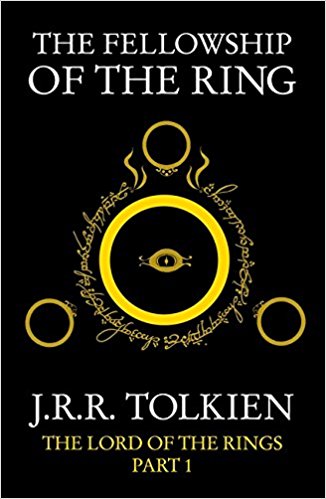
My first cover is of The Fellowship of the Ring, the first part of Tolkien’s trilogy. I ought perhaps to say that most of my books as a child and teenager had plain covers – often faux leather or the Penguin coded ones – and this came as an intriguing surprise. My own copy looks like this but is grey with black, white and red; I don’t currently have a scanner and Amazon don’t apparently have the old version. The elvish script and the way the shape reflects the title, the hint of exotic lands, heroic deeds and a group adventure – these all appealed to me as soon as I saw the book. I had no idea in advance what it would look like – a school friend had recommended it and I requested it as a Christmas present. It is a gift that has kept on giving, as I have read it numerous times, and have referred to the maps and notes when reading The Hobbit and after watching the films. My son-in-law assures me that if I hadn’t actually read my copies of the books they would now be valuable. They are valuable to me, in any case!

My second cover is perhaps a cheat. I have lost my copy, so even if I had a scanner I couldn’t scan it. So I looked on Amazon, in vain, and then googled images. This comes nearest but is not quite as I remember it.
George Macdonald’s The Princess and the Goblin was written in 1870 but still appealed to me when I came across it in the 1950s. The cover hinted at the themes of good and evil, of a child learning about hidden things, and of magical beings. I know my cover had the ‘fairy godmother’ element, and was, like this, a plain cover with a picture superimposed – actually stuck on – in the centre. I’m not sure it was exactly this one; I seem to remember more blueness.
I enjoyed the book and its sequel, The Princess and Curdie. I was never encouraged to read ‘fairy stories’, though perhaps this one was an exception because the author originally published it in a Christian magazine. This may or may not explain my current addiction to fantasy and all things fae! Anyway, I loved the story, though not really for the ‘good and evil’ aspect that the author was perhaps trying to emphasise. I loved the idea of the hidden world of goblins, of their possible interaction with ‘reality’ and the idea that an ordinary girl, albeit a princess, could be introduced to that world. I loved the cover, partly because of liking the contents, but also for its promise of secrets. It’s a precursor of stories like Mary Norton’s Borrowers and Pratchett’s Truckers for younger readers and CJ Cherryh’s Goblin Mirror for adults. It also echoes a variety of traditional tales such as the one about the elves and the shoemaker. I was, I remember, reminded of AA Milne’s Christopher Robin poem about the brownies who might have lived behind the nursery curtain.

Day three. My choice of cover is The Warden by Anthony Trollope. It is, of course, the first in the Barchester Chronicles, a series I loved before the BBC found it. I like the way this cover shows me a picture of rural England and suggests I can enter it and get to know the people and places in the books. It doesn’t try to impose a portrait of any of the characters, either from an artist’s imagination or from a film version, but lets me create them in my own mind. I originally borrowed the books from a friend and from the library, then my daughter bought me a set, (none of which had this cover). In any case, my copies were lost in the fire.
I enjoy the slow unfolding of Barchester life with its sense of place, the gradual character development, and the way the stories never follow traditional tropes or paths but grow out of the characters and their surroundings. I think I prefer Trollope to Austen, though it’s a close call. At any rate, I prefer both to Dickens or Eliot at least partly because there is less high drama and more recounting of gentle individual joys and sorrows. I like nineteenth century novels with their measured pace, so at odds with present day ideas of story-telling. I like modern novels too, but variety is good!

My fourth cover has to be The Colour of Magic by Terry Pratchett, the book that introduces the Discworld series. Paul Kidby’s covers (to the whole series) complement the stories. Both the illustrations and the stories are detailed, funny, wise, and refreshing. They teach us about ourselves and our world in the guise of fantasy tales and pictures, and repay frequent visits! I had all the books and have rescued some. I also had a calendar of covers which might still be around, buried in a box. I love looking at the pictures and finding the characters mentioned in the story. Needless to say, I love the books, too. I love all their covers and have just chosen this first one to represent the rest.

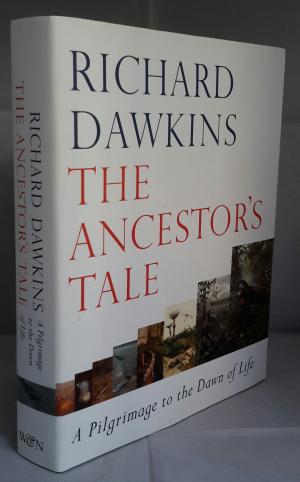
For the fifth day I’ve chosen The Ancestor’s Tale by Richard Dawkins. This was the cover of the copy I had (before the fire) but my version was a softback. It was quite hard to read in the physical sense – heavy, and difficult to keep open, with shiny pages that didn’t do my eyesight any favours. I had to use a lap tray and be careful about lighting. However, I loved the book and the cover seems to point to the wonders within! I can be irritated with the typical Dawkins stridency about all kinds of things revolving round evolution (even though I agree with him) but this is a purely factual book, presenting the latest in research. It is structured in a way that echoes The Canterbury Tales, which is amusing and holds the reader’s interest. Dawkins and his co-writer Yan Wong take the reader from the very beginning of life on our planet to the present day, taking their time, and exploring all kinds of byways as they go. I enjoy reading about biology, and evolution, and this book is excellent. It is also perfectly accessible to the ‘lay’ person, even though the research is, of course, excellent. If I repurchase it, I will not be going for the landscape softback edition even though the orientation suits the illustrations. It was too hard to deal with, and as a new copy would be mainly for reference purposes, a ‘normal’ book would almost certainly suit me better.

My sixth cover is for A Suitable Boy by Vikram Seth. It’s a straightforward romance though it’s far more than that and it’s very long (and very satisfying).The story concerns an Indian girl from a ‘good’ family, and the search for the right bridegroom. In the course of the novel the heroine and the reader meet a variety of possible husbands, and it is interesting that the western reader’s choice might well be quite different from the eventual decision reached by the heroine and her family. The book follows the numerous suitors’ lives in some detail, and gives us a lot of insight into life and culture in modern India, including politics, religion and gender issues. I loved the novel, was deeply immersed in the various lives and loves, and was quite startled by the final approval of the suitable boy. My copy (lost) had this cover, which I think gives a good idea of the contents: a gateway to the world of the upper class Indian in the second half of the twentieth century, not long after the partition from Pakistan. The peacock represents India, of course, but also refers to some of the candidates for Lata’s hand, as well as, perhaps, to Lata herself.

My final cover is one I do not possess (and have never had it) but which is firmly on my wish list. Harry Potter – A History of Magic, produced by the British Library, is the book of the exhibition. I don’t often visit London and when I did, I was unable to get a ticket to the exhibition at a convenient time, but I saw the television programme based on it, and would love to have the book. I’d like the hardback version because I know I’d be using it as a reference book and for me, neither e-books nor paperbacks are adequate for that purpose on a long term basis. I love the cover. The phoenix encapsulates the Harry Potter connection plus the theme of ideas rising from unlikely or unusual origins to create a tradition of magic. Since some of my writing involves fantasy and magic, I would hope to find inspiration and information within the text and illustrations. The television programme was tantalising and has raised my expectations.