I write like…

I found an amusing site. http://iwl.me/

If you load a sample of your writing, a few paragraphjs rather than a single sentence, it tells you which famous author you can compare yourself with…

Of course, if you have a variety of styles for different genres, there might be problems. I uploaded some of my non-fiction writing.

It told me I write like Cory Doctorow.

Now, I’d heard of him, but I’d never read a single word. Research showed me he writes sci-fi so I bought a novella for my Kindle. And that he’s a founder member of EFF, fighting to protect the internet against things like SOPA, P~IPA and ACTA. Someone I could be proud to emulate, then. I did more research and ended up subscribing to his blog. All because of an idle moment internet surfing!!

Self Publishing

Once upon a time…

Self publishing was once regarded as only one step above vanity publishing, despite the fact that some self publishers went on to become famous and in the past (i.e. before the rise of modern publishing houses) almost all authors were either self published or published by private patrons.

Vanity publishing tends to cost a lot and leave the author with a number of volumes gathering dust in the garage. There is no ‘validation’ either by acceptance (they are only accepting the book because of payment) or by sales. The sad thing is that most authors conned by vanity publishers don’t suffer from vanity – they think they have found a genuine publisher for their work.

The advent of p.o.d. with sites such as lulu made it easier and more profitable for people to self publish, particularly in the non-fiction field, where the small size of the potential readership often stopped big publishing houses from taking on interesting books. Other writers used the internet to provide their work on websites organised on a pay-to-view basis. These changes involved only a tiny number of writers, fiction and non-fiction alike, but were the vanguard of the current trend. Both still have much to recommend them but do require quite a lot of initial financial outlay, even though this is usually recouped. The financial outlay is what tempts people to compare them with vanity publishing. The p.o.d. model is probably best suited to books which will sell to a local audience or a very specific one, e.g. within a sport or interest group. The website route requires marketing skills and enthusiasm. Some bookshops won’t stock books that have been self-published, but then some bookshops are going out of business. Websites can be tricky to bring to the attention of search engines.

Then came the e-reader, Amazon, and Smashwords. This has been a rapid and recent ‘revolution’ and like others, I was initially rather bemused by it. Now, I’ve been reading, and learning, and want to share my findings with you.

**********

By about 2005 it dawned on a number of authors, both newcomers wanting to break into publication, and published writers wanting more control over their work and more reward, that:

*the global recession plus the rise of e-publishing has made it less and less likely that a total newcomer will be chosen in the publication lottery and even established series have been axed to make way for more ‘sure things’ such as TV tie-ins,  ghosted autobiographies of celebrities and other ideas that will make money for the publishers.

*editing, in the old sense, has been curtailed; you only have to look at the number or typos in modern books to know that authors are expected to do their own spell checking

*marketing, in the old sense, has also been reduced; authors complain about having to pay their own expenses to get to interviews etc. and that books are not always available at book-signings

*huge advances are very rare and in any case are just that – an advance against possible future earnings, plus, they are paid all at once and therefore are taxed within that tax year, which can be a financial drawback

*e-publishers give even more parsimonious rewards than the big houses (advances are almost unheard of), though often the royalties are higher; they do even less work in terms of marketing and editing; many (though not all) of their editors are less able compared with those who work for the publishing giants; there are drawbacks in terms of copyright agreements, being tied in to contracts, etc.

*e-publishers, to give them their due, also produce very nice print versions, but at that point turn into regular publishing houses…

*Kindle and Smashwords provide a cheap, professional e-publishing service and a number of authors are taking advantage of this and making money selling their books; why give rights and control to a publisher if it isn’t necessary? (Note that we are not mentioning Apple with their greed for copyright control.)

**********

There have been a lot of blogs and articles about this and I have been following: http://jakonrath.blogspot.com/, http://tashasthinkings.blogspot.com/ (Tasha is a friend of mine), http://donovancreed.com/ and http://blog.smashwords.com/, plus reading articles recommended by them and by others. I am also watching with interest Josh Lanyon’s decision to take back his books as the various agreements time out, and self publish. For in depth analysis I would recommend starting with Konrath. His rather humorous style conceals a great deal of interesting comment.

**********

Some of the arguments in favour of self publishing are:

* the writer retains more control over the book – editing, format, copyright, cover, price, marketing ploys

*the rewards are potentially higher; Kindle let the author retain 70% of the cover price if the book is priced at $2.99 upwards, and 35% for books priced below that.

*the rewards are paid monthly (good for tax purposes) and authors don’t usually have to ‘chase’ Kindle – something not unknown with big publishers

*readers will often buy cheap e-books on a whim and as a result, sales figures can be higher than with a traditional publishing route; of course they won’t come back for more unless your book is worth reading

*it’s free; there is no charge for putting your book on the site although of course like any writer you have the cost of your time and your materials (such as your computer) and your research – there aren’t even the postage/printing costs associated with submitting to the big print publishers

**********

Of course, some of the arguments against self publishing are very much the same points (with my comments in italics):

*the writer is responsible for the editing, format, cover, etc; but if you write on a computer anyway, you’re half way there and if you have good betas/supportive friends  it gets even more manageable and the sites give a lot of help

*your book can get lost in among the drivel that is coming out in e-books; well, yes, but it can also sink like a stone in a conventional publishing format or with a professional e-publisher; there is a vast amount of drivel out there anyway

* people will regard your book as somehow less worthy if you are only charging $2.99 for it; this is an argument that can only be resolved by your bank manager depending on your sales and it depends, in the final analysis, on whether you’d rather be rich or famous (given that both may not be on offer)

*self publication does not give you the validation that acceptance by a professional publisher does; no, it doesn’t, but see the previous point about sales; also, I wouldn’t try to self publish anything without a lot of beta input  from people I trust, so the validation comes at that point, and publisher acceptance is more like winning the lottery

*it’s a lot of work and you wanted to be a writer, not a publisher; but it is almost as much work to get something ready to submit to a publisher and then there’s all the waiting and worry; also, while marketing is a pain, a publisher expects you to do a lot of your own publicity anyway

*it only works for people who have already built up a fanbase of loyal readers; according to admittedly anecdotal but numerically vast accounts in Writing’, a magazine I subscribe to, this is not true.

**********

Note that I am not suggesting for a moment that weighty academic books or highly illustrated volumes have any place in the self publishing world. I think the professional publishers are going to have to change their whole publishing model to be able to continue to bring us that kind of thing and meanwhile I wish any authors of those sorts of books well and hope they manage to attract publishers’ attention.

By the way, the magazine I mention also has a free (but limited) online presence: https://www.writers-online.co.uk/ It’s worth a look.

**********

My own personal reasons for even considering self publishing are as follows:

*my work tends to stray outside the tight genres beloved by publishers, making it less likely to get published

* I have a kind of submission phobia, based on the assumption that it is statistically improbable that my work will be considered and that therefore it is a lot of work and worry for nothing

*some friends/family want to see some of my work published

*if I was published/self published, I could legitimately call myself a writer and thus justify spending hours on my laptop and in a dreamworld

*it is easy to share or ‘publish’ my fanfiction; I think/hope my original fiction is as good if not better but it is harder to get it to an audience.

I have to admit that I am not particularly interested in fame or fortune except insofar as both or either would allow me justify the hours etc. Of course I would welcome fame, in terms of interested readers. If I didn’t want to share my work I wouldn’t spend so long on it. I might write a first draft (second if you count the draft in my head) and leave it at that. All the rewrites and edits are for other people and for the pleasure of sharing. (Incidentally, I put the same amount of work into fanfiction which brings no monetary reward.) I wouldn’t say no to money, either, but it isn’t why I write, and as I’m retired it isn’t even a pressing necessity. I have my finances worked out to allow me to spend time writing; it’s the family demands I would like to be able to counter with claims that I had to ‘work’.

**********

I know some of you have experiences to share and others have plans. Are there general points I haven’t covered? (I’ll leave the details to Konrath etc.) And what do the rest of you think?

Reading and watching. January 2012

I thought I would post a monthly account of what I have been reading and watching. The date beside each book or film/series refers to the date of finishing a book or watching the last episode of a series. So Culpeper only just squeaked in. P refers to printed versions and E to e-books. I have not included fanfiction, despite reading a lot of it, and I have also left out most of the books I bought for/read with my grandson though Lost Worlds has made it onto the list. Magazines and e-zines have also been omitted. I have included unfinished books – which are rare in this household. I give a very brief comment on everything but if you have read/watched them and would like to discuss them, or if you would like further information, I would be delighted!

Books.

Jan1. P Culpeper’s Complete Herbal – Nicholas Culpeper. Fascinating insights into old medical

practices and a good resource for both plant information and names for fantasy writing.

Jan3. P Simply Sushi – Steven Pallett – Instant Masterclass. Interesting but overwhelming. I think

I’ll stick with Tesco’s ready-made variety.

Jan6. P Supertips 2 – Moyra Bremna. This was a re-read, found when I was packing books. It has

some timeless/great tips on all kinds of cleaning, gardening, cooking matters, etc. but also

some dated/hilarious ones. The sections on caring for your record collection/record

player are fascinatingly out of date!

Jan6. E Whiskey Sour – J A Konrath. A competent and gripping, somewhat gruesome thriller, on

the same lines as Karen Rose. I bought it because I’m following his blog about self-

publishing and was curious but will definitely read more by him and have already bought

two. I’ll talk about the blog in another post.

Jan10. P Mystery – Jonathan Kellerman. Yes, that’s the title though it’s also the genre. Mystery is

the latest in the Alex Delaware series and is as competent as usual. A kind of comfort

reading with exciting bits.

Jan12, E Men under the Mistletoe. Four fabulous m/m novellas brought out as a Christmas

anthology and on a Christmas theme. I bought it for the stories by Josh Lanyon and Harper

Fox, whose work I already know. Ava March and K.A. Mitchell were new to me but are

equally admirable writers.

Jan15. P Manchester Poets – an anthology including a friend’s work. I went to the book launch.

and my copy is signed. A mixed bag, as poetry anthologies so often are, but there’s

something there to appeal to everyone.

Jan19. P Personal Connections in the Digital Age – Nancy K Baym. This was a great summary of

the issues surrounding digital communication, both online and via mobile phones. The

had some interesting research results and some sensible arguments to make. As I’d put in a request to

‘Santa’ who kindly brought it, I had to read it a.s.a.p.

Jan20. P Books do furnish a room – Leslie Geddes-Brown. This is a visually fascinating ‘coffee

table’ book with gorgeous photographs and some good ideas about book storage. Some

weird ones, too.

Jan24. P Madness of Angels – Kat Griffin. This is a surrealist fantasy about London and magic, lent

to me by the same friend who let me borrow the Books book. With this one, I gave up at

p35. Overdone descriptions and no ‘hook’ or suggestion of where the plot might be going.

Jan28. P Lost Worlds _ Jon Howe. Howe illustrated much of Tolkien’s work. This is a great simple

reference book with beautiful pictures of ‘forgotten’ civilisations, some mythical and others

real enough but swept away by history or nature. I bought the book to put away for my

grandson but I suspect it will remain in my house so that I can share it with him.

Jan29. E The Best Christmas Ever – Anel Viz. A delightful and thought provoking m/m story about

an ‘unequal’ relationship between an intellectual and his mildly retarded lover. I shall be

reviewing it for Wilde Oats.


I note that this month’s reading is short on fantasy though Harper Fox’s story Midwinter Knights in the anthology contains supernatural elements.


Films: DVDs or TV series (usually watched on DVD or iPlayer). Some of the DVDs are rented.

Jan2. Spiral Season 1. (8 eps) A French cop/law show. We had already seen season 3 and bought

seasons 1 and 2 because we liked them so much. Season 1 is gripping and sets up a lot of

scenarios/relationships for the following seasons. The photography, all in Paris, is great, and

the acting is superb.

Jan3. Legend of the Guardians. A confused fantasy, unsure whether to be a cartoon or a serious CGI

adventure. Australian owls battle against the forces of darkness!!! Fun, but I won’t buy it.

Jan7. La vie en rose. Biopic of Edith Piaf. The story was told in a confusing way with too many

flashbacks, and the dark sets didn’t help. There were no complete songs other than ‘Je ne

regrette rien’ at the end. The story was interesting and sad but the film was disappointing.

Jan17. Public Enemies.(BBC. 3 eps) A well-acted drama with an interesting plot exploring the

problems faced by people wrongly accused/convicted. I was surprised by the happy or at least

hopeful ending.

Jan23. The Libertine (Johnny Depp). Amazing acting. Pity about the plot. The story deals with the

decline and fall of the Earl of Rochester in Restoration England. Depp’s portrayal of the earl,

from beautiful courtier to disease-ridden misery, was a masterpiece, though I have to admit I

would watch Depp in almost anything. The story is very thin and hardly worth a full length

film.

Jan24. Sherlock (BBC) Season 2. (3 eps) The second and third episodes were terrifying to watch, for

me. I find knife-edge scenes in films and on TV unpleasant, even though I will read them

happily in books. These were alarming and although I am familiar with Holmes canon, the

BBC version tweaks the stories for the twenty-first century and the viewer does not know

what to expect. I will no doubt watch season 3 next year and be scared all over again.

Jan29. Birdsong (BBC) (2 eps). Visually stunning, filmed around Budapest rather than in northern

France where the story is set. Mediocre acting and some odd ‘takes’ on WW1. I disliked the

book (by Sebastian Faulks)and disliked this.

Jan31. Bent. A Channel 4 film originally made for TV, based on Martin Sherman’s play about

homosexuals in Nazi concentration camps. Incredibly well acted and directed; powerful and

moving. I cried. Highly recommended but I wouldn’t put myself through it again. However,  I now

want a copy of Mick Jagger singing Streets of Berlin and it isn’t available.


So, 12 books and 8 films/series in January. I shall be interested to see what I manage in February. And as I said, I’d love to hear your comments on any of these.

Badgers

Badgers.       by Jay Mountney.     January 2012.

When the badgers came to our garden
they slipped in silently
in the dark,
ghosts with rough fur, claws and a sharp bite.
First they burrowed
under the shed but found
it was not quite
the des res they’d hoped for and so they went
via the lawn (and a fine game
of plough-your-own-furrow)
to the greenhouse. Beneath its foundations
they deliberated but decided the same
drawbacks applied and finally
they settled on the raised fishpond
where they spent the winter safe
under a kind of manmade ground,
dreaming of summer scents and the stars beyond.

When the badgers came to our garden
they dug out the conventions of gardenhood, the strife
between flowers and weeds,
the military precision of design,
and made it a haven
for their own version
of wild life.

When the foxes came to our garden,
hard on the badgers’ heels
(because after all, the place
was now a kind of haven),
they were not as particular.
They moved straight
into the tunnels under the shed;
the ones, you remember, the badgers had abandonèd
as not quite good enough.
The foxes didn’t care.
Looking for meals
or maybe fun,
they chased a few of the neighbour’s chickens,
not killing them,
just causing terror and and a rain
of feathers everywhere.

When the the badgers (followed by the foxes)
came to our garden
the squirrels, who had lived there peacefully
for quite some time,
chattered disdainfully
from the sycamore tree and then
left to seek better lodgings
on the other side of the fence,
telling the magpies they should consider moving while they could,
before the whole neighbourhood
was turned into a wild park.
The neighbour’s cat watched,
her furred expression
showing a kind of domesticated pain.
Her tail whisked.
I think she wished
the badgers had never come
to our garden.

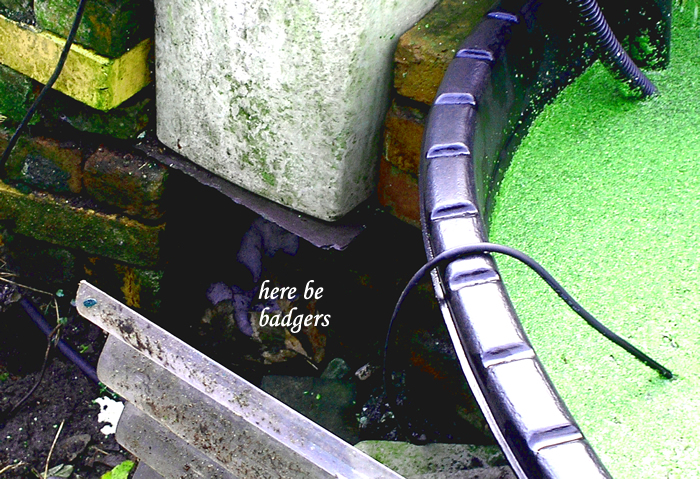
As you can see, the fishpond isn’t finished. Also, a lot of the fish died last winter when we were away during very cold weather and something went wrong with the pump. So it is currently more of a white elephant than a feature, But the damage the badgers have done to what used to be a lawn has to be seen to be believed. And of course they are protected so we can’t evict them.

I write in my head…

I write in my head.

Yes, I really mean that. All my planning and the bulk of my writing is done inside my mind. Commiting the results to the keyboard is a kind of after-effect though I do fill in some details at that stage. The writing is a purely mental thing, so much so that occasionally I write a blog post in my head and forget I’ve never posted it.

At school, I was frequently scolded for not producing essay/story plans (in all subjects, not just ‘English’). I never really understood the need for them. Why would I spend time writing things down when they were already written in my mind and I could refer to them there? The only possible reason for writing them physically would be to share them with others. Why would they want to share my plans? Surely the outcomes – the physically written essays/stories would be proof that some planning had taken place?

At uni nobody seemed very bothered about planning; the outcome was everything, and I relaxed.

When I was training to teach, as a post-grad, I finally realised that not everyone thought/wrote the way I did. Some people would always need a physical written plan to work to and much of their work would only form as they wrote/typed it. I was surprised, almost shocked, to learn about different ways of thinking and learning, but I was also fascinated.

I needed to accept that children should be encouraged to formulate plans, and that I could help them with that if they shared those plans with me. That was fine, although I have to say that just as people have different learning styles, they have different planning styles; once someone’s finished work shows evidence of good planning they should not, I think, be forced to share those plans at any age, and someone who feels as I do could be encouraged to prove their planning ability at the outset. It can be very counter-productive and time-consuming all round to have to deal with pages and pages of  unnecessary notes.

I complete summaries and plans in my head, arrange and rearrange their components, rough out a few pivotal scenes, play with dialogue and descriptions, interview my characters and even ‘write’ extra scenes that will never reach the keyboard but which help me to develop the main plot.

I do, of course, commit some things to physical files and folders, either in notebooks or on my laptop. I thought long and hard about why I might find it essential to do this and realised that it all concerned dates, timelines, chapter sequences, indexes, etc. Then I understood. They’re all to do with numbers, to some extent. I have almost no memory for numbers. I can handle them and my maths ability is at least average and probably slightly above that, but I am capable of forgetting my car numberplate, and have never managed to learn my own mobile phone number. So anything that involves numbers needs to be recorded in such a way that there is an external reminder, something I can refer to!

The other thing I record on the laptop is research/website information I have come across. I defy anyone to memorise quantities of URLs and assign them correctly. In that respect, bookmarks (I use Firefox but whatever you use is almost certainly just as good) are brilliant. Before the age of the internet I had card indexes with that sort of thing on them but those are harder to keep up to date.

So by the time I reach the keyboard, whatever I am going to write is in a sense already written. This means I can type a story or an account at what must seem like astronomical speed.  I am mostly ‘copy-typing’. Yes, I tweak and add as I go but what gets recorded is definitely a second draft.

Writer’s block has never made sense to me. If I approach the keyboard I already know what I am going to write, in detail. Thinker’s block? Well, no, not as a rule; I just have to suppress some of the wilder ideas that make their way into my consciousness and sort out the gold from the dross. If I didn’t have the story ready to roll I wouldn’t sit at the keyboard in the first place. I have plenty of other things to do.

Note that I talk more about my laptop than about pencil and paper. I dislike writing by hand for any length of time; I literally get writer’s cramp. So as I don’t need to plan in note form, I am unlikely to write a story, poem or essay on paper. I keep paper for shopping lists, appointments, addresses, that kind of thing. I plan menus in my head but the number thing kicks in again and I have to write a plan of timings to enable me to produce a dinner party meal.

I started to hate teaching when we were made to commit our lesson plans to paper for the head’s approval. It took so much time and was such a sterile exercise. It felt like hard work, in a physical sense, when I had been used to planning my lessons in my head while I was ironing or walking the dog.

A lot of people have said they have ideas while e.g. ironing or walking the dog but forget them unless they write them down. So far as I know that has never happened to me. Of course, I suppose I could have written a best-seller in my head on a long car journey and then suffered amnesia and I wouldn’t know but it seems unlikely.

I wrote this post a few days ago, while tidying the house. In my head. And decided it deserved a wider audience. How about you? How do you write?

SOPA, PIPA… and ACTA

I am very pleased about the mass protest that has stopped SOPA and PIPA for the time being. I am horrified at the way the mass entertainment industry has taken upon itself the role of policing the public outside as well as inside the USA.

They claim to be fighting piracy but I beg to differ. Piracy (which is to be deplored) is the use of someone else’s work without consent for profit, either not sharing that profit with the originator or seriously decreasing the originator’s chances of making a profit.

Sites that provide downloads of films, music, and books without consent,for payment, are piracy and of course should be prevented from operating. However, karaoke sessions, remix vids on YouTube, fanfiction, reviews that quote/illustrate, etc. etc. are not piracy. In fact, they often act as free advertising for the original works.

Some free downloads of films etc. are piracy but others are a desperate attempt to share with the world the work of actors, singers etc. whose films/TV shows/music have been published solely in the USA and are otherwise inaccessible to the rest of us. In a sense it is the American entertainment industry who are the pirates because they steal the creations of artists in all genres, not rewarding them sufficiently and not allowing global disribution of their work.

SOPA and PIPA are not the way to fight internet piracy. They are, it seems, the way to get a large proportion of the world very incensed indeed! Including me. I have signed various petitions, donated to more than one organisation, talked to anyone who would listen and followed the debates, official and unofficial, closely.

I am also concerned at the closing down of Megaupload and the implications of that, and the current attempt to extradite Richard Dwyer from the UK because of actions he took solely in the UK. More reading, petitioning etc.

I am not, at present, in favour of Black March. In its present form I think the idea could hit a number of independent producers/publishers/record companies who in fact supported the protests. Any attempt to make Black March more specific in its targets would, I think, make it unwieldy.

A further matter for concern is ACTA. This is a global treaty, on its way to being signed by about 39 countries. It purports to combat the manufacture and sale of counterfeit goods and the copying of patented medicines (for use in the third world – go figure – Oxfam are protesting loudly). Because the treaty wording is broadly and loosely drafted the results will be open to abuse, whatever the current governments say about their intent. There will be the potential to enforce invasions of privacy on a massive scale ‘to prevent piracy’.

Look at this YouTube vid:

Then subscribe to this news feed:

https://www.laquadrature.net/en/after-sopapipa-in-the-us-acta-makes-its-way-to-the-eu-parliament

And if you are in UK sign this petition:

http://epetitions.direct.gov.uk/petitions/20850

I intend to follow matters assiduously and will be glad to find ways of protesting and publicising the issues. I have contacted campaigning groups, my MP and my MEPs.

I know that this matter is merely shelved in US and not dead at all elsewhere. We need to stay alert.

What do you think? And can you help to spread the word?

Writers who inspire me

A friend asked, in her blog, who inspired us… She gave examples of people who inspired her, and gave quotations from their speeches or writing.

So here are a few of the people who inspire me. They are all authors, two fantasy writers and a poet.

J.R.R.Tolkien British scholar & fantasy novelist (1892 – 1973)

“A dragon is no idle fancy. Even today (despite critics) you may find men not ignorant of tragic legend and history, who have heard of heroes and indeed seen them, who have yet been caught by the fascination of the worm.”

“One writes such a story not out of the leaves of trees still to be observed, nor by means of botany and soil-science; but it grows like a seed in the dark out of the leaf-mould of mind: out of all that has been seen or thought or read, that has long ago been forgotten, descending into the deeps. No doubt there is much selection, as with a gardener: what one throws on one’s personal compost-heap; and my mould is evidently made largely of linguistic matter.” (On the creation of LotR)

“What really happens is that the story-maker proves a successful ‘sub-creator’. He makes a Secondary World which your mind can enter. Inside it, what he relates is ‘true’: it accords with the laws of that world. You therefore believe it, while you are, as it were, inside. The moment disbelief arises, the spell is broken; the magic, or rather art, has failed. You are then out in the Primary World again, looking at the little abortive Secondary World from outside. …… Every writer making a secondary world wishes in some measure to be a real maker, or hopes that he is drawing on reality: hopes that the peculiar quality of this secondary world (if not all the details) are derived from Reality, or are flowing into it.”

“I cordially dislike allegory in all its manifestations, and always have done so since I grew old and wary enough to detect its presence. I much prefer history, true or feigned, with its varied applicability to the thought and experience of the reader. I think that many confuse ‘applicability’ with ‘allegory’; but the one resides in the freedom of the reader, and the other in the purposed domination of the author.”

 Guy Gavriel Kay (Canadian fantasy writer !954 – )

“…it also needs to be remarked that sagas and idylls are constructed, that someone has composed their elements, selected and balanced them, bringing whatever art and inclination they have, as a offering.”

Robert Frost (American poet 1874-1963)

In Neglect (published 1915)

“They leave us so to the way we took,
As two in whom they were proved mistaken.
That we sit sometimes in the wayside nook,
With mischievous, vagrant, seraphic look,
And try if we cannot feel forsaken.”

Who inspires your writing? Can you share any of your favourite quotations?

Cautious introduction

I am a writer.

I have had very little published: odds and ends of poetry in school and parish magazines; some educational texts; an academic review; a few flashfics and book reviews in online zines.

I write in more than one genre: non-fiction (mostly travel and cookery); children’s stories; reviews; poetry; adult fantasy/romance. I have abandoned the academic stuff; more about that in a later post, perhaps. Most of my output has so far only been read by people reading my various blogs. Because I move from genre to genre I use pen names – no sense upsetting, worrying and confusing the readers! My nearest and dearest know who I am, as do the bank and the tax office should they ever need to. Other than that I can’t imagine that my various personas are anyone else’s business and so I run a mile from Facebook and from Google in all its manifestations. They make it impossible to keep pen names in completely separate compartments without a great deal of deception and hard work. A writer’s nightmare!

I have other blogs where I share personal stuff, and the travel and cookery aspects of my work. I use one of them for fanfiction which I also write under another name. I have a website, too, where I keep these things accessible.

Here I will be sharing my thoughts mainly on the adult fiction and perhaps the poetry. Of course, sometimes the genres overlap and perhaps have something to offer each other. In that case I will refer to them, but you need not, on the whole, expect recipes or travelogues. I won’t be sharing the actual stories in full, either, just the experiences, problems and joys of creation.

I have retired from teaching (mostly language and literature) and have been writing fiction quite assiduously for about six years. I now have quite a body of work that needs to be submitted somewhere or other. I don’t suffer from writer’s block but I do suffer from submitter’s block. I know all about the idea that you need luck, to be in the right inbox at the right time, etc. Why should I be that lucky? I have never had much of a gambling streak! You also, I believe, need persistence. Well, I persist with my writing…

I have been following a number of blogs and reading books about self-publishing, particularly e-book publishing. I have just about decided that 2012 is the year when I will try my hand at that. Hard work to make a go of it, yes, but all under my control and not requiring any element of luck After all, if nobody buys my stories it’s hardly the end of the world. I know my friends like them, and I won’t have spent anything other than time.

I will share my journey, including set-backs and learning curves, here.

There! That’s me, and the purpose of this blog. I’m hoping to make friends, give people the benefit of my experiences and learn from their comments en route.