The House (a sci fi ficlet)

They came up between the floorboards at first, a little like smoke, or perhaps mist because nobody seemed to suspect fire. Tendrils crept into the various rooms, up the stairs and down into the root cellar.

They made things strange. Not uncomfortable, exactly, or not that anyone could articulate. There was an atmosphere of oddness, of unrightness. A glass that had been polished and put away would reappear on the table, smeared, with a yellowish sediment in the bottom. A bed that had been neatly made would be tumbled and creased, the pillow tossed on the floor. A towel in the bathroom would be wringing wet when nobody had used the basin or shower since the previous day. Everything could be ascribed to poor memory, to human error. But everything added up. Nobody was harmed, but nobody was happy and eventually they left. They sold it, of course, but the next residents, and the ones after that had the same experiences. Ridding the house of humans took a few years but they could afford to wait.

Next, they turned their attention to the small things. The bugs that lived in the cracks, once there were no humans to clean the place, found their cracks filled with unpleasant textures and smells. The mice under the kitchen sink had a nest damp from drips even though the taps were no longer working. The birds that built homes in the roof space had a feeling that predators were constantly overhead. They all left, not at once, but one by one, reluctantly but in the end with relief.

Then the moss on the roof failed to thrive. The lichen that tried to establish itself on the front step found the atmosphere polluted despite the lack of anything within miles that could affect it. The creeper on the back wall rotted.

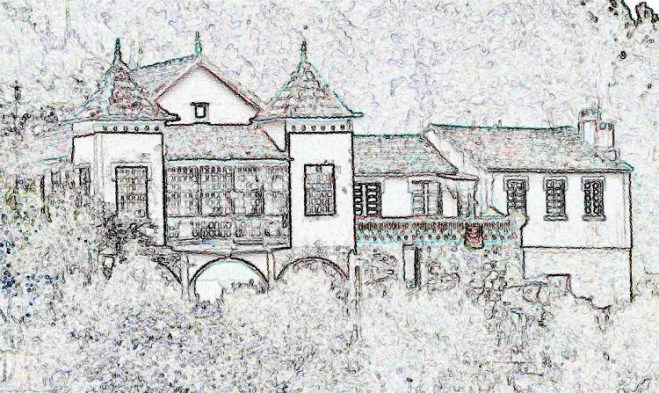
At last they had the house to themselves. It was a beautiful house, built from aged silvery grey wood with large airy window frames. It was the perfect home and it had taken a while to get it exactly the way they wanted and it had taken a lot of work but at last it was finished, and they settled down. Anyone passing, though very few ever passed, might have heard, soft on the evening air, a sigh of contentment.

(The picture is not mine. It’s a slightly photoshopped version of one I found on Pixabay by Wyosunshine. The information for the photograph said it was free for even commercial use. It’s very similar to the one used for a prompt that inspired this ficlet. Given a lack of wooden houses anywhere near either of my homes, I felt obliged to go looking and make sure there was no copyright violation. One or two of you might have seen the ficlet a while ago on my personal journal.If so, ignore!)

Autism Awareness Month

Autism Awareness Month is of passing interest to people who are not involved with autism on a daily basis. For those of us who have a close family member with the condition, we don’t have ‘autism month’ – we have autism day after day after day, month after month, year after year.

However, autism month does at least give us the chance to share our thoughts with the hope that people might be slightly more willing to listen – not just to sympathise but really understand.

Autism is a spectrum and people diagnosed as autistic can be almost anywhere on it. They can be highly skilled, or unable to function in nerotypical surroundings. They can be apparently easy to deal with, simply seeming to be reserved or cold, or they can have all the social problems of a toddler with uncontrollable tantrums. They can be anywhere between all these, or different again. The media don’t understand and just lump them all together. People with physical conditions such as blindness, deafness or paraplegia are not lumped together in quite the same way. (Governments manage it, but only in terms of costs and benefits.) Most people, even journalists, can see the different problems and needs when it comes to physical problems.

My grandson is autistic. He also has ADHD and high anxiety levels. He is, into the bargain, gifted across all subjects other than personal and social education, and team games. He is nine years old. He has the academic skills of a teenager (and some of the knowledge) and the social skills of a four year old. He was diagnosed at the age of five, when it became obvious that his progress in mainstream school was causing difficulties for everybody, he has an EHCP (these replaced the old ‘statements of special educational need’ and cover health as well as education) and he has medication, prescribed and monitored by a psychiatrist, to calm his anxiety and help him concentrate.

He is gorgeous. Really interesting to talk to, charming most of the time, imaginative and caring. He finds it hard to understand sarcasm, satire, and hidden agendas. He is truthful, and expects the same of others. He loves animals, sport, computers and books. He has friends and enjoys outings to the park or the swimming pool. He is easily upset and has occasional panic attacks and meltdowns, more often at school than at home. He is aware of his condition, approves of his medication, and finds his psychiatrists ‘interesting’.

For the last twelve months he has been receiving only part time education. When he has a meltdown he is taken out of the classroom by his teaching assistant (full time funded by the EHCP) and kept in a ‘calm room’ where he is given a choice of educational activities on an iPad. He is allowed to choose whether or not he goes back to class. (Guess what he chooses!) In any case, he does not attend school in the afternoons, he is not permitted to join the class for things like swimming, and until recently he often missed playtime (until his meds were increased). The school have tried really hard to cope but nobody on the staff has specialist training or knowledge, and the only advice they have comes from a special school for autistic children with low academic ability. (They told them to reduce pressure at all costs.) Parents and grandparents are, of course, not regarded as experts.

The local authority have been trying to find a placement. We, as a family, rejected the offer of a place at the school for low ability children. He would be just as isolated there, and with even less chance of studying to higher levels with anything resembling a peer group or adequate science facilities.

Now, at last, there is good news. A school run by a private trust, for children with challenging behaviour, has opened just a few miles away and he has been offered a place (after two interviews and a lot of to-ing and fro-ing of files). It sounds ideal – its sister schools in other parts of the country are good – and it will take him right through to GCSE in the core subjects so he will be able to avoid the trauma of transfer to a secondary school that would almost certainly be even less able to cater for his needs than his primary school.

For him, for us, and for the primary teachers who tried and failed, this is excellent news but it makes me think hard about the way we provide for children like him.

The local authorities in UK have had to close many special schools. This has been basically a cost cutting exercise although there is an attempt to pass it off as ‘inclusivity’, good for both children with special needs who will feel included, and ‘normal’ children who will mix with children with different needs. Frankly, I don’t think my grandson was ‘included’ at any stage and I’m fairly sure this is the case for a lot of children with his problems. The cost cutting has not resulted in extra money going into classroom provision for children like him or into extra staffing and staff training. It has merely allowed local authorities to keep up with rising costs. It has done nothing to educate either the teaching force or the media.

It all strikes me as very similar to the much vaunted ‘care in the community’ for adults with mental health problems. People with widely differing needs are abandoned to social services that are already stretched to capacity.

It is possible to extrapolate wildly from the arguments for inclusivity or community care. We could suggest that intensive care patients could be nursed at home or that patients from e.g. Broadmoor could live in locally managed sheltered housing. These are extreme examples, of course, but nobody would dream of suggesting they should be tried. But there are many people who fall between these extremes and the commonly held image of ‘special need’. The problem is that until someone is in really dire physical or mental straits it is considered reasonable to try to accommodate them in facilities that are designed for the average person, child or adult. When this doesn’t work, there is panic as officialdom tries to find placements that do not exist within public provision.

So what happens? Private companies move into the gap in the market. Some of them, including the trust that runs the schools I have already mentioned, do an extremely good job and we can only be grateful to them. The same applies to private medical facilities that help the NHS to cope. But the fact remains that they are private, that they make a profit, and that that profit comes from the taxpayer. The local authority are funding my grandson’s place at the special school and are paying fees similar to those paid to private schools, from our tax.

I am grateful to them. I am grateful to the school, simply for existing, for providing something that is not available in ‘mainstream’ provision.

I still think the philosophy and policies that have brought about this state of affairs are morally wrong.

My grandson looks ‘normal’. Until you watch his behaviour or listen to him, you have no idea there is anything unusual about him. He is extremely intelligent, articulate, nice looking and physically graceful so he doesn’t quite fit the usual ‘special needs’ definition. He is also in extreme need – need of somewhere that can deal with his challenging behaviour at the same time as stretching his mental skills, and somewhere that does not simply put him in an isolation room with an iPad, reducing his wish to learn and his will to succeed.

Research is still ongoing and expert opinions and knowledge about autism are in flux. There are some brilliant psychiatrists doing their best to find out more, and to explain their findings, but the knowledge trickles down very slowly to the grass roots of teachers or even educational psychologists. It takes even longer to reach the media, the general public and the politicians. Fifty years ago, my grandson would either have been punished into some kind of submission for his expressions of his anxiety, or would have ended up alienated from the school system and possibly from society. We can only be glad that this is no longer the case.

He, and others like him, have a great deal to contribute. I can foresee him in some kind of IT work, helping to shape and maintain the future for all of us. I know of similar children who excel at the arts – music, in one case, drama in another. These are by no means the ‘idiot savants’ so beloved of media stories. They are highly intelligent young people who simply cannot function in a class of thirty mixed ability pupils with just one teacher but who can be helped to interact with society, given patient tutors and calm surroundings.

As I said, autistic people are as different from each other as they are from neurotypicals, but there are a lot of them, all with very special needs, and it seems only the private-for-profit sector is prepared to meet these.

If a month devoted to autism helps to educate people about these needs, then it will be welcome. But at the end of the month, children like my grandson will still be with us, needing to learn, needing to socialise, and most of all needing to be understood and loved.

Autism is a spectrum. Yes, I’m repeating myself but it bears repetition. People with the condition can be almost anywhere on the spectrum. We need to get this across to the public at large. Now.

March Reviews

Since I’ll assume you’ve now all read my post about how I rate things I can include the abandoned!

March Films and TV

Spy in the Wild (BBC)*****

A highly enjoyable series which filmed animals using spy-cams – things like tree stumps, dung, etc. were all utilised, and some of the cams were sophisticated robot animals. The final programme showed how it was all done and I assume the cost goes towards future filming for other series. However, I’m watching Secret Life of the Zoo (BBC) *****, which is an ongoing series following animals and keepers at Chester Zoo. I got interested because it’s my nearest zoo, and it’s a lovely programme. Also, I think it has in fact taught me more about animal reactions to each other than Spy in the Wild did, despite the fact that that was the stated purpose of the spy idea, and the secret life is more of a ‘diary’.

Yuri on Ice Season 1***

So many people are so excited by this. The story is sweet and the animation is good, but I would be more likely to watch the same thing filmed with live actors. The skating sequences are very pretty but also very long and leave little room for plot progression. I won’t be watching season 2. The basic story is the growing relationship between a Japanese skater and his Russian coach who is an ex-skater. Nice, but not world shattering. I’ve read better storylines in the Ice Hockey Real Person Fiction fandom.

Lewis season 9 *****

The final season. I was away so much I had to rely on boxed sets and my family and friends gradually got them all for me. I have loved the entire series. I have two complaints about this last season. Firstly, the directors changed the introductory scenes and music, which had always been, for me, part of the charm. Then the storyline that paired Lewis with Laura Hobson never seemed to me to be believable; there was no on-screen chemistry between them. It isn’t just that I wanted a slash pairing. I was always happy (in Morse) with Lewis’ marriage, and in Lewis I was happy with the various pairings attributed to Hathaway. Lewis and Hobson? No. I think the writers wanted to round the series off with a romantic ending (why? viewers don’t demand that) and couldn’t find an alternative. However, I’ll still give it five stars, for the episodes, for the acting, for the locations, for the entire concept. Morse had spin-offs – Endeavour, as well as Lewis. I think Lewis could well generate another spin-off. Hathaway and Lizzie make a good team, with the extra dynamic of the new Chief Superintendent. Crossing my fingers for a series called Hathaway, though I believe Laurence Fox is less than keen!

Sense and Sensibility****

I’ve been wanting to watch this for ages and a friend kept saying they would lend it to me and then saying they couldn’t find it. So I finally bought it. It was good – good acting and true to the book. But there were aspects of the direction I found flawed. For instance, sound was lowered when the characters were further away. Now this might be realistic, but it doesn’t make for ease of following the dialogue for the viewer. Probably, in the cinema, it wouldn’t matter because cinema sound is always so loud. But my laptop was not able to compensate.

Dark Horse ***

A lovely true story about a winning racehorse bred by a village syndicate in Wales. However, the film was presented as a long documentary which didn’t quite work because the supposed ‘live’ clips inevitably didn’t always use the right people or animals, or used them but not at the right age. Also, the DVD was faulty towards the end.

2Cellos on YouTube*****

I keep telling myself I ought to actually buy the music these guys make. The trouble is, I like watching the videos too much and for most of the music, whilst they’re good, without the visuals they’re not playing pieces I would listen to frequently enough. So I go to the YouTube versions and follow them on Facebook. I assuage my conscience by thinking that YouTube hits add to their profits. My favourite – which I fell in love with even before I knew who they were – is their version of the Game of Thrones theme, played in Dubrovnik. The vids are stunning and the guys are such eye candy…

Not a lot this month – I’ve been concentrating on the news and related stuff online!

March Books

20 altogether and then 4 abandoned.

The excellent: 11 highly recommended (five star) this month (which might be a record).

Don’t Kiss The Vicar/Charlie Cochrane*****

Absolutely delightful m/m romance between a young vicar and a member of his congregation. There was a mystery involved, which was interesting and eventually satisfying. Although it was only a poison pen mystery, not a murder, the characters were engaging enough to make it quite gripping and I didn’t guess who the writer was till quite near the end. I would hope there might be more parish problems for this pair to solve. As a vicar’s child I was all too familiar with some of the problems faced by the vicar and his parish council. Highly recommended.

Down Under/Bill Bryson*****

I love Bryson’s wry humour and have read a lot of his work. This book takes us on a trip round Australia and as I had visited some of the locations he explores I felt really ‘at home’. He always so obviously loves the people and places he pokes gentle fun at. And of course there’s a wealth of factual information in there too. I was glad I had the paperback and not an e-book version because I kept referring to the maps. I know you can do that with e-books but it’s less satisfactory and you, or I, at any rate, risk losing the place… Highly recommended.

Daughter of Smoke and Bone/Laini Taylor*****

Wow!! One reviewer suggests an amalgam of Northern Lights and Pan’s Labyrinth. I would add Good Omens and Neverwhere to the mix. A fabulous fantasy that starts in Prague, deals with otherworld explanations for angels and devils, has heartbreaking romance and characters who twine themselves into the reader’s soul. Karou is both a modern girl, an art student, and not quite human. Akiva is both an angel and a soldier, a reluctant killer who thinks he has lost the great love of his life. The writer, in her notes, says she writes because she finds it unsatisfactory that life does not, for instance, contain dragons. Nor, so far, does Elsewhere, in this story. But there are two more volumes to come. I might have to wait till my birthday. So highly recommended it’s off the normal charts.

When Christmas Lights Are Blue/Harper Fox*****

It’s only a short novel but it manages to include homophobia, racism, honour killings, Lockerbie, the paranormal, the state of the NHS and even Brexit. A gripping m/m story set in rural Northumberland, with winter storms, ambulances and love. I like Harper Fox’s style and her characters are always so three dimensional – even the paranormal manifestations. Highly recommended – especially as a Christmas ghost story with a happy ending.

No Place To Hide/Glenn Greenwald *****

I watched the film at the time Snowden’s whistle blowing hit the headlines. Then recently, with all the focus on surveillance, I felt the need to remind myself of just what had happened. This is a fascinating account, much better than the film in many respects because it explores the motives of the press etc., as well as the protagonists, in more depth and recounts the experiences of Greenwald’s partner and other related stories. Highly recommended for anyone interested in the politics of surveillance.

Nowhere Ranch/Heidi Cullinan*****

Roe leaves a homophobic family and ends up with Travis on Nowhere Ranch. On the way we get a good look at BDSM (the good consensual kind that 50Shades hasn’t heard of), ranching, homophobia in various shades, education, unplanned pregnancies, and other assorted delights. I didn’t want the story to end! Heidi’s minor characters are always so well rounded that I feel as if she’s writing about my neighbours and when the book ends I’m sad they’ve moved away! I’m not always a BDSM fan but this was really well done, and not particularly explicit for readers who are not into that. Highly recommended.

The Last Runaway/Tracy Chevalier*****

I love Chevalier’s books because she takes a well known period of history and looks at it from a fresh and unexpected angle. (Mediaeval tapestries in The Lady and the Unicorn, Dutch art in Girl with a Pearl Earring, Dorset fossil hunting in Remarkable Creatures). In this story a Dorset Quaker goes to America in the mid nineteenth century with her sister who is going to marry another Dorset Quaker who emigrated in advance. The book chronicles Honor’s experiences both as an immigrant in Ohio and in relation to the Underground Railroad helping runaway slaves reach Canada. Chevalier explores the range of northern attitudes to southern slavery and the amount of help that even Quakers were prepared or not prepared to give. Honor’s life in Ohio was fascinating and cast a new light on already known facts about the escaped slaves. Beautiful writing, well developed characters and a great story. Highly recommended.

Eleventh Hour/Elin Gregory*****

Miles and Briers are spies in London in 1925, working to defeat an anarchist plot. Guns and cars and grenades. Undercover spying and observation. Homophobia. Sewers. Cross dressing. This is a brilliant and exciting m/m ‘thriller’ which should appeal to anyone who loves either the later Bond films or the Professionals series. I adored it and hope to see them at work again. Highly recommended.

Fiddleback/J.M.Morris*****

This calls itself a novel of mystery. At the start, Ruth is searching for her brother Alex, who is missing, and looking back on her relationship with an abusive ex-lover, Matt. The search for Alex leads to unexpected places and events. The mystery deepens until we, like Ruth, are not sure what is real and what is not. The ending is almost satisfying and yet there is a twist right on the last page which leaves the reader shivering. I don’t usually like horror stories but this is not really explicit, just very, very dark in places. I was totally hooked and didn’t realise what was going on until Ruth did. So the writing was obviously structurally very assured as well as being technically good. Highly recommended for anyone who enjoys psychological thrillers.

Labyrinth/Alex Beecroft*****

This is an almost luminous book set in Minoan Crete. Kikeru has not quite decided whether to be male (and forced to marry) or female (forced to be castrated and then to be a priestess) then events intervene in the shape of Greeks who want to invade. The story deals with the way Kikeru defeats the invasion with friends and family to help, but even more so it deals with various shades of sexuality and desire. The legend of the Minotaur is nicely twisted to further the plot. The research is impeccable (as I have come to expect with this author) and the only ‘inventions’ for the sake of the story are those which researchers disagree about anyway. A gorgeous tale that will bear re-reading. Highly recommended, especially for those who love history and archaeology.

The Silent Scream/Karen Rose*****

I know I said I wasn’t going to buy any more of Rose’s books but I already had this and I’m glad. There was more than one villain, all coming from different perspectives and the mystery of motives and links was kept going right to the end. The use of deaf victims and witnesses and the problems of interviewing them was well handled and interesting. The romance was a bit OTT but was a nice tie-in to an earlier book. It follows another book which I had read, but apart from knowing a little more about one or two minor characters, the first book wasn’t essential pre-reading. Highly recommended for those who like romantic thrillers. And now I really am abandoning this author, partly because of the cost of even her e-books. No more, unless I see them in a charity shop.

And the rest, good: 10 books which were fairly good but which don’t come quite so highly recommended.

In the Spotlight/Charlie Cochrane****

This is two books, packaged together. All That Jazz is a longish novella that explores attitudes to cross dressing. If Music Be is a short story that has the protagonists taking part in a production of Twelfth Night and visiting their own prejudices in light of the play. The stories work well together because of their connection with the theatre. I just wanted more, in both. And the proof reading could have been better. Good, but not five star.

The State of Hate: Hope Not Hate report for 2016****

Political information presented in an easily digested form. Useful if you are interested in current Brit politics.

From Venice to Istanbul/Rick Stein****

Eastern Mediterranean cookery presented with perhaps too much emphasis on the author’s wanderings in the region rather than the people he got the recipes from. Some nice recipes to try and it made me go out and replace my empty bottle of pomegranate molasses.

Sheep’s Clothing/Elin Gregory****

A reluctant gay werewolf plumber moves to Wales. Amusing and romantic but far too short. It’s part of a series but there’s no indication of whether we are likely to meet this particular hero again so I’m reluctant to indulge.

The Complete Book of Spices/Jill Norman (1992)****

This was a re-read but last time I think I skimmed, looking for spices I already knew. This time I read about all of them and it was quite informative but didn’t, sadly, spend much time (or photography) on the really unusual ones. Also, over 20 years later, remarks about availability in shops can be rather quaint. Worth having for reference.

lab romance/Brad Tanner***

Well written romance between researchers. I didn’t end up caring about either of the ‘heroes’ but it should be a popular read.

Chat-Line/Clare London***

Nicely done brief (too brief?) tale of a mistaken phone call that leads to possible m/m romance.

Twelfth Night/Clare London***

Another pleasant m/m/short story with one partner watching the other playing online games and waiting for them to return to reality.

Clare’s writing is good but I prefer longer stories in this genre. If you like short stories, these could be for you.

Murder Any Witch Way/N.M.Howell***

First in a series of urban fantasy crime stories. I found the heroines tiresome and the heroes were shaping up similarly so I won’t be following their adventures. Quite an amusing mystery plot and well written.

Formatting e-Books for Writers/Susan K. Stewart***

This didn’t tell me anything I didn’t already know and personally, I think the free guides from Smashwords and Amazon are a better bet, but –  if you are going to self publish and you aren’t sure which platforms to use, and you want to know things in advance of hiring ‘experts’ to help, this might be the book you need.

and bad: nothing, this month, between reasonably good and totally unappealing (to me). 4 books I abandoned:

Incoming/AE Wasp.

Abandoned. I mentioned this last month and I tried again. But I’m not American and I just couldn’t grasp the basic premises of this to an extent that would let me enjoy the story.

Willow/Amy Richie.

Abandoned. Bad formatting made it impossible to read in comfort.

Red Mountain/Boo Walker.

Abandoned. The story of four very boring people in the wine growing region of California and how their lives intertwined. Nothing was happening and I didn’t much care whether it did or not.

Piercing the Veil/Nicole Taylor.

Abandoned. It started in some kind of fantasy world then moved to modern US. A woman here was possibly being followed by a man from there. No interesting characters appeared and whilst it was obvious our world and the fantasy one were going to intersect I found I didn’t care.

March fanfiction.

I’ve read quite a few short fics and drabbles but none worth separate mention. I’ve been concentrating on the articles in:

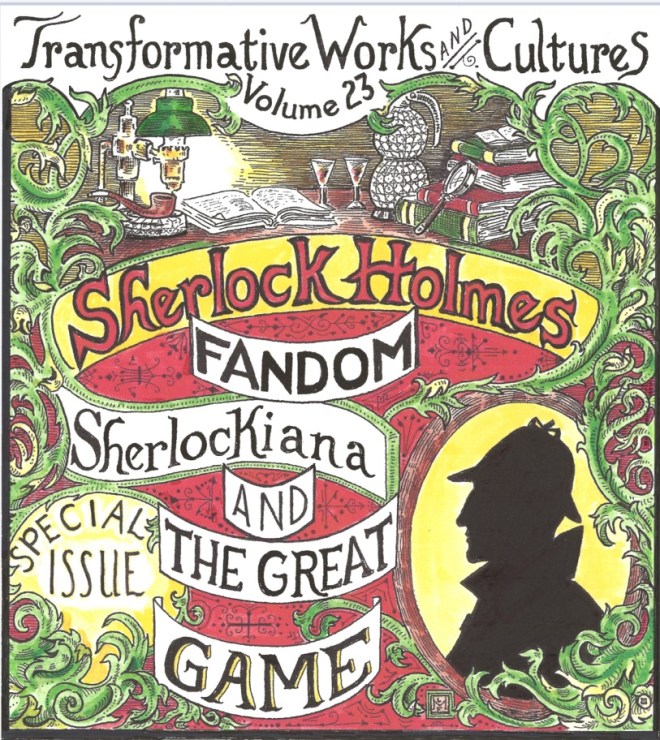
Transformative Works and Cultures Issue 23

This is an online zine which is a project of OTW (Organisation for Transformative Works). As you should know by now, I’m a staffer though my work is mostly connected with Archive Of Our Own, the fanwork archive which is another OTW project. The zine is a prestigious one full of peer reviewed articles on aspects of fandom and highly regarded by university departments specialising in e.g. media studies. This issue is completely given over to Sherlock and the various guises of Sherlock fandom. The articles were totally fascinating. Highly recommended for anyone even remotely interested in Sherlock, original, later or modern. You can read it at

http://journal.transformativeworks.org/index.php/twc/issue/view/27/showToc

and I’m uploading the gorgeous cover here.
Some of the short works I have been reading were also in the Sherlock fandom and I have to recommend the writings of Small_Hobbit. You can find her work on AO3 listed on her dashboard at http://archiveofourown.org/users/Small_Hobbit/pseuds/Small_Hobbit and dip in almost anywhere. Some of her offerings are newspaper items or diary entries couched in the style of the original Holmes stories and the newspapers they appeared in. Some are pure fantasy, with Mouselet, a mouse who lives in the wainscot at Baker Street and is in love with Inspector Hopkins. Or avatars of Holmes and Watson in the animal world. Quirky, well researched, and absorbing. Enjoy!

I thought that while I was talking about AO3 with no specific recommendations from March, I would recommend two of my favourite stories. Both are ‘gen’ in the sense that they contain no romance of any kind or any hints of romantic or sexual relationships. Contrary to ‘popular’ or perhaps media belief, fanfiction is not all sex driven.

The first is Sharpe’s Dragon by DisaLanglois. This is a crossover between the world of Sharpe (Bernard Cornwell) and the world of Temeraire (Naomi Novik). It’s an exciting story of an alternate Napoleonic war, with dragons, of course. Long and satisfying. I’m sure Naomi, who was one of the founders of OTW, would approve. Here’s the link to Part 1 (45,451 words) http://archiveofourown.org/works/129908/chapters/184803

and then Part 2 (34,794 words) is at http://archiveofourown.org/works/136503/chapters/195615

Bear in mind it’s novel length.

The second (touching on the mouse theme again) is The Honour and Glory of a Mouse by Transposable_Element at http://archiveofourown.org/works/4599858

This is very short (only 731 words) but quite lovely. The focus is on aspects of feminism, something that is sometimes covered in Narnia, where the story is set, but this tale takes the idea a step further. When I first read it the author was hidden behind anonymity because the story was for a challenge. Challenges, where the authorship is not revealed till the challenge is finished, can be one of the excitements of following fanfiction.

I hope there’s something for everyone there! I’ve now caught up with myself across all my social media platforms so from now on, there will be one review post per month.

Five stars or none: my review ratings explained.

OLYMPUS DIGITAL CAMERA

I thought I’d better post this before it’s time for my March reviews (coming soon, of course).

Whilst sharing my monthly reviews with you I’ve been wondering what makes me really love some books. I often read books, even those written by friends, which are fine – no criticism – but which don’t attract my five star rating. Not because they’re badly written. Not because there’s anything wrong with them. Because they aren’t exactly right for me. So what is?

To begin with, my five star book has to have impeccable grammar. If the writer uses things like fragmented sentences they have to know what they’re doing and break the rules carefully, showing quite clearly that they know the rules in the first place and are breaking them for special effects. I can easily be ‘thrown’ by dangling participles for example, though I usually have no objection to prepositions at the ends of sentences.

Then there’s the structure of the writing. (I’ll come to plot later.) Repetition annoys me, whether it’s repeated adjectives or repeated information. It’s acceptable in dialogue where it might relate to a character’s speech patterns, but not elsewhere. Too much use of flashbacks annoys me. Flashbacks can be interesting but for me, they need to be used very sparingly and I need very clear signals that the section is not in the same ‘timeline’ as the main story. The same applies to recounts, where you find out what is going on through a letter, a phone call or a character spending time bringing everybody up to date. Changes of point of view have to be shown quite clearly, preferably by an extra line break or a new chapter. I recently mentioned Joanna Trollope, who switches point of view in the middle of paragraphs. Ugh! Information dumps are occasionally necessary but should be punctuated with action. Even in a long serious lecture real people move, cough, look out of the window etc. Characters should do this too. It’s almost unbearable when characters ‘tell’ other characters what they should know already, presumably so that the reader will be better informed. There are other ways to educate the reader. I like plenty of dialogue but find it hard to cope with the way some authors try to use a different way of saying ‘he/she said’ with every line. The word ‘said’ doesn’t shout at the reader and provided it’s occasionally changed to ‘asked’ or similar, the dialogue flows smoothly. There are better ways to tell us the character was shouting or laughing than to use these verbs instead of ‘said’.

I can accept typos as long as they aren’t frequent. There are some mainstream publishers who seem to expect their authors to do all their own proof reading and even writers like Terry Pratchett and Robin Hobb are not immune. But provided the typos are few and far between, I’m just sympathetic. Sympathy takes a nose dive when it comes to an inability to recognise homonyms and an obvious reliance on a spell checker to catch them, which it can’t. Similarly, I object when writers use long words and choose the wrong ones. Again, spell checkers are not the best judges of this. You need to know what you’re doing before you use a spell checker in much the same way that it’s better to have some kind of grounding in arithmetic before using a calculator.

I personally dislike books that can’t make their minds up about style. Some highly respected writers (e.g. Hilary Mantel) move from first to third person, from plain narrative to a kind of screenplay, etc. in an effort to retain the attention of the reader. It doesn’t do anything for me other than irritate me although I know some critics regard the practice with awe. I am less concerned about the type of admonitions given in books such as the Chicago Manual. To begin with, novels are not journalism, which is what the Manual was always intended for. Also, if you look at almost any page in any of the classics or modern classics (e.g. Lord of the Rings)the Chicago Manual and its advice (or the equivalent when the book was written) has been, thankfully, ignored. The past tense, formed using ‘was’, is sometimes essential. Adverbs have an important part to play in description. Etc. I do not want my fiction (or serious non-fiction) written in journalese.

I also find it almost impossible to read long stories in present tense. There is a growing tendency to use it. I think it’s some kind of effort to make text resemble the way films give us an immediate look at what is happening. I can read it when the writing is a very short story but anything longer and I get quite stressed at the immediacy and would truly rather keep it for films! Short passages in e.g. a crime story can be effective, provided they really are short and the writer reverts to past or narrative tense as soon as possible. When people are talking about something that happened to them, even recently, they usually use the past narrative tense. Present tense tends to be used only by people who have a poorer command of language and this is another reason I think the practice annoys me when used for characters who are clearly reasonably well educated within their ‘world’.

I also find it quite difficult to read sustained passages in italics. Sometimes authors use italics for e.g. letters but I always hope they won’t be long. I find italics visually disturbing (perhaps the very reason we use them for emphasis) and always wish I could easily change the font of the text as well as the size.

The formatting has to be reasonable. I abandoned a book in March because it had line breaks after every two lines and I simply couldn’t concentrate.

So – impeccable grammar and excellent style, with my own personal quirks attended to. I need these, and quite often I can tell within a page or so whether I’m going to get them. If one is missing, the book can still hold my attention because of the content or something else I appreciate. (With Trollope it’s her descriptions and her witty ways of expressing characters’ opinions.) Having got those or most of those, there’s the question of content.

I like well developed characters who appeal to me from the start. I’m never attracted to characters I would not like to meet in real life and don’t much enjoy reading a story told from the point of view of a villain or even someone I just disapprove of. I accept that such writing might be clever and interesting – admirable, even. All I’m saying is that it isn’t to my taste. So if, for example, a crime story starts with a look at the crime from the point of view of the criminal, I’m quite likely to abandon it without caring whether they are caught or not. I want to know the feelings of the victim or of the investigator from the beginning. This is not quite as much of a problem in fantasy or romance, of course, though there may well be e.g. romantic detective stories I have not read because of this type of introduction.

Sometimes, characters just bore me, and if after a few pages I couldn’t care less what happens to them, that’s also a signal to give up. I’m sure there are other readers who would follow their adventures with eagerness and it isn’t a criticism, just an observation that is more about me than about the writer. I find it very hard (though not impossible) to get interested in vampires, ancient Egypt, medical and technical research, or high school and college students so books about any of those have to try harder to ‘hook’ me.

My favourite characters live on in my head long after their ‘story’ has finished and I admire the writers who can create these new fictional friends for me. Sometimes I will turn to fanfiction, my own or that of other writers, to explore the further adventures of characters I love.

Once we have characters who have ‘hooked’ me we reach plot. I hate plot holes with a really fierce hatred. I have read crime stories published by the big mainstream publishers where questions are raised and never answered or where I can see the flaws in the information given. I have read fantasy or sci-fi where the basic premise of the story or world is never properly explained. I have read romances where the ‘chemistry’ between the main characters is not obvious, or not obvious enough to explain their apparent passion. In all genres there are stories where events clearly couldn’t happen the way they’re described. I know I once wrote a story where a minor character could not possibly have been where I said they were at the time stated. I caught the error and if I hadn’t my editor would have done, I hope. It’s easily enough done, but it certainly throws me out of the story and I find it hard to get back in. The same applies to other types of incorrect information. I remember reading a historical romance set in the time of the Borgias and based on some real characters. As soon as the writer had chocolates served at a party I lost all trust in her and never regained it. (Whilst chocolate arrived from South America at the end of the Middle Ages, chocolates, in the form of sweets as opposed to the drink, were not created till much later). This need for correct information is just as strong in fantasy and sci-fi. Good writers build a fictional world and must stick to the ‘rules’ they themselves lay down, whether those refer to our reality or another. And of course their editors must be aware of the pitfalls. I personally gave up on writing about a world with two moons because I couldn’t get my head round the difference this would make to things like tides and seasons.

So my favourite writers have a grasp of language and style that appeals to me. They introduce characters I can’t bear to leave. Their plots are handled deftly and I can trust their information.

Finally, they need an underlying message I can relate to though I don’t want to be preached at and I don’t enjoy fiction that is just a vehicle for pushing an agenda – I’d rather read non-fiction for that, and I probably read as much non-fiction as fiction, if not more. Non-fiction also needs good language and style as well as trustworthy information. Info dumps are slightly more acceptable but there are still ways of splitting text into manageable portions.

I want to read things that agree with my world view. I am aggressively anti-racist, anti-sexist, anti-homophobic, etc. I accept that other people will have different religious and political views but don’t want their beliefs pushed at me. I believe in human rights for everyone. I don’t expect all the characters to agree with me but the overall tenor of the book should be acceptable. I know that horrific acts take place in our world and am interested (though not happy) to read about them in non-fiction but would prefer my fiction to have less of a focus on the gory, the depressing, etc. unless I can be assured of a happy ending. Escapist? Up to a point – the point where my fiction and non-fiction reading diverge.

For example, a pair of books I read about a year ago one after the other were The Spanish Holocaust by Paul Preston and Too Many Fairy Princes by Alex Beecroft. The Preston book dealt in horrendous detail with the Spanish Civil War and I was mesmerised, distressed and interested enough to seek out more books on the subject. Alex Beecroft’s fantasy, whilst it did deal with a kind of civil war in a fae kingdom, gave me romance, beauty and hope, a sort of counterpoint to the realities of Franco’s regime.

I rarely read books in the same genre without a hiatus to read something else. When I give something five stars I really really mean it! Any flaws at all lead to a four star rating. Books that are good enough in their way, possible even excellent for other readers, and quite often technically good get three. Then there are those with two (lots and lots of flaws but I carried on reading) and one (dire). An abandoned book might not mean any flaws at all, just that the book wasn’t to my taste. I abandon books that don’t interest me after a very short trial. I give five start rating to books I would absolutely recommend and those vary enormously.

To sum up:

Five stars: I adored it and would recommend it highly
Four stars: I liked it and would recommend it but there are criticisms
Three stars: fine but not really my ‘thing’ – neutral about recommendations and suggest readers look at the blurb.
Two stars: fascinating enough to finish but exasperating because of all its flaws; not really recommended
One star: dire. (I rarely finish a one star book but some short stories fall into this category)
Abandoned: abandoned (!) and that could be either content or style. As with three stars, read the blurb.

February Reviews (late)

I forgot to post these and we’ve nearly reached April and the March ones.

I’ll use my star system – five for excellent, four for good with flaws, three for OK, two for not recommended, and one for dire.  I’ll post at greater length about my ratings another time.

February television: series and films:

A million ways to die in the west ***** Hilarious and thought provoking. I loved this, with its amusing yet gripping plotline and its subtle commentary on America past and present.

Elementary (pilot)*** Well, it was watchable and if it was on at a friend’s house I wouldn’t look away, but I was disappointed. I thought it tried so hard to make itself thoroughly ‘transformative’ that it lost sight of the original concept.

The world’s most extraordinary homes (4 episodes)**** I enjoyed this series but admit to having fallen asleep once or twice. I adored the house built into one of NZ’s protected forests and was fascinated by the underground homes. Some of the others worried me because I thought the architects had not considered what might happen if the owners were permanently or temporarily disabled – or their visitors or families were. There is perhaps something to be said for the EU rules on making all new buildings accessible to those in wheelchairs.

The great interior design challenge ***** I don’t often watch ‘reality’ TV but this series had me absolutely gripped. Interior design is something that really interests me and I got completely caught up in the designs and in the competition element. I knew only one person could win but I was slightly disappointed – I would have voted for the other finalist. An added bonus was the information about the various types of houses the competitors were assigned with some history of the areas.

Sherlock season 4*** I didn’t enjoy this at all. No criticism of the actors who did really well and were worth watching. I didn’t like the way it strayed so far from the original idea into fairly gruesome and unpleasant territory and into realms where I found it hard to suspend disbelief. Initially I disliked the emphasis on Mary’s past as a spy, then towards the end of the series I disliked the new discovery of the female Holmes. In so many crime shows recently (Whitechapel, Ripper Street, Hawaii 5.0) the focus has switched from the cases and the methods used to solve them and homed in on the lives of the main characters. The change of emphasis doesn’t appeal to me. That isn’t saying it’s either good or bad – just that it isn’t for me.

Books – I’ll comment properly on the four and five star ones. 17 this month if I ignore some I quickly abandoned because they just weren’t of interest to me. I haven’t included  abandoned titles in this list because it isn’t fair to authors who might be perfectly good if their stuff is what you’re looking for.

Five on Brexit Island/Bruno Vincent*** (humour) OK but not very funny.

Just Stay/Aria Grace*** (m/m romance) OK but I wouldn’t bother with any more by the author. The writing is fine, but the plot is ultimately forgettable.

So this is Christmas/Josh Lanyon**** (m/m romance/crime) A lovely addition to the Adrien English series, which all fans thought was over. But even after the guys get together, there are crimes to be solved. And some of them happen at Christmas. This one is a missing persons case. Adrien and Jake are an interesting couple and the extended family adds to the feeling that these are real people. Recommended if you already know the series.

The Secret History of Fantasy/ed Peter S. Beagle**** (anthology with extra essays) Mixed quality, as most anthologies are. The essays, by Peter Beagle, Ursula Le Guin and David G. Hartwell talk about modern fantasy, its genesis, history, etc. and there seems to be a small amount of snobbery directed at the kind of fantasy that involves any kind of fae, though why, when they all approve of Tolkien, I have no idea. One of my all time favourite twisted fairy tales is in the book: Snow, Glass, Apples by Neil Gaiman, which turns Snow White on its head.

There are 19 stories altogether.

9 (incuding the Neil Gaiman) are good or excellent

7 are OK or interesting

3 were boring but well written

The Gaiman story was the only one I had seen before. Recommended if you’re interested in what I can only describe as alternative fantasy.

How it Works: The Dog/Jason Hazeley and Joel Morris ***** (humour) These Ladybird books for adults are hilarious and this one is no exception. The style and format are based on the Ladybird children’s books. Recommended for dog lovers.

The Complete Mary Berry Cookbook**** (cookery) I got this at a massively reduced price in Aldi and it was worth it. The recipes are good and so are the explanations about various techniques and ingredients. However, if I had paid full price I might have been annoyed. The editors (Dorling Kindersley) had made a lot of proofing errors, putting the wrong pictures with some recipes, and leaving out essential information for others. Nothing I can’t cope with but I’m a fairly experienced cook. I’m busy going through it again to note the recipes and tips I want to access quickly. Most of our good recipe books are in Portugal and it will be nice not to have to consult the laptop and then carry the info in my head to the kitchen!! Recommended for serious cooks but not for the beginners because the errors make some of it confusing. I should also perhaps say that yes, I read cookbooks cover to cover.

The Tales of Beedle the Bard/J.K.Rowling**** (fantasy) I’ve kept meaning to read this! It was very sweet though I like the commentaries on each tale, by Albus Dumbledore, better than the tales themselves. An interesting addition to the Potter pantheon and I was impressed that JKR could make me believe (whilst reading) that these were genuinely old tales. Recommended for HP fans.

I’m Watching You/Karen Rose**** (crime) I like Rose’s books – formulaic, yes, but gripping. The usual scenario – cop meets woman lawyer/teacher/etc in the course of a serial killer murder case and romance ensues. I found I’d read this before – the titles and blurbs tend to merge and my paperbacks are in Portugal. Last time, I see, I gave it five stars – perhaps it wasn’t quite as exciting second time around because whilst I was still enjoying the story, I remembered who the villain was. Recommended for anyone who enjoys crime/romance. However, I will only now be buying this author in second hand bookshops. The Kindle price, let alone the hard and paper back versions, is prohibitive. I have one more on my Kindle which I will probably read soon.

Faery Born/Donna Joy Usher**** (fantasy) A witch discovers she is half fae and that she’s good at fighting. She joins the border guards to protect both peoples from goblins. There is also a budding romance with a fairy prince. Well written and a fresh approach to both fae and witches, but although it’s the first in a trilogy I won’t be buying the others because there is too much fighting for me and I can do with slightly less gore in my escapist fiction – goblin brains over breakfast don’t altogether appeal. However, if bloody battles are your thing and you like feisty heroines and fantasy, I can recommend this.

Once upon a dream/Megan Derr**** (m/m fantasy/short stories)This is a collection of the author’s short twisted fairy tales written at various times in her career. Some are excellent and others are boring. Like JKR Derr has captured the ‘voice’ of old fairy stories and when the tales are good, they’re captivating. Recommended for readers who like to see fairy tales given a new look.

The Sinclair Selkie/Chris Quinton**** (m/m fantasy romance) Well, obviously, a story in which human meets selkie. There’s a mystery, too, and the whole plot is excellent. However, as with another friend’s selkie story, (Priddy’s Tale by Harper Fox). I was disappointed not to learn more about the kingdom under the sea. I shouldn’t really criticise either of them for that – these were the stories the authors wanted to tell – but for me personally, this lost a star for the omission. Recommended for anyone who likes the Scottish Isles and selkies.

Half Broke/AE Wasp**** (m/m romance) This is part of a series about military veterans and it explores issues of PTSD among those returning from war and those who have had trauma in their lives at home. Set on a ranch with some nice minor characters including some interesting children. Recommended but I’m not sure I’ll be following the series and indeed another story set in the same series was one I abandoned as being so impenetrably American that it was not really accessible for non US readers.

Next of Kin/Joanna Trollope**** (family story/modern fiction) I wasn’t going to read this but it was in the same hardback as the other book of hers I read last month. Again, the writing is beautiful – superb descriptions, well developed characters, interesting turns of phrase, etc. etc. But again, the plot just doesn’t exist. The characters react to a death in the family in various ways. That’s it. I don’t totally regard this as a novel because it has very little in the way of beginning, middle and end, it relies on flashbacks and some confusing changes of viewpoint, and is more of a portrait of a family than a story. I gave it four stars for the writing, but I’m not sure I should recommend it.

The Challenging Behaviours Pocketbook/Fintan O’Regan***** (psychology/education) This was a refreshing book. It spent very little time on the causes of challenging behaviour but actually described examples and suggested sensible ways to deal with it. I really feel it ought to be required reading for the staff at my grandson’s current school. Recommended.

Lessons in Love/Charlie Cochrane***** (m/m romance/crime/historical) I realised I hadn’t read any of Charlie’s books and in fact had mixed her up with another author. As she’s a friend on DW, WordPress and FB (and might be reading this) I thought I should rectify the matter. I adored this book. It’s set in Cambridge where two academics in the first years of the twentieth century get drawn into investigating crime, and into each other’s lives. The characters are wonderful, the mystery and conclusion are satisfying, and the historical element is interesting. The very best thing is that this is the start of a long series so I have lots more pleasure to come. Charlie was published by Samhain, who have just closed, but I managed to get the first eight books before they disappeared. Apparently they are to re-appear either with another publisher or self published. Highly recommended.

Wanted, A Gentleman/KJ Charles***** (m/m romance/historical) I loved this. The story is a regency romance that turns regency romances upside down with one of the main characters a freed slave and the other a disgraced writer. Apart from the characters, who are interesting and let the author explore concepts of how much we owe to other people and why, and the meaning of freedom, the story is a standard one of an eloping heiress and attempts to prevent her marriage at Gretna Green. One friend who is a reviewer on Goodreads thought it was too short but I enjoyed it very much. I like all KJ Charles’ writing because she invariably casts new light on the society her characters are inhabiting. Recommended for anyone who enjoys regency romance.

St Nacho’s/ZA Maxfield***** (m/m romance) A gorgeous romance which also manages to explore the psychology of addiction, of guilt, and of different kinds of love. I got it as a ‘freebie’ and wasn’t expecting too much but it was one of my favourite books of the month. Highly recommended.

Fanfic – a good haul of ‘keepers’ this month.

I’ve given a rough wordcount so that you know whether or not you’d have time to read them! They’re all on AO3. No ratings – I only tell you about five star fics. I’ve also given the URLs. Guests are welcome to read on the Archive though some authors have disabled guest comments. If you like the story you can still leave kudos.

The Last Shreds of Autumn/merripestin (Lord of the Rings) 16k Frodo/Sam. The story takes place in the ‘gaps’ of canon, starting in Rivendell. Beautifully told and very plausible.

http://archiveofourown.org/works/366658/chapters/595983

My Time/Pale Rider (The Professionals) 58k This is essentially a ‘prison fic’ exploring issues about prison. Doyle is in prison after his (canon) trial – he doesn’t escape a sentence. So we see the British prison system through his eyes. The slash is minimal and serves as a background rather than a main part of the story. Blink and you’ll miss it. Very well researched and extremely thought-provoking.

http://archiveofourown.org/works/8878033

Oak and Mistletoe/HildyJ (The Hobbit) 55k An AU in which Smaug never took Erebor. Prince Thorin comes to Bilbo as a last resort. Bilbo is a healer or wiseman, and Thorin is seeking a cure for an inability to use his senses. A nicely told story, with a long build-up to romance. There are a couple of short sequels on AO3

http://archiveofourown.org/works/3674136/chapters/8123694

They Do That Sometimes/nagi_schwarz (Stargate Atlantis, Stargate SG1) 8k John’s nieces are kidnapped and the team goes into action, helped by Daniel Jackson. Exciting and ‘different’. An m/m element is present but only as background and there is no explicit romance.

http://archiveofourown.org/works/8883298

Rich and Strange/hedda62 (Lewis) 18.5k A gripping case fic with a first time romance blossoming at the same time. The story is very loosely based on concepts in The Tempest, and there are lots of Shakespearean and other literary references to intrigue the reader.

http://archiveofourown.org/works/482648

Next month (which is approaching rapidly), I hope to be more organised and do reviews at the beginning, after which I hope I can keep it up all year!

March

It didn’t come in like a lamb or a lion.

More like a skittish goat, or a March hare

ready to box for domination.

Or perhaps a polar bear

exploring tentatively

south of the ice cap

but prowling,

not roaring,

quiet to lull

the unsuspecting population.

…………………………………….

Strong gusts

came without warning,

amid snow, frost, hot sun.

Not so much

global warming

as severe change

and a dizzying sense

of doom.

…………………………………..

Spring leapt into action:

cherry blossom, daffodils,

crocus, forsythia

and even, on the south coast

rumours of magnolia

and then

it snowed again.

…………………………………….

It wasn’t friendly snow.

It didn’t fall softly overnight.

The children never got

to build a snowman or sledge

down a slope of white.

It snarled the traffic

(and the flower buds)

then crept away

before anyone could play.

………………………………….

If the lion and the lamb

are absent,

unaccountably diverted or delayed

will the month depart

soft with Easter chicks and rabbit kits

or will

high winds from the north pole

shatter the world apart?

Whatever looms I think

most will be glad when this March

is spent.

………………………………………

Can anyone tell me how to get WordPress to accept line breaks between verses? I have edited and edited until I’m blue in the face and eventually settled for lines of dots. It only behaves like this when it senses poetry!!

Brexit

I haven’t said much about Brexit, on any of my social media platforms, though I’ve reposted things on FB. However, today made me feel I should make my feelings very clear, if only for the sake of showing solidarity with others I know who feel likewise.

I am personally distressed by the idea of leaving Europe. I have always felt European first, Brit second and English trailing last. My family were proud of their connections with Scotland, Ireland and France. My husband’s mother was German. We own a house in Portugal. We have close friends (and some family) in Germany, France, Spain and Portugal. Needless to say I voted to join the EU in the first place and thought that the membership would be forever.

As well as my personal feelings I believe that a strong EU is our best defence against the threats of political movements such as neo-fascism and the safest way for our industries (such as they still are) to prosper. There are other important considerations like pan-European research projects which affect industry, universities and medical advances. The EU has helped us to make huge strides in areas like the environment, protection for women, for workers, etc. Whilst there is some vague reassurance that laws will simply be re-enacted so that they are Brit laws instead of EU ones, there has to be some doubt, too. Even though Britain helped to develop the European Human Rights Act it had to be dragged kicking and screaming through the courts to keep some of the provisions.

Brexit made me cry, on and off, for about a month. I am personally afraid for more than just my feelings of being European. I am worried about our second home, about the stuff we invariably cart to and fro ranging from wine and oranges from Portugal to marmite and cheddar cheese from UK. I am worried about our Portuguese bank account. I am worried about our Portuguese car, about the rates on our house, about the cost of travel to and fro, of insurance, and about medical reciprocity between here and there. I can’t make any plans or decisions because it will take two years (at least) before we know the details of the break-up.

But this is pure selfishness compared with the situation facing some of my friends. Some examples:

*how will this affect someone with a UK passport living in Germany with a German partner, children and grandchildren? And the woman in The Netherlands who is divorced but works there full time and has two children in higher education?

*how will this affect people with businesses in Europe – things they invested in in good faith whilst retaining their UK passports? One lot are both Brit, another is half Brit and half Maltese. How can they plan their businesses sensibly?

*what happens to couples of mixed nationality – a Brit guy with a Belgian partner living in Portugal and working in both Portugal and Belgium?

*how does someone involved in research at a UK uni seek either European co-operation or funding, or for that matter offers of career advancement if they aren’t UK passport holders?

*what happens to the European guy brought over here to work by his firm – in good faith on everyone’s part – who uprooted his family and settled here – when he is asked to leave, or when his firm gives up and leaves, uprooting him again?

They aren’t all retirees sunning themselves on the Costa del Sol, but even if they were, they went there in good faith (one such couple I know are retired after a lifetime of service in the RAF) and now their pensions, their healthcare, their property rights etc. are all at risk.

All the above are very real people and are my friends – people who really matter to me.

Then there are the Leave voters who tell us it will all be all right in the end. And accuse us of being Remoaners. Even, in once case, telling us we should remove ourselves to Portugal and not return. Goodness knows what they’re saying to my friends who are not UK passport holders.

Today saw two last straws.

First of all, there was a campaign leaflet through the door for the Greater Manchester mayoral election. Not related to Brexit? Bear with me.

We were asked, some time ago, to vote on whether the ‘satellite’ boroughs around Manchester should be more closely connected with Manchester city, with a mayor. The consultation and vote were expensive (paid for by our local taxes). All the boroughs, Trafford, Stockport, Wigan, Oldham, Bury, Tameside, etc. etc. with a variety of political leaders heading their councils and some wildly varying styles, campaigned and the vote was overwhelmingly against the whole idea. A resounding NO. We celebrated, right and left alike. Nobody wanted closer contact with Manchester city which has very little in common with the outlying towns. We did not want the expense of another tier of government, especially one so diluted and so difficult to tailor to fit all. The government shrugged and said that our expensive vote was not binding and they would go ahead anyway. After a democratic vote the ‘will of the people’ was completely discounted and we are now having an expensive campaign (paid for by our local taxes) for a mayor nobody wants at all. The front runners appear to be a right wing councillor who might, for all I know, be fine in his borough but has no connection with ours, and a left wing politician who is ambitious but not particularly connected with Manchester at all.

So I am pretty cynical about anything that involves ‘the will of the people’. Politicians of every hue will carry on with their own agenda regardless. It’s very nice for them and for their supportive media, if a popular vote happens to coincide with that.

Which brings me to the media. I have been shocked by the politics of hate promulgated by some of our press and have joined the Stop Funding Hate campaign. I am quite certain the constant diatribes of some newspapers contributed to a great deal of hate crime and the death of Jo Cox. I have just been shopping and looked at the headlines on display as I left the supermarket.

I think the Daily Fail surpassed itself and its headline encapsulated a great deal of what is wrong.

In response to Ms Sturgeon’s application to hold a second Scottish referendum the Fail says:

Keep your hands off our Brexit, Nicola.

You mean we aren’t dragging Scotland along with us into this mess?? And Ireland? And the rest of Europe? And people who couldn’t vote because they didn’t have UK passports or had lived outside UK too long?

Our Brexit? Not mine. I am ashamed of my country.

Monthly reviews


Since I’ve been subjecting my social media friends on Dreamwidth and LiveJournal to reviews which have sparked interesting conversations, I thought I’d post them here too. Of course, I’m now running to catch up because the end of January and even the end of February are well behind us, but by the end of this month I’ll be in sync with my other blogs. Providing them with reviews was a commitment to a new year’s resolution.

Let’s see how long I can keep it up…

I’ll list the books I’ve read each month but will only review in depth the ones I either adored or think are important. I’ll include long fanfic that I think deserves to be read. I’ll also mention films, plays and TV series but only when they’re over, and again, only the things that mattered to me.

Reading first.

The excellent:

The Folklore of Discworld/Terry Pratchett and Jacqueline Simpson
A fantastic look at the Discworld myths, legends and superstitions, comparing them with their earth counterparts. Quite informative about earth and very funny about Discworld. The co-author is a folklore specialist. Lots of explanation as to where Pterry found some of his inspiration and a great deal of tongue-in-cheek research about cross-cultural fertilisation between here and there.

Hexbreaker/Jordan L.Hawk
I quite liked her Widdershins books and expected to be mildly entertained – and then was blown away. She creates an early twentieth century alternative New York with shape shifters and witches as ‘normal’ elements in the population and puts them in an m/m crime story. Lovely writing and I really hope that there’s going to be a series, which is her usual m.o. I desperately want to leave a review somewhere but know I didn’t buy it on Amazon. I can’t work out where I did get it but strongly suspect somewhere like All Romance which of course is now scattered to the winds. Any advice?

Brexit: What the hell happens now?/Ian Dunt
Useful book which doesn’t so much bemoan leaving as explore what could happen next. Pulls together all the threads we’ve been getting in the news and presents them along with credible alternative scenarios stretching years ahead. Frightening and serious but contains advice both for politicians and protesters.

Pwning Tomorrow/ed EFF
25 stories – speculative fiction based around modern technology and where it might lead. Like most anthologies, this is mixed but I think everyone would find at least some stories that would appeal. I got it as a freebie because I’m a member of Electronic Frontier Foundation but they ask people to spread the word so if you want to give it a try, donate at https://supporters.eff.org/donate/pwning-tomorrow

Monks and Wine/Desmond Seward
We got this very cheaply and it’s out of print but there are some sensible offers on Amazon. I would recommend it highly. The book traces the influence of monasteries on viticulture and along the way describes the various areas, buildings, etc. and gives the non-Catholic reader (like me) a useful amount of information about things like the differences between monks, friars, etc. and their history. It was published in 1979 so the final chapter: ‘Monks and wine today’ is perhaps less inspiring than the rest because obviously a lot will have happened since then!

My Lady Dis/ChibiMethos
Gorgeous fanfic (http://archiveofourown.org/works/1401862). The story is now in my head canon and bridges the gap between The Hobbit and Lord of the Rings. Dain invites Dis to join the rest of the family (what’s left) in Erebor and on the way she has to pass through Mirkwood. Thranduil comes himself to escort her and brings Tauriel who had a baby by Kili (so film canon, not book) and therefore considers herself a widow. The women bond, the baby is wonderful, and Thranduil ends up in love with Dis. All perfectly believable and romantic without being over sweet. Beautifully written and a lovely long story (51,426) that unfolds slowly with lots of diversions and extras. I suppose it’s het romance, which doesn’t always appeal to me, but the culture clash of elves and dwarves made it instantly intriguing.

The reasonable:

The Modern Natural Dyer/Kristine Vejar
Interesting and useful.

Dead in L.A./Lou Harper
M/m crime. Quite well done and readable.

The Best of Friends/Joanna Trollope
I like her writing, her world building and her characterisation but deplore her plots.

Needing A Little Christmas/Silvia Violet
Pleasant and nicely written m/m Christmas romance.

Fractured Hymns/A.M.Arthur
Competent exploration of PTSD in an m/m romance context.

Neurocomic/Farinella and Ros
Beautifully drawn and produced ‘comic’ exploring the brain.

And two to avoid:

Incognito/L.A.Watson
Rather confusing and badly put together m/m crime story. I am still not sure who anybody worked for or what happened.

A Matter of Scale/Jonathon Burgess
The cover and blurb of this freebie were delightful – a wizard takes on a litter of baby dragons. Very short, badly formatted, and not terribly well written. Plus, he only really takes them on at the end.

So – 13 published books and about the same number of fanfics though only one is mentioned here.

Screen and stage.

We went to The Curious Incident Of The Dog In The Night Time.

The National Theatre production finally left London (well, no, it’s still in London till summer but the tour started) and came on tour, starting in Salford at The Lowry. Simon Stephens, who adapted Mark Haddon’s book for the stage, came from Stockport so is a ‘local lad’. The Lowry was a great venue to start the tour. Local/regional TV made the most of it! Bruce McGregor, one of the (new) touring cast, is a close friend and near neighbour of ours – he had been regaling us throughout rehearsal time (which was in London) with dire tales of ‘bootcamp’ and various injuries. The performance is amazing – lots of exciting sound and light to show us neurotypicals how Christopher experiences the world, and lots of strenuous work by the actors who literally throw and carry Christopher around. I had already watched a programme about the adaptation and staging and was fascinated by the end result.

Highly recommended if it comes to a theatre near you. The only downside was the cost. After paying for three of us (husband, daughter and me), plus car parking, plus programme, plus pre-show drinks (beer and ginger beer so nothing spectacular) we felt we might need to take out a mortgage. And we didn’t go for the expensive seats – Bruce had warned us that you actually get a better view of all the movement from high above.

Then we went to Alice In Wonderland at Hyde Festival Theatre.

This was adapted for the stage by a couple of local writers/producers/directors and performed by a cast drawn from a local amateur theatre group working with a local children’s drama academy. The adaptation was excellent. The show was full of music and clever lighting, with some stunning choreography, dance sequences and costumes. I just wish whoever taught the children to move so well had taken the time to train them to speak a little more slowly and facing the audience. One or two were ‘naturals’ but the majority were inaudible. However, the story was carried bravely by the adult actors and the whole evening was very enjoyable. The entire event, including a programme, only cost two of us the price of one seat at The Lowry (and parking was free).

We went with some friends, one of whom is a pianist who works closely with the local theatre group. His wife was, like me, a teacher, and remembers teaching one of the writers/producers at primary school. She said that in those days he was hopeless and nobody thought he’d ever amount to anything. How wrong can schools be??!!

I’ve already posted about my reactions to To Walk Invisible, the BBC film about the Brontë Sisters. It was one of my TV highlights for January.

The series that had me hooked all January was Class, the Doctor Who spin-off which was totally gripping. It was broadcast two hour-long episodes at a time, starting at 10.30 on a Monday night and given very little publicity. I have not seen it mentioned once online and am wondering if I was the only one to see it? (And adore it.) If it’s still on iPlayer or if it’s repeated and you get the chance… It’s all set in Coal Hill Academy where Clara taught, and a group of sixth formers have to battle aliens. One of them is, in fact, an alien and he is in love with another of the group, a Polish boy. One of the teachers is an alien, too and then there’s the new headmistress. The Doctor did try to rescue things at the start but then went off in his Tardis and left them to it. There is to be another season but it won’t make much sense unless you saw this one.

I watched The Real Marigold Hotel On Tour (in USA and Japan) and The Real Marigold Hotel (in India) and was fascinated both by the cultures they explored and by the celebrity pensioners themselves. They (and their needs and beliefs) seemed about as alien to me as the places they visited did to them. It was all worthwhile for the in depth look at ordinary life in Japan and India.

I’ll be posting my February reviews in a day or two.

Debunking myths about writing

120-debunking-myths

Debunking ten common myths about writers and writing.

#1. Writing can be done any old time and happens in the gaps between other more important commitments.

This is a myth most usually believed by family and close friends. Sometimes the belief spills over and affects the writer themselves. It is by no means true. Writing, and particularly editing or drafting a second version, requires concentration. It’s perfectly possible to write short sections in ten minute bursts, and then string them together. But the mere act of stringing them together satisfactorily takes a lot more than ten minutes, and ten minute writing sessions are not very satisfying to the average writer. I know I need aat least an hour to get into a story or chapter. This is at odds with the other demands on my tattention. I’m responsible for various household needs such as shopping and cooking; these not only take time but are at the mercy of other people’s agendas such as when the shops are open and when the family want or need to eat. The same constraints would apply to any other household necessities that members of any family commit to supplying. Even a solitary writer has to eat, sleep and supply the needs of themselves and perhaps their pets.

Besides the actual act of typing or writing the words, there is thinking time. This is essential. Some writers plot in advance and other simply see where the characters want to take them, but whichever kind of writer you are there is a necessity to think either of the way your story is going, or the way it has gone, if only to check mentally for inconsistencies and plotholes. Some people produce a story in a linear fashion, going from A to Z via the other letters in the right order; others write sections as they occur to them then fit them together and write linking material to fill the gaps. Both methods are valid and both require time and thought.

Thinking can take place alongside other activities – for example, in the shower, in bed before falling asleep, or whilst doing some mind-numbing task such as ironing. It doesn’t go well with anything that needs concentration like stirring a risotto or supervising a child’s homework. So writing and its handmaid, thinking, need time, quality time, and it’s all to easy to let this be squeezed out. I suppose if you’re JKR or James Patterson, you can plead that you’re working, but most writers don’t earn so much that they feel able to make this plea. However, they should not allow other people to encroach on their writing time, even if the writing is mainly for their own pleasure. Nor should they go along with the myth and allow their writing time to be elbowed out of the day.

#2. Writing is not work, just a hobby that sometimes results in payment.

Whether it’s for private enjoyment or close friends or a wide audience, and whether or not it’s to be published for payment, writing is hard work. (So are some hobbies but that does not invalidate the general argument.)

Some writers find that plots come easily. Others have characters spring up fully formed in their heads. Yet others find that language flows, provided they have more than ten minutes (see #1 above) to devote to it. But all of them will need to edit what they write, to check it for style, for whether it says what they intended, to make sure the characters have the correct names (especially minor ones who appear chapters apart) and are wearing consistent clothing. It’s no good having character A in a shirt that matches his eyes and then throwing his soiled white shirt in the laundry basket at the end of the day. Similarly, it’s not helpful to have characters go upstairs if you’ve located them in a bungalow in Chapter 1. Reading through what you’ve written is important to help avoid repetitive vocabulary. Readers get irritated if A looks soulfully at B more than once. (Actually I get irritated the first time but that’s just personal preference.) And even if all these things are sorted, the writer still has to physically get the words down on screen or paper. Fingers can get tired, too, and backs can suffer. So can eyes. Nobody suggests that a secretary doesn’t work, so a writer works at least as hard just getting their words down.

Once the initial draft is written there’s editing. Yes, you can employ an editor, or your publishers might wish one on you. Whichever, they’d really prefer it if you’d done a bit of editing yourself before offering up your draft. Before seeking another pair of eyes it’s as well to make sure your story flows, and that there aren’t too many typos. If you’re self publishing you need to know something about formatting, whether you do it yourself or pay someone else. You need to know about copyright, about marketing (at a minimum, how to tag your work, write a blurb, etc), about taxation (if you ever get royalties), about the royalty system, about the way publishing in general works, whichever route you take. If you were talking about any other craft, the same kinds of things would apply. The person who knits for a hobby only needs to buy wool, needles and patterns; the person who hopes to sell their knitted garments needs to know all about wool and its attributes, current prices, sizing, labelling, etc. and has to know how to package, present and market their work. Children who kick a ball around are hobby footballers, and remain so even when they grow up and just join in a friendly neighbourhood game; professional players have a whole host of other things to learn and worry about. It’s the same with writing so for anyone who wants to publish, writing is not a hobby even if it started that way.

#3. Writing could be done by anyone who wanted to give the time to it.

Well, no. You only have to glance at the stuff school students produce to know that some people are creative and others just aren’t. I’m not talking about ability with words, grammar, etc, but the ability to bring characters alive, to make locations seem real, to get readers to suspend disbelief at the inevitable artificiality of plot or the way an event is recounted (because real life just doesn’t behave like story but we forget that both when we’re reading, and when we’re living). Writers have a gift of being able to share their worlds, fictional or non-fictional, with their readers. Not everyone can do this, and for those who can, there’s a long apprenticeship that starts in early childhood. Most writers, in almost any genre you care to name, including non-fiction, will have spent most of their lives reading and researching – not always formally but in some depth. They will be fired by enthusiasm for their chosen subject matter to the extent that they actually feel a need to write, to impart the stuff in their heads to other people. Never mind merely wanting to give time to it – they will feel impelled. Some writing courses (and online sites) purport to help wannabe writers generate plots. Most writers I know have so many plot bunnies the problem is finding time to feed them all. Of course, there’s always the age-old maxim that there only so many basic plots (usually presented as seven, nine or eleven – magic numbers) and everything else is just variation on a theme. You can deconstruct any story to prove this theory, but it’s the variation that counts in the end, and the ability to think up that variation and build it into a satisfying novel, poem, thesis, etc. that matters. I don’t think ‘anyone’ could do this any more than I think ‘anyone’ could be a chef or a violinist, a nurse or a teacher. We all have special skills, talents and passions. Those of a writer include an ability with narrative that is outside the grasp of just ‘anyone’. This applies to the writing of anything from a recipe to a novel.

#4. Writers are always in the market for materials or, “I’ve got an interesting story for you. You’ll like this one. You could write it.”

No thank you. Sometimes we write starting from prompts, which are not usually detailed. They could be the outline suggested by a magazine competition, the idea put forward within a writing group, or perhaps a headline seen in the news. All these can send the mind off in unforeseen directions. This is just writers grabbing materials from the environment, much as they might grab their observations of a place to help them describe a fictional location.

Most writers do not want to write someone else’s story. They don’t feel the same passion for it, you see, because it isn’t theirs. Obviously some journalists and documentary writers will develop their work from stories they have been told by others, but they will have given them their own spin and unique viewpoint. There are a few writers who ‘ghost write’ for the famous, either by producing so-called autobiographies or by putting e.g. well known recipes into print or even writing sequels that come under an umbrella series by a well known author. Often, their contribution is not acknowledged. They may be paid well, but fame escapes them. They’re probably the only writers who might respond favourably to the offer that headed this section, and even then, they’d want to know what the rate of pay was going to be.

#5. Writers should write what they know, and many readers believe writers know, from personal experience, what they write.

The idea of only writing what you know is so silly it doesn’t really deserve any rebuttal. If people only wrote from their own experience we would have no historical novels, no sci fi, no fantasy, nothing from an animal’s pov, no crime stories except those written by police or criminals, no women in books by men or men in books by women. However, the advice works if it is interpreted as ‘do your research’. All reasonably good writers do indeed do their research and this takes time, hard work and a basic knowledge of where to find the needed information.

Sometimes writers choose to present things in first person, using the voice of the character to get an idea across. In any case, characters are going to articulate their beliefs at some point or they will remain unreal and two-dimensional. You know those warnings you get on some TV programmes or DVDs where the channel or film company disclaims responsibility for the opinions expressed? This should, perhaps, be stated at the front of every book, as clearly as the copyright claim. Then readers could be shown how ridiculous it is to accuse writers of the very things their characters are intended to get across as undesirable. If I want, for example, to write a novel that discusses racism, I am going to have to have characters who make racist comments. It should be obvious that I don’t agree with them. But some readers ignore the obvious.

#6. Since word processors you don’t even have to know grammar to get published – just look at all those badly edited self published books.

Simply untrue, or rather, untrue if you want to write and sell more than one book. Spelling and grammar checkers don’t always know what they’re doing. It’s a bit like calculators. Unless you’ve been taught basic arithmetic, you won’t be able to tell when the machine is not working properly or when you’ve failed to ask it the right questions. So, as with calculations, to write you do need a basic grasp of grammar and a reasonably wide vocabulary (and the ability to use a dictionary and a thesaurus). It’s no good relying on an editor. They might disagree with you, especially if you are writing in e.g. Brit English and they are American (or vice versa). They might fail to spot less obvious errors. (You’ll almost certainly fail, because you read what you think you wrote.) Your editor might well read what they expected you to have written and even professional proof readers can fall foul of the cultural differences I just mentioned. The computer spelling and grammar checker is less likely to make these mistakes (though it won’t always spot things like the misuse of homonyms) but it will sometimes misunderstand your intended meaning and you need to have the confidence to ignore it. It will sometimes give you choices and you need to know which to accept. There are definitely self-published books with poor grammar. There are also mainstream published books with typos, plotholes and inconsistencies in e.g. names. One thing is common to both – with the advent of the word processor, all editing has been left more and more in the hands of the writer, who has an absolute need and duty to know something about grammar.

#7. If you’re a writer, why aren’t you rich and famous?

Unless you are J.K.Rowling or James Patterson, you probably won’t get rich from writing. Tolkien didn’t. Some people make a good living, usually by writing dozens of books every year and having virtually no life other than writing and its associated activities. Even then, a lot of their profit gets ploughed back into writing, by attending conferences, book signings, etc. and doing research. Even the most prestigious mainstream publishers no longer give writers expenses for that kind of thing – it has to come out of royalties. Royalties are low with mainstream publishers but there again, they do all the things like paying cover artists, formatters, etc. Self publishing royalties are higher and if you do some of the ‘other’ work yourself, you get to keep more of the profit, but sales are by no means guaranteed. Then, either way, there’s tax… I suspect readers think writers for the big mainstream publishing houses live in a lost world of long lazy expense account luncheons, and paid-for holidays in the sun to research their next title. Not nowadays, and for very few even in some glorious past.

They also seem to think anyone claiming to be a writer should be able to achieve this golden state of affairs simply by being good enough. Unfortunately, leaving aside the matter of royalties and and the lack of other financial support, it is not enough to be a good writer. You have to be a lucky writer, too. Someone who worked for one of the big publishers once told me that yes, there has to be a modicum of talent but after that, the manuscript (and note that I’m now talking about the days before emailed submissions, when there were in fact fewer books written altogether) has to land in the right intray when the submissions editor is in the right mood, has an opening for a work of that particular genre, length, etc. and has time to read it. We all know the stories about how books like Watership Down were rejected time and time again – nothing whatsoever to do with their quality.

#8. Everyone has a book in them

I seriously doubt it. There are people whose lives are so dull that we wouldn’t want to read about anything they wrote; people whose only ‘hobby’ is watching sport on TV, who have no family dramas, who are comfortable in their jobs, their finances and their relationships. Some of them might have rich imaginations and then, certainly, they might write a book, but if they haven’t, then they will have nothing to write about. There are other people whose lives are so chaotic that they can barely make sense of them themselves, let alone tell others about their experiences. They might be able to express some of what they know or believe to a writer who can incorporate it into a story, an article or an academic thesis, but that’s not the same thing as having a book in them. Then there are people who are passionate about something, driven and organised. But their way of dealing with their subject matter is in action, political, business, local community, personal, charity, etc. Or in music or art. They do not have ‘a book’ in them; they may have a painting, a sculpture or a symphony or they may have a parliamentary maiden speech.

#9. Genre fiction and non-fiction is not as important or as high quality as literary fiction or academic non-fiction.

This opinion seems to have been firmly embedded in our culture, no doubt given a helping hand by reviewers in the weightier papers and magazines, and by sundry academics. It is pandered to by booksellers, on and offline, who want to put things on tidy shelves and label them often with profit in mind. They want to target the right demographic. This trend entirely loses sight of the fact that many of our classics started as genre fiction.

Dickens, for example, wrote romance and mystery for the serial magazine market. Yes, his, and many other ‘classic’ books are well written with many-layered plots and delightful characters. So are some of today’s ‘genre’ novels which are dismissed out of hand but have so much to offer. Tolkien made it out of the fantasy ghetto, perhaps because of his academic background, but although I adore Lord of the Rings there are other equally good fantasy writers who are still behind the barriers – Tad Williams, to name only one. Alan Hollinghurst’s books escape the m/m romance genre probably because the author is a respected reviewer (and maybe because he doesn’t always have happy endings). Forster escaped, too, possibly by being dead, but Maurice is hardly ever mentioned in discussions of Forster’s work. There are other m/m romance writers who deserve similar attention. It is fashionable to praise Ian Rankin’s Inspector Rebus novels whilst still putting them firmly in the crime genre whereas Wilkie Collins’ The Moonstone is considered to be the first English detective story but at the same time is regarded as ‘literature’. H.G.Wells and George Orwell crashed through the sci-fi barrier but only, perhaps, by dying. There are too many other examples to list here.

Non-fiction suffers similarly. A really good cookery book is as useful, and as research-based, as a lot of academic papers, but is dismissed as mere ‘lifestyle’ or ‘hobby’ fodder. There are brilliant popular books that analyse history or finance or art, but unless they emanate from university research they are too often ignored.

Obviously many readers find these books for themselves, enjoy them, recommend them, etc. And some of the authors may as a result find some fame and fortune. But not, apparently, the accolade of the serious critic. And that’s something that has trickled down to the general public who in turn regard anything other than the ‘classics’ or the latest prize list litfic as ‘mere’ light entertainment.

#10. Writers are either unsociable or full of themselves (sometimes both)

The prevailing images are: the standard stereotype of the starving artist in a garret; the shy writer tucked away in their converted garden shed; the eccentric and absent minded cat owner with a creaking typewriter and few friends.

The reality is people with families of one kind or another, large friendship groups, and a well-developed social life. How else would they observe human nature so closely and find material for characters, locations and plots? And although some might initially scribble their thoughts down in notebooks, transfer to a state of the art computer screen is an inevitable part of the process requiring an electricity supply, internet and a familiarity with technology.

So writers are not unsociable. But are they arrogant or boastful? They do have to ‘blow their own trumpets’ if they are to make any sales at all. Even the big publishing houses offer very little in the way of marketing and advertising. But selling the product of a lot of hard work is no different from the florist’s sign outside the shop or the bakery buying ad time on TV. After all, if they didn’t tell you about their books, how would you know? You’d be left with nothing to read but the classics, and good as they are, these don’t meet our need for new and exciting ways of looking at the world.

A ficlet for Valentine’s Day

capture


Travelling together

Ken had only come to Waterstones to get a map. The trip up to Scotland would take him off the beaten track and he had no desire to get lost before he found the castle where his cousin’s wedding was to be held. He had neither the money nor the inclination to install any kind of GPS in his car and those print-outs from the AA usually led via diversions into delays.

So he headed for the map section but couldn’t resist a glance at the sci-fi shelves on his way past. Maybe there would be time to read and relax over the weekend.

A mass of red curls over a slim but muscled body was evidently studying the section in depth. Luscious. And with a shared taste in reading matter.

Ken sighed and continued to ‘Maps’. No time for dalliance if he was to set out today. But how he wished… Then again, he consoled himself, the other man might be a raging homophobe or perhaps just choosing a book for a sci-fi loving sister.

Comparing maps of the glens and realising he hadn’t brought his reading glasses, Ken sighed again, then noticed a slender hand with a dusting of freckles picking up the map he’d just discarded. A polite voice murmured,

“I don’t suppose you’d know which of these would be the best to get me somewhere near Gairloch?”

Ken looked up slowly. Red curls framed enquiring green eyes. The hand that wasn’t holding the map was clutching a copy of Terry Pratchett’s Going Postal.

“I don’t,” he told the green eyes, quietly drowning in them as he spoke, “but I’m going there myself. Perhaps we can figure it out together?” He gestured with the map he’d almost decided to buy and indicated the coffee bar across the shopping precinct. It was too much to hope they were both going to the wedding, but at least the detour to Waterstones seemed to have led to a meeting of minds.

It turned out they were indeed both going to the wedding. Alasdair was a distant relative of the bride and despite his Scottish name had never ventured across the border. They agreed to travel together and Ken walked out of the shop with his map purchased but no more longing glances at the fiction books. He rather thought his time in the Highlands would be adequately filled.

(Yes, it’s Edinburgh Castle, but it was the only Scottish photo with a castle I could lay my hands on today)