The plot’s fine but the sub plot thickens

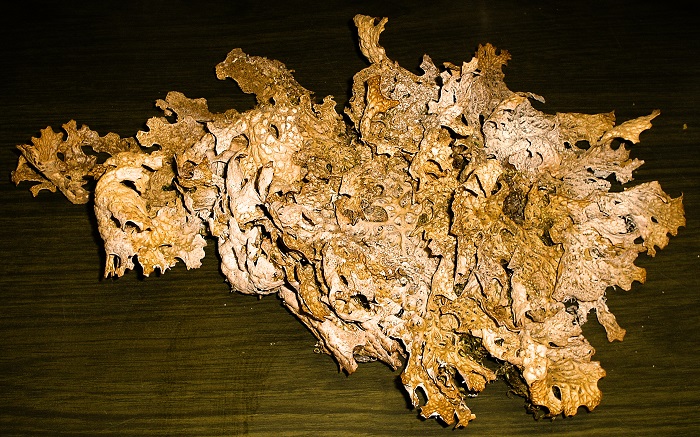
lichen

I hope you recall my post about the editing of Harlan Coben’s book. I found another of his in a local charity shop and grabbed it. It turned out to be a much earlier one, and although it was very good it was easy to tell just how much he has matured as a writer.

The title of this second read is Drop Shot.

It was a competent crime story with believable characters and an interesting plot. There were a couple of places (in a whole novel) where I would have edited the tense usage, but it wasn’t anywhere near as bad as the later book. I can only assume that as authors become more and more famous publishers leave them more and more to their own devices, which isn’t really very sensible, because if Coben was confused about tense use in the first place, the mere process of becoming a best-selling author wasn’t in itself going to sort him out.

I’m not sure whether they hold back on editing out of deference to someone who is making them a lot of money (far more than he is making for himself) or whether they just think they are paying him enough to find a proof reader/copy editor privately.

The fact that there were very few ‘errors’ in construction goes some way towards justifying my theory that he isn’t actually using tense changes for effect. (If he was, I can’t imagine what the intended effect might have been, in either book.)

I will definitely read more by this author, but I am confused by editing policy!! And annoyed that people point the finger at self-published books with the comment that they’re all so badly edited. Not true, and even when they are, they’re no worse than what comes out of the big publishing houses.

Does anyone have any similar stories to tell?

What do we expect from editors?

New Image

First of all, sorry for the hiatus! I was seriously stuck whilst in Portugal – as well as internet limited by how much I could afford to load on my dongle, I had laptop problems. My laptop had a hissy fit at the heat (38-45C) and the dust/ash caused by the forest fires (and yes, we were in the middle of the affected area). I’m now back in UK and just recovering from the trauma of buying a new laptop – more about that in another post.

Because I was internet deprived and laptop deprived I couldn’t write so I did a lot of reading, and quite a bit of pondering on what I’d read. I want to share a couple of in depth reviews/commentaries with you because they raise issues that affect the craft of the writer.

The first writer I want to discuss is Harlan Coben. I have only read one book – The Woods – so bear with me if it is out of line with the rest of his work.

Now, the book I read deserves much of the praise Coben garners. It has an intriguing plot, an excellent introduction to the mystery, great characters (even the minor ones), well-written dialogue, fascinating insights into states of mind including those of criminals, prosecutors and parents. And I was truly hooked on the story. I can see why he wins awards and I will definitely be looking for more of his work.

But – and this is where the discussion point comes in – who edited it and where did they learn about grammar (or not)?? And who lets Coben get away with murdering his native/adopted tongue?

From the beginning the book is simply packed with tense shifts, sometimes within the same sentence, lack of agreement between subject and verb, jarring continuity errors… I hate it when tenses are misused and it says something for the story content that I carried on reading anyway and just felt forced to share my feelings with others.

Am I really a dinosaur for preferring English to be correctly written? Do the editors at Orion simply not care because they know they will make money anyway? Do readers in general really not notice faults like this? Any writer can make occasional mistakes, some of them typos and some of them out of ignorance. But this is constant! Coben probably doesn’t realise what he’s doing but surely an editor’s job is to work to polish material? Isn’t that one of the arguments for buying ‘published’ writers in the sense of those published by the big/known publishing houses? Whilst I’ve come across a few self-published books that share some of Coben’s problems this is actually the worst example of badly edited language I’ve come across outside school English essays.

Note that I’m by no means giving the writer a bad review. I can recommend the book in spite of its flaws. Your thoughts would be welcome!

Young Adult Fiction – some thoughts.

56. Young Adult Fiction

I recently bought and read a book called The Prince of Mist by Carlos Ruiz Zafón. I had previously read The Shadow of the Wind by the same author and had enjoyed it immensely. This book advertised itself as ‘young adult’, which was quite a change of genre, but as I’m interested in books for younger readers I thought I’d try it. It’s a kind of thriller and a kind of ghost story, but I found it very disappointing. Neither the location nor the characters were sufficiently developed to enable me to get thoroughly into the book and the parts that some reviewers thought scary seemed overdone and ridiculous to me. However, it did leave me with some questions about young adult books in general that I want to discuss.

First of all, the genre is somewhat nebulous. Some authors and publishers seem to mean ‘teenage’ by the term – perhaps trying to lure teenage readers by calling them young adults. Some seem to mean they want to target readers between the ages of fifteen and twenty-five, and specialise in ‘coming of age’ stories. Yet others seem to apply the term to anything that is ‘lighter’ reading, stories that are shorter or less complex than what are presumably ‘fully adult’ books. Zafón says he wrote the kind of story he would have liked to read as a teenager but hoped it would appeal to all ages. I find all this confusing. The only conclusion I can tentatively come to is that publishers regard the term as a marketing tool.

Secondly, even if the target audience is young, I am not at all convinced that the readers deserve some of the stories handed out to them. Personally, I was reading ‘fully adult’ books at quite a young age, particularly the classics, and was perfectly capable of coping with quite complex plots, language and structure. I also had sufficient general knowledge to handle references to well known historical, geographical or scientific facts, etc.  However, younger readers do not always have the experience to empathise with older characters and might prefer  heroes, heroines, and even villains to reflect their own lives and emotions. This would be true, I suppose, of films and shows, too, so a middle aged detective (for example Poirot, or Morse) might appeal to fewer young readers or viewers, though I admit I enjoyed Poirot when I was a teenager. The main protagonists in Zafón’s story were teenagers, which actually made them less interesting to even the youngest of adult readers, particularly because the average adult would know quite well that most teenagers would be physically incapable of the heroic feats they were portrayed as engaging in. (A group of teenagers must confront a ghostly monster and try to defeat it.) I suspect most teenagers would know that, too. I accept that a lighter kind of novel is probably better without too many sub-plots or a cast of hundreds, and that a short novel can do without an overabundance of descriptive detail or philosophical meanderings, but I do think that plenty of people, both teen and adult, want light reading that still respects their intelligence. And I do think that teenage heroic figures need to be realistic, even within a fantasy or paranormal tale.

Thirdly, I was annoyed, in The Prince of Mist, and in some other YA books, by the over-simplification of the language. It is not necessary to avoid complex sentences or ‘difficult’ vocabulary even with older primary age students so they certainly shouldn’t be dismissed from YA novels. I am not sure whether Zafón or his translator was at fault but I found the results irritating and staccato. I have, however, found the same level of simple sentences in some books directed at an adult audience (including the Swedish Wallander detective series), so maybe it’s just a style I dislike. If a series of books are actually intended for people whose reading skills are limited, I suppose some publishers might advertise them as YA to avoid stigmatising readers. But that leaves other young readers short-changed. And I’m pretty certain the Zafón book was never intended for this category.

So these were some of my thoughts: I did, as a teenager, want stories with comparatively fast-paced action, but when I read Les Miserables (I was about twelve) I just skimmed the philosophical asides and carried on with the story. Zafón’s story had such fast-paced action I was unable to suspend disbelief. The only time I have ever needed a dictionary by my side (for fiction) was when I read (as an adult) Eco’s The Name of the Rose, and that was because I didn’t know, and wanted to know, some of the mediaeval architectural terms used. I think we cheat young readers if we don’t give them the chance to come across unusual words. There are stories, such as retellings of fairy tales, that demand spare language and simple sentences, but modern thrillers, in my opinion, do not.

I then began to wonder whether my own fantasy detective series is a YA series and whether I should, when I eventually publish, market it as such. It deals with coming of age, with starting a career and learning new skills, and with the beginnings of romance. In that sense, it’s about young people and likely to appeal to them.  The individual novels aren’t long epics – they average about seventy thousand words. They aren’t particularly complex, because each deals with one specific crime or series of crimes. There is, admittedly, a teenage dragon. But should I be concerned about what age group I am writing for? I started writing the series for myself, not for anyone else. And should I worry about the language?  It isn’t especially difficult but I haven’t tried to keep it simple. Something I have tried to do is to keep sex out of the stories, other than by implication, because I am not personally fond of finding explicit sex in what starts out as a lightweight detective novel. That’s really where the series differs a lot from some of my other work. It’s the only way in which I think I have leaned towards a YA series, apart from the subject matter.

I have enjoyed some YA books enormously. Others leave me less than impressed. This, I think, has been true ever since I was a teenager myself. What I don’t know is whether I should be using the term to describe what I have written – for marketing purposes – or whether I should simply ignore the entire issue. I certainly would not like to think my books were directed solely at teenagers, though I am fairly sure they would appeal to older teens and younger adult readers.

I’d love to have your views on the subject and I know some of you have written in the YA field. Can we define it? Should we? And is it a minefield or is it somewhere stories can find a comfortable home?

Meanwhile, to anyone who loved The Shadow of the Wind for its convoluted plot, detailed locations, three dimensional characters and beautiful language, be warned – The Prince of Mist is probably not for you!!

Spring, and a good review.

55. Spring and a good review.

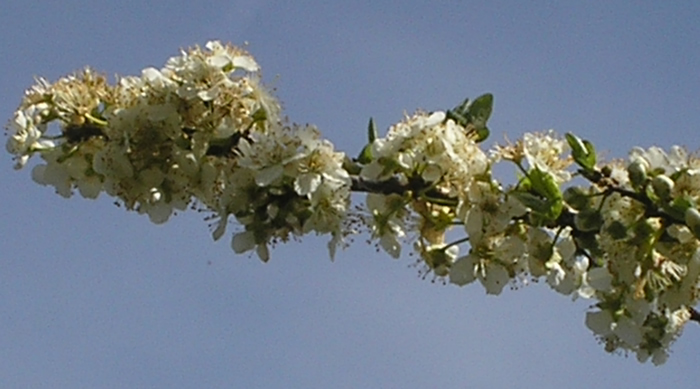
The illustration is a branch of our plum blossom in Portugal. Unfortunately we had heavy rain, which the bees hated, and I suspect there will be a poor fruit crop. But the blossom was pretty…

We’re back in UK and I’m enjoying being online again for much longer!

My mood has lightened considerably in the last few days. Spring would appear to have reached England and there are actually signs of green on a few trees. There is quite a bit of sunshine, too, no longer accompanied by freezing temperatures.

I was really thrilled to get good reviews of my novellas in the April issue of Wilde Oats, an online zine that specialises in gay short stories but also has, every time, a number of in-depth and thoughtful reviews. I have often bought books following their recommendations. If you’d like to see what Matt Brooks had to say about my writing, go to http://www.wildeoats.com/review_ThreeNovellasByJayMountney.html
After that, stay to explore the other reviews! For those of you who have Kindles, bear in mind that my novellas are now available from Amazon, too, in mobi format.

I have been struggling with my laptop recently. The cursor has a mind of its own and jumps around all over the place, worse in some applications (like email) than others. A few days ago it got so bad I could barely use the keyboard. I’m told this is a fairly common laptop problem and has something to do with the thumbpad. A build-up of static is one suggested cause… I’ve cleaned the thumbpad assiduously (and used a cloth intended for spectacles) and things are more or less back to normal – not perfect, but acceptable.  At least I will be able to write again, something that simply wasn’t possible last week!

So, I have no poetry, no news on my novels, and no real news at all. But I thought it was time I posted!

I did it!

I finally did it!

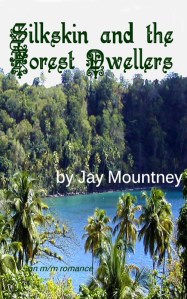
Some time ago I was very excited because I self-published my novella on Smashwords: Silkskin and the Forest Dwellers.The excitement died down when I made only one sale, after having the book free for a month and getting lots of (free) downloads. Obviously my marketing techniques are less than brilliant. However, this was primarily by way of experiment and learning and at least I got to grips with the self-publishing system.

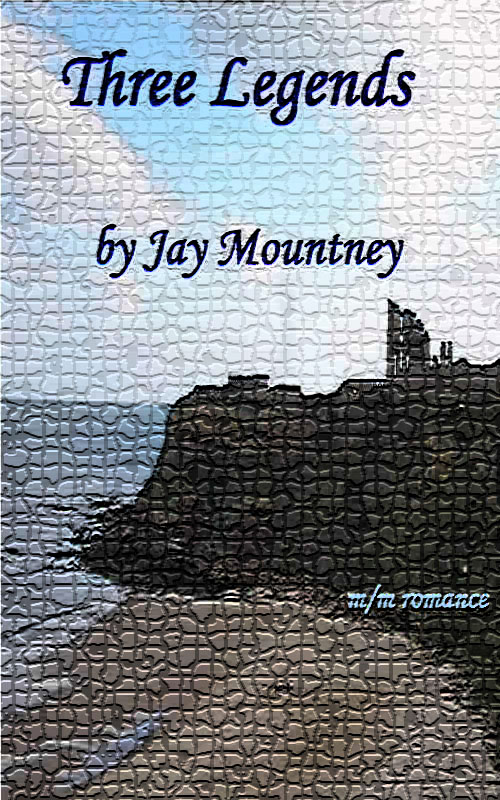
I have at last published two other books on Smashwords, another novella, Lord of Shalott, and a collection of three short stories, Three Legends.  I also published these, plus Silkskin, on Amazon. They have all gone ‘live’ although Smashwords hasn’t approved the new ones for distribution to sites like Apple yet. (That can take about a week.) So at least I have kept one of my New Year’s resolutions, which was that this was the year I would self-publish these three books.

Here are the links to my ‘author’ pages. On Smashwords, make sure you have the adult filter off. These are adult books with some mild erotic content.

http://www.amazon.co.uk/s/ref=nb_sb_noss?url=search-alias%3Daps&field-keywords=Jay+Mountney

http://www.smashwords.com/books/search?query=Jay+Mountney

I read a lot of self-publishing advice and I thought for ages about the marketing ploy of making Silkskin free, but it backfired. New titles get some interest but are quickly buried under a mass of other publications. By the time I set a price, interest had waned. So for the other two, there’s a charge from the start. I’ve kept them very cheap, and I’m hopeful. If they go well I might do some giveaways later, and meanwhile I do have some Smashwords discount codes (100%) to hand out to anyone who’s desperate or – and this  may be the main thing – willing to leave a helpful review. I can’t do that for Amazon – it’s free for all or none there.

I should perhaps say that I did everything – writing, obviously, but less obviously formatting and cover art – myself. You’ll realise if you read my last post that it was an arduous process and I’m quite proud of the results. It rather took over my life for the last few months and has been the reason I haven’t done much actual writing recently. Soon I intend to start on the formatting of a couple of my novels but at least I now know what I’m doing!

If you are interested, you can find the books on Amazon, or on Smashwords, under the author name Jay Mountney. You don’t have to be interested in the books themselves to comment here about my work on the formatting etc!! I’m always delighted to discuss those issues and ideas about cover art.

Apart from Silkskin, which was originally written for a fanfic challenge (yes, fairytales are a fandom, but of course there’s no copyright so the lines are blurred), the stories were not recent efforts. But they have been polished recently and I’m happy to have them out there as samples of my work.

Here are the covers for your entertainment, a little larger than they appear on the sale pages but not, of course, full size.

Surviving the Self Publishing Minefield

Last January I made a resolution. I declared that 2012 would be the year I finally got some of my work self-published in e-book format. In June I put one book (a short story) on Smashwords. For a variety of reasons, mostly my marketing failures, it did not do well once I set a price on it. However, I still wanted to keep my resolution. I was determined to do everything myself and spend as little as possible on the process. I am finally ready to launch two other books – another short story and a collection of three flashfics – on both Smashwords and Amazon. It has been a steep learning curve and I thought I would share the main aspects of it with you.

I have spent approximately six months researching and practising. I have read widely about the phenomenon of self-publishing. I have investigated the myths surrounding tax issues and ISBNs. I have wrestled with the great god Formatting. I have learnt how to construct a linked Table of Contents. I have grappled with new cover dimensions. I have explored and come to terms with Word10. It has been exhausting. I hope it has also been worthwhile.

I was amused to realise that learning all this has taken me longer than writing the three books in question. In one sense, of course, that is not true. I wrote the first of the three in 2005 and it has taken a long time to polish my work, to have real confidence in it and to decide to launch it on an unsuspecting world, a world that might well take little notice. But I have definitely spent more hours on the practicalities of publishing than I ever spent writing or editing. Thinking is harder to quantify, but the same probably applies.

So what have I learnt? I will summarise my new knowledge here and anyone who wants more detail on any of the issues is welcome to email me. I wish I’d had someone to guide me through the minefield. That isn’t to say that my friends haven’t helped; they have, enormously. That includes some of you. They have shared their findings, allowed me to use them as sounding boards (and occasionally to rant), and encouraged me. They have attended conferences and courses and passed on the notes. They have pointed me at websites, blogs and books. None of them had the full set of answers to my queries, and many of them subscribed to the ‘myths’. This is even true of Writing Magazine, which I tend to use as a handy reference guide. And I still have one query, which I will leave to the end.

1. Self-publishing. During the past year, the self-publishing industry has really taken off. Last Christmas was the first time people started talking about the way e-readers were taking over the reading public, and the traditional publishers started worrying. There will, I think, always be a place for traditional publishing, especially for reference books, art books, the books we call ‘coffee table books’, maps, some children’s picture books, some ‘comics’ and other publications that don’t lend themselves well to an e-reader, or even an iPad or laptop screen. But for the bulk of ordinary fiction, the e-reader is just fine. It is small enough to slip into a shoulder bag, or even a capacious pocket, it has a long battery life, it lets you carry a whole library of books on a journey or on holiday, and it suits the way people nowadays interact with the world. Most people are easily converted to using e-readers.

There are issues related to piracy and copyright that need to be solved, there are arguments over pricing structures and distribution, and there are other problems that will be dealt with and yet others that will arise. They shouldn’t worry the writer. The things the writer needs to worry about are writing and editing. The writing needs to be good if the book is to stand any chance against all the thousands of other books competing with it. The writing also needs to be well edited and proof read; readers are soon turned away by too many typos or misspellings, never mind other errors.

Self-publishing is no longer synonymous with vanity publishing. The stigma is disappearing very quickly as longstanding authors appreciate how much control they have over a self-published book, how much greater the royalties might be, and how long, in comparison with a printed book, their work remains available.The only thing the big publishers still offer is marketing, and I gather they don’t do a great deal of that. They also offer validation, but so do sales. So for the new writer, there is no reason not to try self publishing but I should stress that you need a good editor and beta reader to help you polish your work.

2. Tax Issues. I did a separate post about this when I got my EIN and was wildly excited. So many people told me I needed an ITIN which would have been costly and difficult. In the end, I got my EIN which exempts me from American tax, for the cost of a phone call to Philadelphia. I used Skype so the cost was negligible. Now all I have to do is download the W8-BEN form and send a completed and signed copy by snail-mail to Smashwords and to Amazon once I have actually sold some books. Again, postage to America. All told, the entire operation will probably have cost me less than £2.

3. ISBNs. Basically, you don’t need one for Amazon, which has its own internal numbering system, and you don’t need one for Smashwords. You do need one for some of the other retailers e.g. Apple, but if you distribute to them via Smashwords, Smashwords will very kindly provide you with a free ISBN – provided you click on the right box on your dashboard.

4. Formatting. This is much harder than tax or ISBNs though it doesn’t initially engender as much panic. You need:

The Smashwords Style Guide (free pdf)

Building your book for Kindle (free download; you can read it on Kindle for PC, also free)

Word. Yes, really. You can write in any program/word processor you like but you need a Word document for upload to Smashwords and Amazon. No exceptions.

Notepad This should be in your ‘accessories’.

Calibre. A free download that does a good job of converting things into e-book formats.

Patience. In really large quantities, probably accompanied by tea or coffee but preferably not alcohol as you will need all your wits about you and wish you had more – wits, that is.

Go through the guides, make sure you understand them, go through again and memorise as much as possible, go through again and make notes, and go through again just in case. Practise what you have learnt. Use text that doesn’t matter – I used some flashfics I was never going to publish. Add chapter headings, add italics, add a title, add anything you think you might want till you know the rules backwards. Use Calibre to convert your formatted text into ebook format and use either Kindle for PC or Adobe Digital Editions to check how things look. Learn from your mistakes and make notes. Then apply the rules to the text you do want to publish.

Something you need to learn quite early is that Amazon and Smashwords are not singing from the same hymn sheet. Most of the instructions are similar but the devil is in the details so don’t get over-confident. For both, however, it is worth applying what Smashwords call the ‘nuclear method’. Copy/paste your book into Notepad (which should be in your ‘accessories’) then copy/paste from Notepad into a fresh Word document that has had the formatting you want set up. This clears previous formatting and lets you start with a clean slate – invaluable. By fresh, I mean close Word down and open it again; don’t just start a new document.

Once you’ve done your best with the formatting you need to save two documents – well, more, because you need back-ups, but two types. For Smashwords you need a Word document in .doc format. For Amazon you have to save your text as a filtered web page. Make sure you get the right formatting saved in each kind… There are all sorts of pitfalls. Read your notes! Read the two guides again!

(If you’re considering selling your book from your own website, you still need to do all of this – then you can create a mobi version, an epub version, a pdf version and an html version – which should satisfy most needs.)

5.Table of Contents. You have to have one, even if you are publishing a single short story. You have to have a linked, navigable one. Why? Well, because e-books can have them, so retailers think they’re smart, so…  There are various options.

(i)Smashwords version.

If your work is a novel with standard chapters, you just give all your chapters the heading Chapter…. and Smashwords will create your ToC. You format your chapter titles using a heading style.

If your work doesn’t have chapters, maybe because it’s a short story or a collection of stories, you have to build the ToC yourself and this is as difficult as the initial formatting. You mustn’t use the heading style but have to creat a custom style for your headings.You use Word’s bookmarking and hyperlink functions and they can be seriously strange. Even when you’ve finished, your converted book (via Calibre) might show anomalies. This whole process is not for the faint hearted and has made me resolve never to write anything else that doesn’t have ordinary chapters.

There’s a minor query here. You are advised to add a link to your end notes ‘about the author’. I formatted the heading for that exactly the same as the stories I had put together, but in the final ToC the line ‘about the author’ insisted on centring itself even though all the rest of the ToC was left justified. I decided to leave well alone rather than risk having to do the whole thing again. Mystery…

(ii)Amazon version. You use the heading styles and then you use Word’s ToC generator, which you must not touch for Smashwords….

(If you’re selling from your own website you don’t have to go through all this but your readers might expect aToC so you could use either the bookmark method or the ToC method to produce one. Of course, they don’t work in pdf which has another system altogether but then any reader who buys a pdf isn’t going to expect a live ToC.)

6. Cover dimensions. Recently, both Smashwords and Amazon issued new guidelines about the size of the covers they expect. Smashwords have chosen to align themselves with the new standards set by Apple and by Barnes and Noble. Amazon just seem to be following the trend. The new sizes are approximately 1500×2500 pixels. Huge. The reasoning appears to be that as screens of all kinds get better and better the covers need higher resolution to look good. Whatever the logic  or necessity of this, new uploads have to follow the rules. There are a couple of problems. You might, like me, design your own covers, using your own photographs or free/cheap stock photographs and a cover generating service. You might use a cover artist and pay them to produce a design for you. Whichever route you used you might well have designed your cover or had it designed before the new rules came into being earlier this year. You or your artist might have been working while the editing and proof reading was going on. Or you might be issuing a new version of a book, with a new cover. The trouble is, your beautiful cover might have an original file source that is too small to look good in the new dimensions.

Smashwords warn against merely using a photo editing program to re-size because it can cause pixelation and a rough outcome. If you’ve paid an artist you might have to go back to them and pay them some more to fix things, which might be easy cheap) or difficult (expensive) depending on the originals they used. Or, if you did the work yourself, like me, you might have to spend a great deal of time… I even downloaded a trial version of a seriously posh and expensive editing suite which promised the earth and did not deliver anything better than I already had.

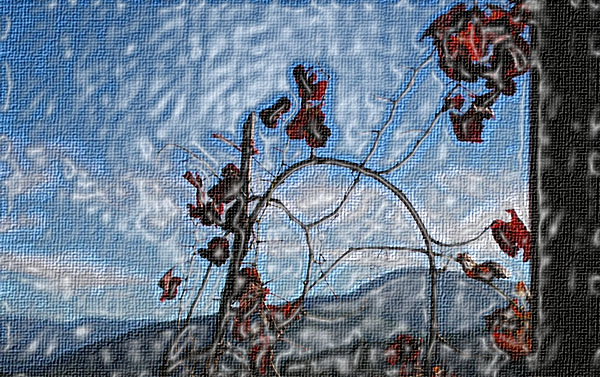
I use Photoshop  and Fireworks, and sometimes use online editing sites for special effects. I am a keen amateur ‘artist’ and enjoy designing covers, cards, icons, etc. I eventually found that if I used the filters in Photoshop I could end up with a re-sized picture that was slightly different from the original but which had no pixelation or strange halo effects round the fonts. That last point is quite important because not all fonts work well at larger sizes. There are a number of filter effects that work but the ones I liked best were mosaic tiles, and sandstone texture. In future I will make sure I start with a larger source picture and will only use filter effects for effects, not for hiding problems! The photo at the top of this post is taken from my bedroom window in Portugal, in autumn with vine leaves showing autumn colours, then the picture has been subjected to Photoshop’s ‘plastic wrap’ filter effect.

7. Word10. There are probably those amongst you who are perfectly happy with Word10. Spare a thought for someone whose computer crashed and who had to get used to Word10 overnight with lots of documents that were already written in Word 2003-2007, Open Office, or RoughDraft, and which had all undergone beta and editing and tranfer through different programs, different computers, and so on. I don’t normally write in Word because I like RoughDraft – I like its tab system, its notepad system, etc. etc. I don’t mind copy/pasting into Word once I’ve finished and of course Smashwords’ ‘nuclear method’ helps. However…

I have dealt successfully with almost everything but still have one serious glitch and would welcome advice.

Both Smashwords and Amazon advise writers to format fiction with Times New Roman 12pt,  indents at the start of paragraphs and no line space between paragraphs. Fine. In theory you can set normal style in Word10 to produce exactly this effect. It works, for new writing. But I can’t get it to work for anything that has been imported in block paragraph style from elsewhere. I get the first line indents and the correct font. The extra line spacing between paragraphs remains stubbornly in place. If I work in compatibility mode and use Word 2003-2007 as default the problem remains, even when the imported work was written in that form. My crashed laptop was recovered, and the only workaround I have found is to reformat the work on that  (in Word 2003-2007) – which happily removes the line spacing, then copy the work via a pendrive to my current laptop which accepts the new layout of the text with no problem. So what on earth is going wrong and how do I fix it? I’m wondering whether to remove all my documents that matter from the current laptop, use Word’s reset to default function, and start again but that seems drastic and in any case might not work. Has anyone ever had a similar problem and if so, what did you do? (Feel free to be reasonably technical – this is someone who can understand the Smashwords Style Guide…)

Now all I have to do is actually upload the books. 🙂

Wheee! I have an EIN.

I am feeling really good today. I finally managed to get an EIN number for US tax exemption. I blogged about the problems ages ago and Martyn Halm was kind enough to point me at a fantastic WordPress post by Catherine Howard and David Gaughran, which explained how to get an exemption number with little hassle and at almost no cost. The only drawback was phoning a US number and risking being put on hold for ages, sending our BT phone bill sky high. Then my daughter bought me some headphones with a microphone for my birthday, and I downloaded Skype when I realised it could be used to phone landlines. Even then, I was reluctant to do anything. Smashwords have only sold one copy of my short story so the world wasn’t going to end if I didn’t get a tax exemption on it. Amazon didn’t seem prepared to let me open a publishing account without a number, and without an account I didn’t feel inspired to investigate formatting any further, so everything ground to a halt. However, my daughter was nagging… I made copious notes from the helpful blog and associated comments, and took a deep breath. Everything was finally in place.

It took ten minutes at a cost of 20p.

It is totally amazing to me that I now feel able to tackle the formatting and publishing hurdles. The tax issue was clearly affecting me more than I realised. Amazon publish a formatting guide (Building Your Book for Kindle) and the latest edition is evidently intended to wrestle with Word10 so I have hopes. It is a Kindle book, so not as useful for search/research purposes as the .pdf version which is available to customers in US, but I’m sure I can make notes as I go through it.

Feeling more confident about the technical side of things has made me feel more inclined to write. I was restricting myself to creating fanfic whilst I thought publishing was out of reach.

For anyone reading this who wants to know more about EINs or who has friends who are asking, the blog post that changed my life is: http://catherineryanhoward.com/2012/02/24/non-us-self-publisher-tax-issues-dont-need-to-be-taxing/

Tax problems on the way to being solved!

The internet is a wonderful thing.

Writers are generous and supportive of each other!

My last post garnered a response from a very kind complete stranger (Martyn V Halm) who gave me a link to this article:

http://catherineryanhoward.com/2012/02/24/non-us-self-publisher-tax-issues-dont-need-to-be-taxing/

It seems I’m not the only one suffering angst over these issues and other people have bravely gone before, tested the system and posted about their experiences so that the rest of us can de-stress! There is a method of obtaining a tax number, via a phone call to the IRS people, which can then be used for all e-publishing firms. Whoever worked it out and tested it deserves a medal!

If you’re at all interested in the tax problem, on your own behalf or for anyone else, go and read the article and the numerous comments which extend the initial research.

I think the thing I need now is Skype. I did have it installed on my old PC but then my microphone broke and as I wasn’t really chatting to many people I never bothered to replace it. I could do with a new headset and will buy one of the combined headset/microphone things but that might have to wait till I get back from our next trip to Portugal so that I can order the kind I want and have some chance of being here when it arrives. Skype will prevent the cost of phone calls to America becoming as astronomical as any notary expenses…

Once I can call cheaply I shall follow all the instructions given in the article and let you (and the authors) know how I get on. That will probably be some time in October.

Meanwhile, I’m extraordinarily grateful to Martyn, a Netherlands based author who has taken the time to reassure me and point me in the right direction. His WordPress blog is http://amsterdamassassin.wordpress.com/ if anyone wants to have a look at what he writes – sounds interesting.

The hidden cost of publishing on Kindle and Smashwords

To be strictly fair, it costs nothing to publish on Kindle because Amazon don’t charge for their publishing service.

However…

In order to publish on Kindle you need to open a publishing account with Amazon. You have to fill in a form that details things like your name, address, bank account, etc., all of which is fine, and then you have to have an exemption certificate (as a foreign writer) from US taxes. Amazon send you to an IRS site that tells you how to get a certificate.

You have to send documentation, preferably a copy of your passport (but there are other things that will serve if you don’t have one). Fine.

However…

Your copy of your passport has to be certified by a notary. (Well, unless you fancy sending your passport to America by post and hoping it will return within three months… They don’t advise that, by the way.)

This is where the costs start to mount. To begin with, notaries are few and far between so wherever you go it will probably take you at least half a day to make the round trip. (There are none in my local town.) Then, they charge. I did some research. They are, most of them, quite reticent about their charges but a few make some general charges public, whilst pointing out that there might be further expenses in any particular job. (Note that I think it’s quite reasonable that they should charge for doing work – I am not criticising notaries in any way.)

It seems the minimum would be £140. If I wanted two certificates – and I would need one for Amazon and one eventually for Smashwords – it would probably cost more. Possibly not twice as much, but still more. Plus, for some reason I can’t apply for one for Smashwords until I earn a certain amount and then get a letter from Smashwords so that could mean two separate outlays of £140.

Now, if I paid that out,  even working on Amazon’s (and Smashword’s) generous royalty rates, I would have to sell about 200 books to break even. That’s right. I would effectively earn nothing until I had sold 200 books.

In a niche genre such as m/m fiction, a new writer is unlikely to sell this many straight away, if at all. So publishing with Kindle begins to look like vanity publishing for a non-American author.

I already knew about the requirements and the possible costs from Smashwords. There is, however, a huge difference. Smashwords do not ask for an exemption certificate ‘up front’ so you can wait and see how your book is doing before deciding to spend a lot of money getting one. And even if you don’t, Smashwords imply that the only problem will be that they will have to withhold 30% of any money due to you unless and until you provide the certificate. That reduces your earnings considerably but you would still be earning. Amazon won’t let you create an account until you have the certificate.

I feel really disappointed. I could, in theory, afford to get a certificate. But is there any point? This isn’t false humility by the way, just realism. Yes, I believe in my work, but I know that sales in the genre are not that high whether authors are self-published or published by a publishing firm. Yes, I have more than one book to publish, but it could still take a long time to see any return on my ‘investment’. I’m just not convinced I could justify it to myself. It sounds, as I said, too much like vanity publishing. Of course, I could offset the costs against each of the books I have ready, and it doesn’t sound so bad when I break it down like that, but I’m still not sure whether it’s really justifiable, with no ‘track record’ or whether I’m just indulging in wishful thinking about publication. The figures are further affected by the conversion rates from dollars to pounds and the 20% tax rate in UK. I would end up earning about £1 per copy at best, even before the notary costs or the withholding of tax by Smashwords. I really wonder if it’s worth it!

To add insult to injury, I had looked at Amazon’s formatting after posting here about it, and it wasn’t really so different from the Smashwords variety. The biggest difference is that you upload a filtered web page instead of a word.doc. and the table of contents has to be generated before you start rather than after you’ve uploaded. So I spent the afternoon playing with formatting, had the thing ready for Amazon, felt really proud of myself, and then went into the account set-up only to be faced with the costs I have outlined.

Oh yes – and it can take a minimum of two months before the IRS send you a certificate of exemption so it would be November at the earliest before I could realistically hope to upload to Amazon. And that’s if I could get an appointment with a notary before we go back to Portugal in the next couple of weeks. It would be more likely to be early next year.

Free and simple self-publishing? To say I’m disillusioned is the understatement of my year. I’ll be sticking with Smashwords for now, and as I’ve sold one copy of my novella at $2.99 I don’t think I’ll be contacting a notary any time soon.

Any comfort, encouragement or commiseration gratefully received…!

Summer writing and procrastination

I have been lazy about posting – some kind of summer doldrums, perhaps. I have not been idle, but have been writing more fanfiction than original fiction, and have been involved in beta work for other people. None of this activity ever seemed appropriate to write about for this blog, which is intended to be where I discuss original writing.

The novella I published on Smashwords – Silkskin and the Forest Dwellers – has not done well. Once I ended the free period (after a month) and set a price ($2.99), the downloads came to a complete halt. This made me stop worrying about applying for a US tax exemption for foreign writers, and also made me postpone reformatting for Amazon, though I should probably do that. The US tax forms look threatening, and I am dreading trying to work through them.

I have put a lot of effort into making the formatting as good as possible, and have been shocked at the low standards achieved in this respect by some professional publishers. The widespread criticism of self-publishing  for poor editing and formatting is not, I think, deserved, and seeking so-called professional help is not necessarily the way to go. There are good and bad examples on both sides.

My heart sinks at the thought of the different formatting rules for Amazon. It probably won’t be so bad once I get down to it. Lots of people manage it without problems so why shouldn’t I? Smashwords was an uphill struggle at first, but I now feel confident so Amazon shouldn’t be any different. And once I’ve done it all for one story, the others should be easy. Right?

My heart also sinks at the thought of needing to advertise. I don’t have (and frankly don’t have either the inclination or time to have) either a Facebook or Twitter account. I lean towards longer posts and conversations, and more personal privacy. But some researchers are beginning to suggest that too much self-marketing can be counter-productive. I hope they’re right!

What I do think I need to do is get my Amazon edition sorted and then format the other stories I have ready so that I have more chance of attracting attention. Research also claims that writers do better with a number of stories for sale. The stories are there – written, edited, and ready to go. I have some kind of publishing block which is as unconstructive as writer’s block must be.

Meanwhile, I continue to write fanfic, at least partly because I can post it easily (to AO3 – Archive Of Our Own) and get feedback. And yet I have a lot of original stories to tell!

Have any of you got advice or encouragement to offer?