
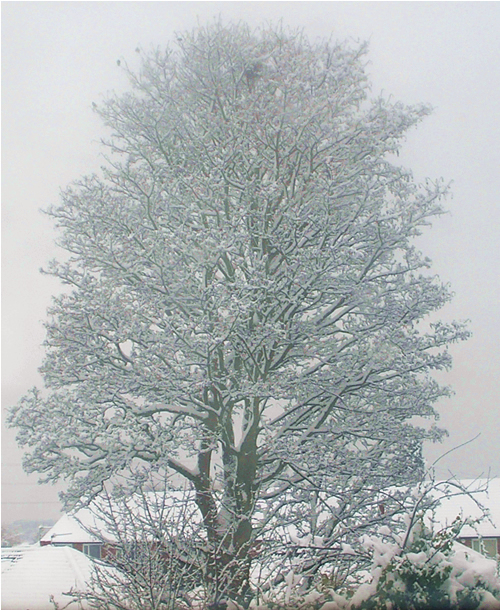
The photographs I choose to illustrate my posts are usually vaguely linked to the topic, even if only in my mind. This isn’t. It’s just the tree at the end of our garden in the current weather.
I have been musing about various pieces of advice I have seen, from authors who feel sufficiently confident about their own status to tell other writers what to do. I am quite sure they mean well and equally sure that the advice works for them. However, everybody writes differently, not only in terms of their style etc. but also in respect of the entire process of writing.
One frequent admonition is to cut your first draft drastically. One author went so far as to say to a friend of mine that if you didn’t cut a third of your first draft you couldn’t be editing properly.
I know at least two writers (one of them with many publications to his name, and very popular) who write first drafts that have gaping holes in them. There are fragile links that have scribbled notes such as ‘insert dialogue here’ or ‘maybe a sex scene’ or even ‘do some research’. I can totally understand how this comes about. The writer wants, indeed needs, to get to the end of the basic story, and doesn’t want to stop to flesh out some scenes until that end has at least been reached a first time. It is then possible to go back and fill in the gaps, calmly, and bearing the ultimate ending in mind. But what would happen if these writers cut their first drafts by a third? Chaos, I should think.
I don’t leave gaps in my first draft, or only the occasional one where I need to research something like the correct spelling of a foreign place name. The story, which has usually been simmering in my head for some time, simply flows out onto the page or screen until I reach the ending, or an ending. (The ending might change.) On the way, I edit details. When starting a new chapter I always re-read the previous chapter; that puts my mind back into the flow of the story, and usually prevents plot or name errors. It also gives me the chance to spot minor problems such as overuse of a particular word, or some clumsy dialogue. So those get corrected at that stage. Then I hand everything over to a beta reader.
My beta readers (and I have used several) have one thing in common. They all, without fail, ask me to expand what I have written. They used to tell me to add more dialogue but I’ve got into better habits recently, and now the main complaint is that I need to include more explanation because readers aren’t psychic. If I cut that first draft by a third my betas would presumably be incoherent with rage!
I’m sure there are writers who ‘overwrite’ at first; they put in anything and everything that occurs to them and are particularly prone to inserting purple prose that pleases them but no-one else. Certainly for them the advice is good. But there are many of us who ‘underwrite’ and the advice is bewildering. I can almost guarantee that my initial draft will eventually be expanded by about a third…
Another piece of advice is to write what you know. This is so widespread as to be almost trite. It also bears some closer investigation. Obviously it can’t mean that you should always stick with your own surroundings, gender, experiences. If it did, we would have no genre fiction whatsoever. And yet one of my friends was told, on a writing course, that she should not attempt to write outside her own experience – as she was at the time writing a murder mystery, both she and I were somewhat shocked by the advice.
Surely the advice simply means that you should do adequate research and that you should try to build on your own experienced emotions when developing your characters. We can all write villains, and can ‘know’ them, too, by extrapolating from the fleeting thoughts we have had and taking them to extremes. I am, of course, talking about villains with some semblance of reality and not melodramatic stereotypes. And of course we should always make sure that we know what we are writing about, which is not the same as only writing what we know from our own experience.
Perhaps it’s because much of my writing is fantasy that I distrust the ‘write what you know’ adage. And perhaps those who give the advice confine their reading to modern novels set in modern surroundings?
Some of you are writers. How do you approach your first draft? What do you think of the advice I have treated with such contempt? What advice have you come across that is truly worth following? Let me know!

 Jay's World